
Ollastra
From 1928 to 1946, it was a hamlet of the nearby town of Simaxis and shared its name. It was not until 1991 that Ollastra Simaxis became the present day Ollastra. It is a small farming town of 1200 inhabitants on the border between the Campidano plain of Oristano, from which it is 16 kilometres away, and the hills of the inland. During the Roman era it was crossed by Via Maxima. The town name derives from ollastu, i.e. wild olive, a tree that covers this particularly fertile land crossed by Tirso, the largest river of the island. Vineyards, citrus fruit orchards and fields of artichokes and other vegetables cover the flatlands near the town thanks in part to the Santa Vittoria dam. Some lands are set aside for the cultivation of cereals. To the north-west, the wild olives have been replaced by domestic olive trees, from the fruit of which excellent olive oils are obtained. To the south-west, rice is being cultivated in the reclaimed ancient swamp of Arcais. Consequently, the town’s economy relies heavily on farming, although a small contribution is also made by shepherding and artisanal production of carpets and baskets. The vernaccia, an almond and cheese sweet is a local specialty of note.
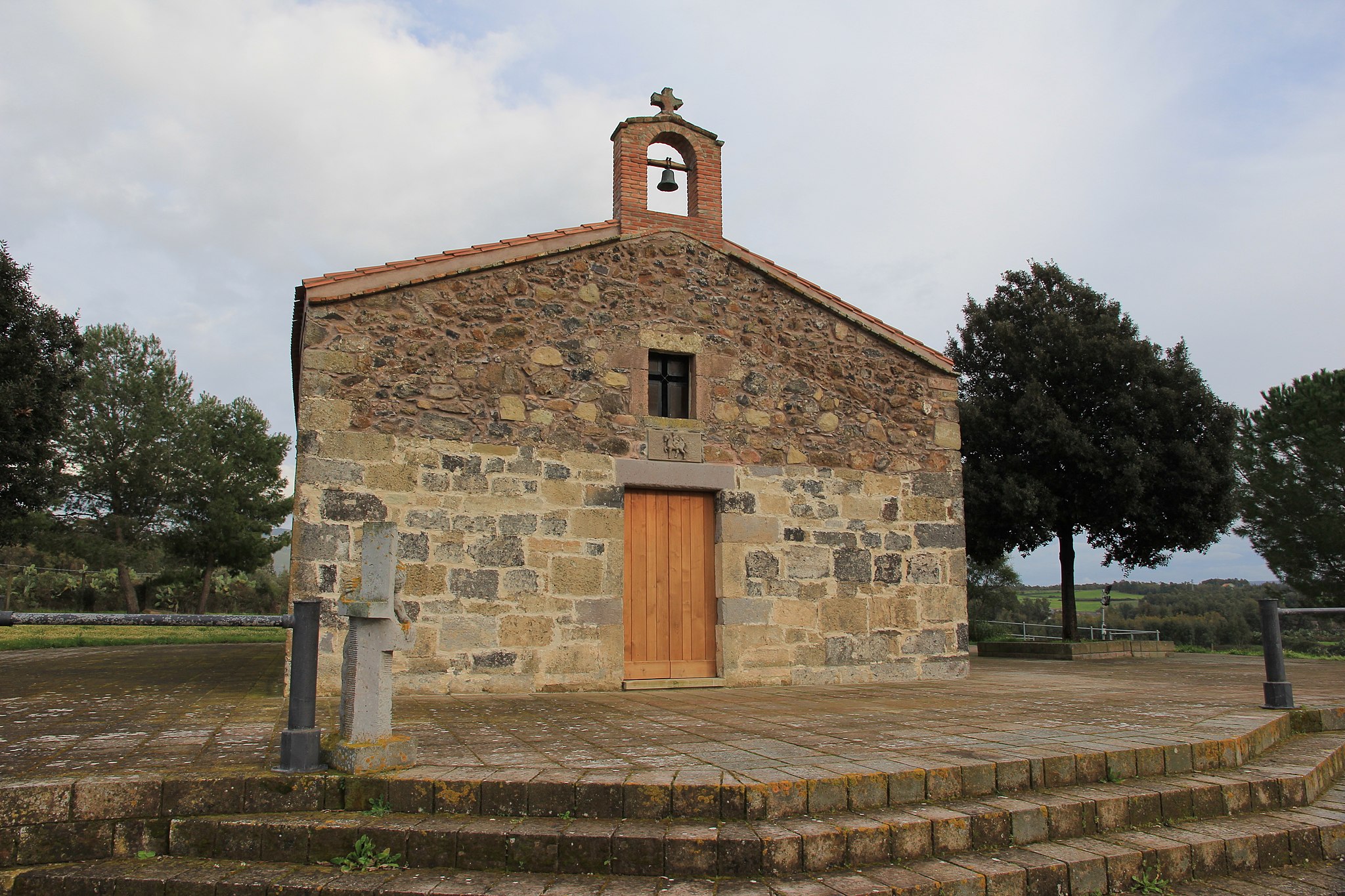
The town, which has a historical centre of unfired mud brick (ladiri) houses, is surrounded by hills. The tallest of these, Mount Ollastra (380 metres high), shares its name with the town. The hill is perforated by two caves, S’Arutta e ‘Conca e’ Mesu and S’Arutta e’ Margini Figu. The San Martino area is dominated by Mediterranean shrubs. The most important churches are far from the town centre. The Church of San Marco is on a small hill in the outskirts. It was constructed in the 13th century on land given to the Cameldolese monks and expanded in the 16th century with the addition of two lateral naves. The thatched, gabled roof is supported by wood beams (s’urriu) following an ancient technique. San Marco’s Feast Day is celebrated on April 25 with a livestock exhibition held since 1839. The su pannu race with riders participating from all over Sardinia is also held in the saint’s honour. The Church of San Costantino is set on a small hill close to the town. It was constructed using materials from the nearby ruins of the Church of Santa Vittoria. The Church of San Sebastiano dates to the 17th century. On January 20, a large bonfire is lit in the square where all the inhabitants gather to celebrate San Sebastiano’s feast day. The oldest church in the area is the Church of Santa Severa, built in the second half of the 15th century.
Because of its fertility, the territory has been populated since prehistoric times. Around 550 BC, when the Nuragic civilization was in decline, the town was at the heart of a territory surrounded by the ruins of numerous nuraghes, including Accas, S’Orco and San Perdu, and by small settlements of mud and straw sheds.
Pabillonis
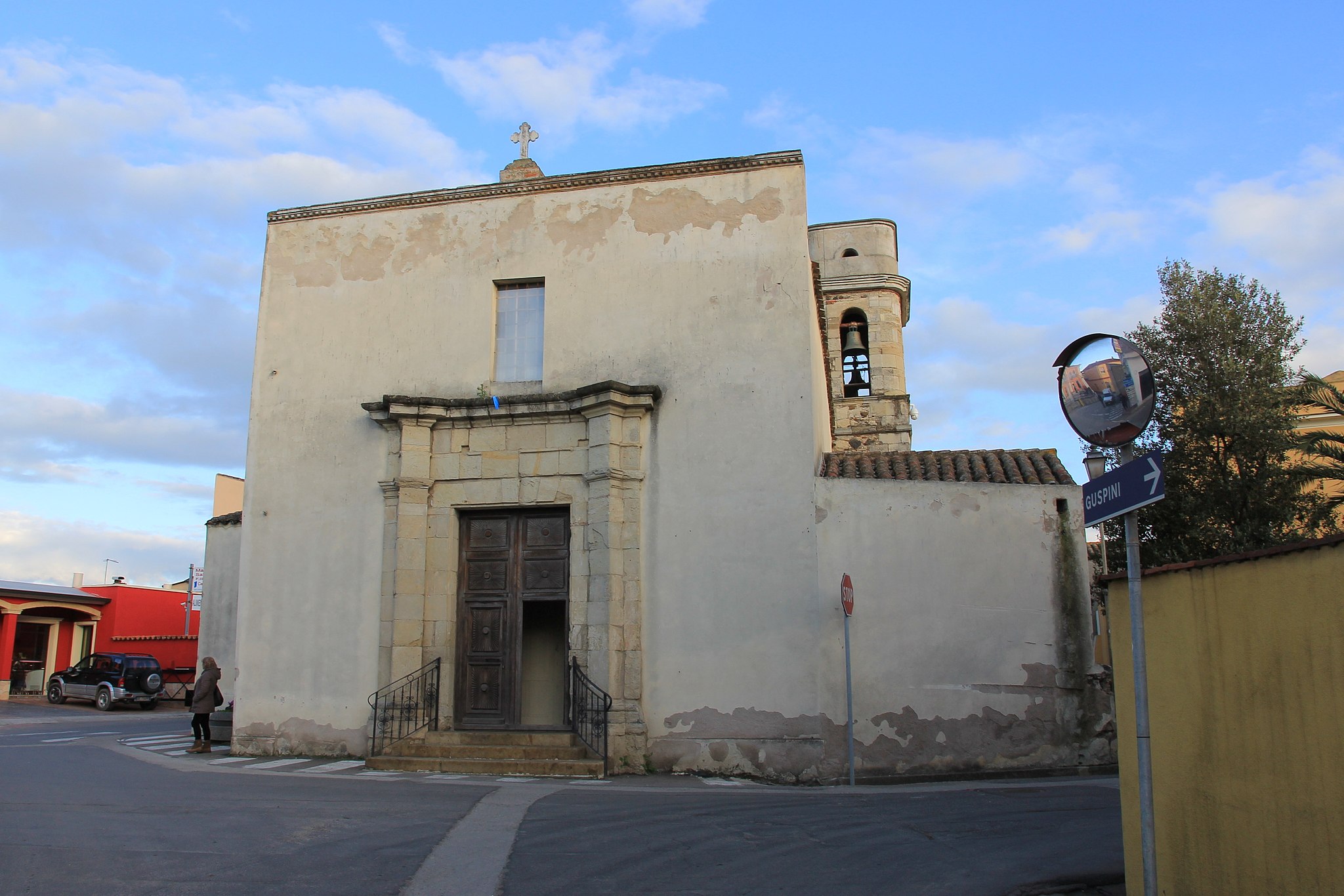
Situated in the central-south of Campidano, near the confluence of Flumini Mannu and Flumini Bellu, on lands rich in clay, which has defined its history and economy. Pabillonis is a town of almost 3000 inhabitants, with close ties to its farming and crafting traditions, particularly to the production of baskets and modelling of terracotta to produce tiles, bricks, pans and sciveddas (smoothed and glazed bowls). It has been known as bidda de is pingiadas, the town of pans, for centuries: an exceptional quality of the products is assured by the skill of master ceramicists and high quality of the raw materials available in the surrounding swampy land. The town extends around the Romanesque Church of San Giovanni Battista, the oldest of the town’s churches (12th century). The birth of the saint is celebrated in late June, and his death, in late August with traditional carrus de s’àlinu (decorated floats).
The church, housing the most artwork of value is the Parish of Beata Vergine della Neve (16th century): it houses frescos, a 16th century wooden tabernacle, a part of an 18th century wooden altar and a 19th century organ, in addition to valuable statues and holy objects. The Patron Saint’s Feast Day is celebrated in early August. Local festivals begin in mid-January with the Fires of Sant’Antonio Abate and conclude on December 31 with Su Trigu Cotu (cooked wheat) when cooked wheat and sapa (dehydrated grape juice) diluted in honey is distributed from door to door as a good luck charm for the new year.
In the peace treaty between the Crown of Aragon and the Giudicato of Arborea (1388), the town is sited as Paviglionis and Panigionis, from the Latin pavilion (pabillone in Sardinian), i.e. military encampments for defending the borders of the Giudicato, of which the village was part. Originally, the town stood in San Lussorio, where the ruins of this former village, destroyed by Saracen raids, and a small church dating to the 1960’s can be seen. Buried below the church are the ruins of the Nuragic complex of Santu Sciori, composed of a polylobed bastion, of which the bulwark towers can still be seen, and used in the Medieval period as a burial place. It, along with Su Ponti da Sa Baronessa, a Roman bridge that is still standing, is evidence of the towns antique origins. The Nuragic period left other traces in the area as well: the ruins of nuraghes Surbiu and Domu ‘e Campu, and above all, Nuraxi Fenu, three kilometres from town. Excavations have uncovered fragments of vases, lanterns and Roman coins, which testify to human presence in the area up to the age of Imperial Rome. Today, the artefacts are housed at the Archaeological Museum of Sardara. This nuraghe complex dating to the Bronze Age (1600-1300 BC) and called by the historian Vittorio Angius (19th century) as “one of the most colossal on the island”, extends over two thousand square meters.
Palmas Arborea
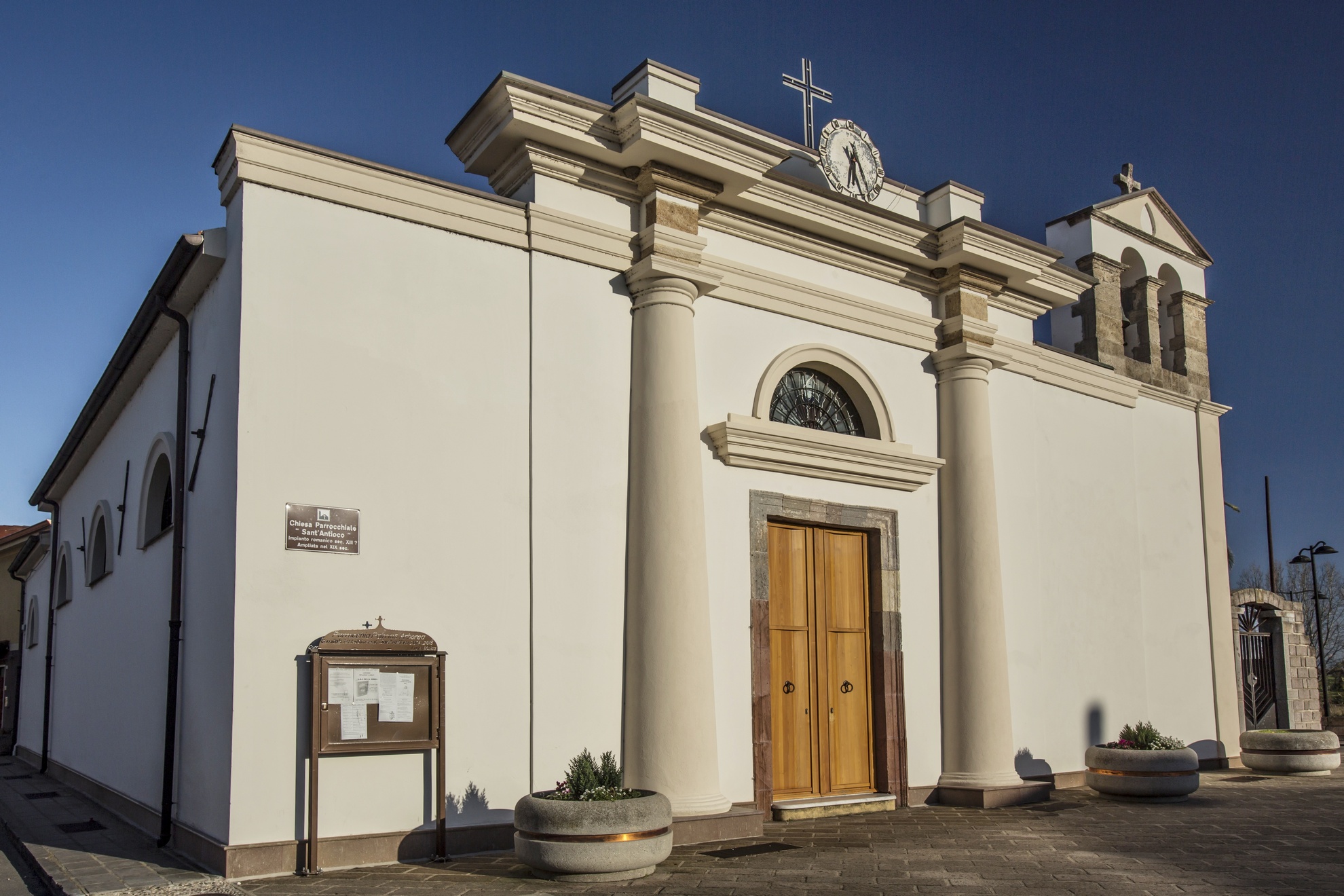
Gently descending towards the plain, it is dominated to the east by the Monte Arci volcanic massif and flanked to the west by Pauli Majori pond, just a few minutes from the enchanting beaches of the Sinis Peninsula. Palmas Arborea is a town of almost 1500 inhabitants in the Campidano plain of the Province of Oristano, located about 10 kilometres away. The town’s main income comes from shepherding and the cultivation of artichokes, citrus fruit and grapes. The town has Medieval origins: around the year 1000, three small villages stood here, Palmas Majori and Palmas de Ponti were abandoned by the 15th century, while Villa de Palmas, which stood where the present-day town lies, survived. Originally, it was called just Palmas, due to the large number of palm groves surrounding it. In the 20th century, Arborea was added to differentiate it from another Palmas (of San Giovanni Suergiu). In the historical centre, you will see houses made with unfired mud bricks set around the Parish of Sant’Antioco, who has several feasts during the year. One of the festivals held in April is Pariglie Palmaresi, which includes a procession on horseback accompanied by folk groups, and the Is Tre Aneddus during which riders try to thread rings and perform acrobatic tricks. In July, there is a Sardinian Dance Exhibition among other celebrations. In November, the death of the martyr is commemorated, and a must-visit Mushroom Fair is held with a show and mushroom tasting.
The scenery around the town is multi-faceted and multi-coloured, granting unforgettable views. The calm waters of the Pauli Majori, a paradise for birdwatching enthusiasts, is home to the swamphen, purple heron and the white-headed duck. The flora, on the other hand, is characterized by splendid orchids. It is one of Italy’s most important wetlands. In the Park of Monte Archi, the Island’s largest deposit of obsidian, you can travel back in time eight thousand years (during which various Mediterranean peoples settled in Sardinia, leaving traces behind) in search of this mineral – the ‘black gold’ of the Neolithic – abundant on the mountain’s slopes and used to make prehistoric weapons and tools. Archaeological sites range from recent Neolithic to Nuragic stone circles. The massif is covered with basaltic lava flows, while its interior is composed of trachyte. Volcanic conduits come together in three peaks (the highest is Trebina Longa at 812 metres), giving the mountain the appearance of a tripod. A green carpet of holm oaks and Mediterranean shrubs, with occasional cork and downy oaks, covers the mountain. The 150-hectare Forest of Sa Dispensa, populated by weasels, martens and birds of prey (goshawks, kestrels, buzzards and sparrowhawks), is within the territory of Palmas Arborea.
Pauli Arbarei
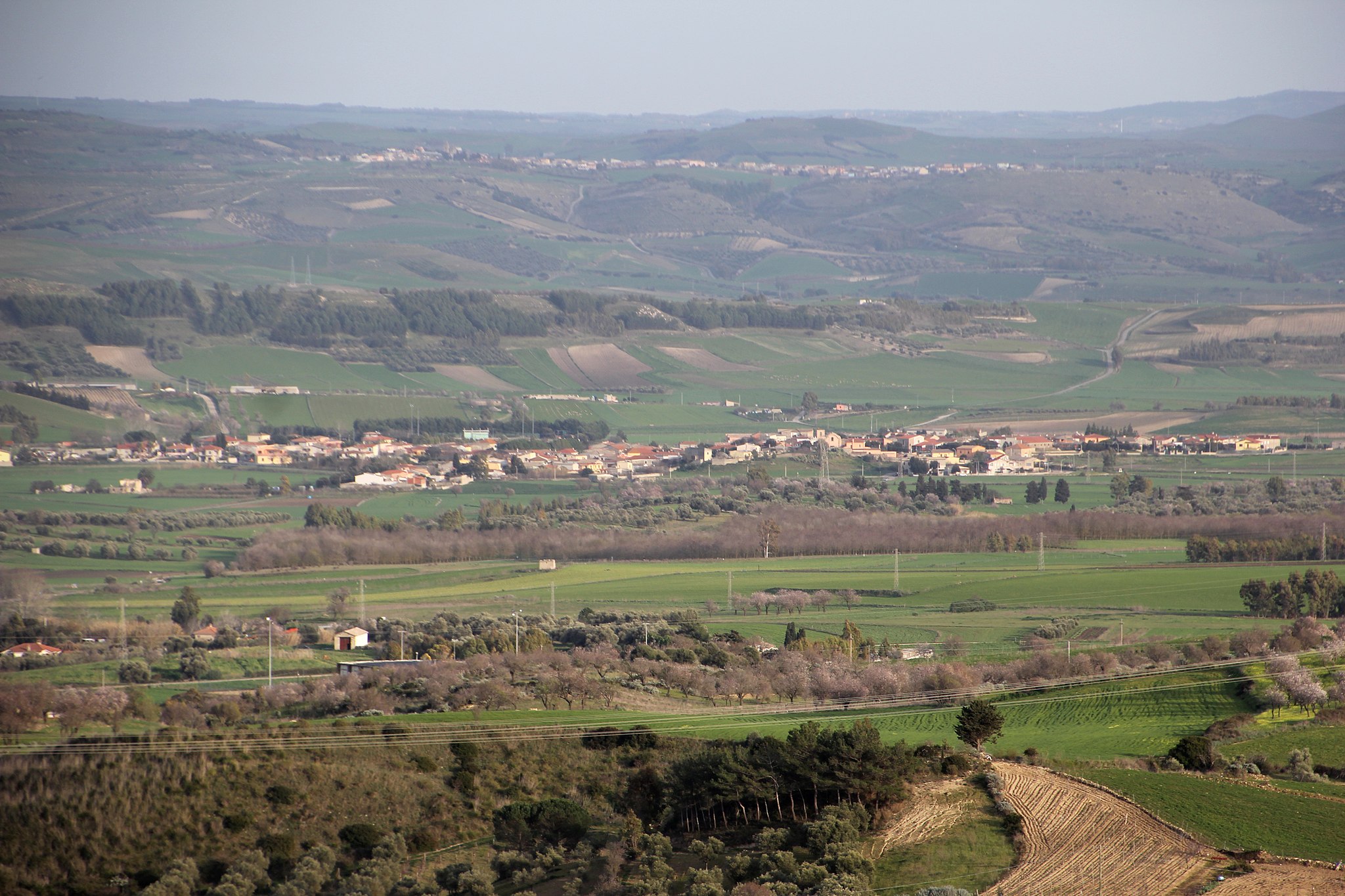
Located on a flat area in the centre of Marmilla, by the western edge of a bog, drained at the end of the 19th century. Pauli Arbarei is a town of 600 inhabitants with agro-pastoral traditions, which relied on cereal farming in the past and today boasts quality food and wine products. The area is exalted by a dozen or so Nuragic sites, some of which are yet to be studied; particularly, the three-lobed Nuraghe of Bruncu Mannu. Its fertile countryside is dotted with archaeological sites, with new sites still being discovered: worked stones, half-buried sections of nuraghes and even a triangular well temple hidden among the ruins.
The centre of the town hosts the Parish of San Vincenzo Diacono, built in the 17th century in Renaissance style. The town’s patron saint’s Feast Day is celebrated in late January. In mid-May, the Feast of Sant’Isidoro, protector of farmers, is marked by a procession of yoked bulls, horses, farming carts and tractors festively decorated. In late August, the town’s most important celebration is held, in honour of Saint Gostino, to whom a three-nave church with a wood roof and round arches is dedicated.
The Ethnographic Museum, equipped with multimedia tools, tells the story of the town through the testimony of women, who talk about the town’s traditional activities: from working the looms in the home to working the fields, from baking bread to worship. The objects are easily reached, can be touched and manipulated, to make this brief visit back in time even more realistic. Old, poignant photographs serve as a backdrop. A second ethnographic exposition, Sa Tellaia, was inaugurated in 2002 in parallel with the Sheep Festival. It was set up in a private home suitable for housing a museum. It contains objects typical of a farming culture and of ancient Sardinian cuisine.
Romana
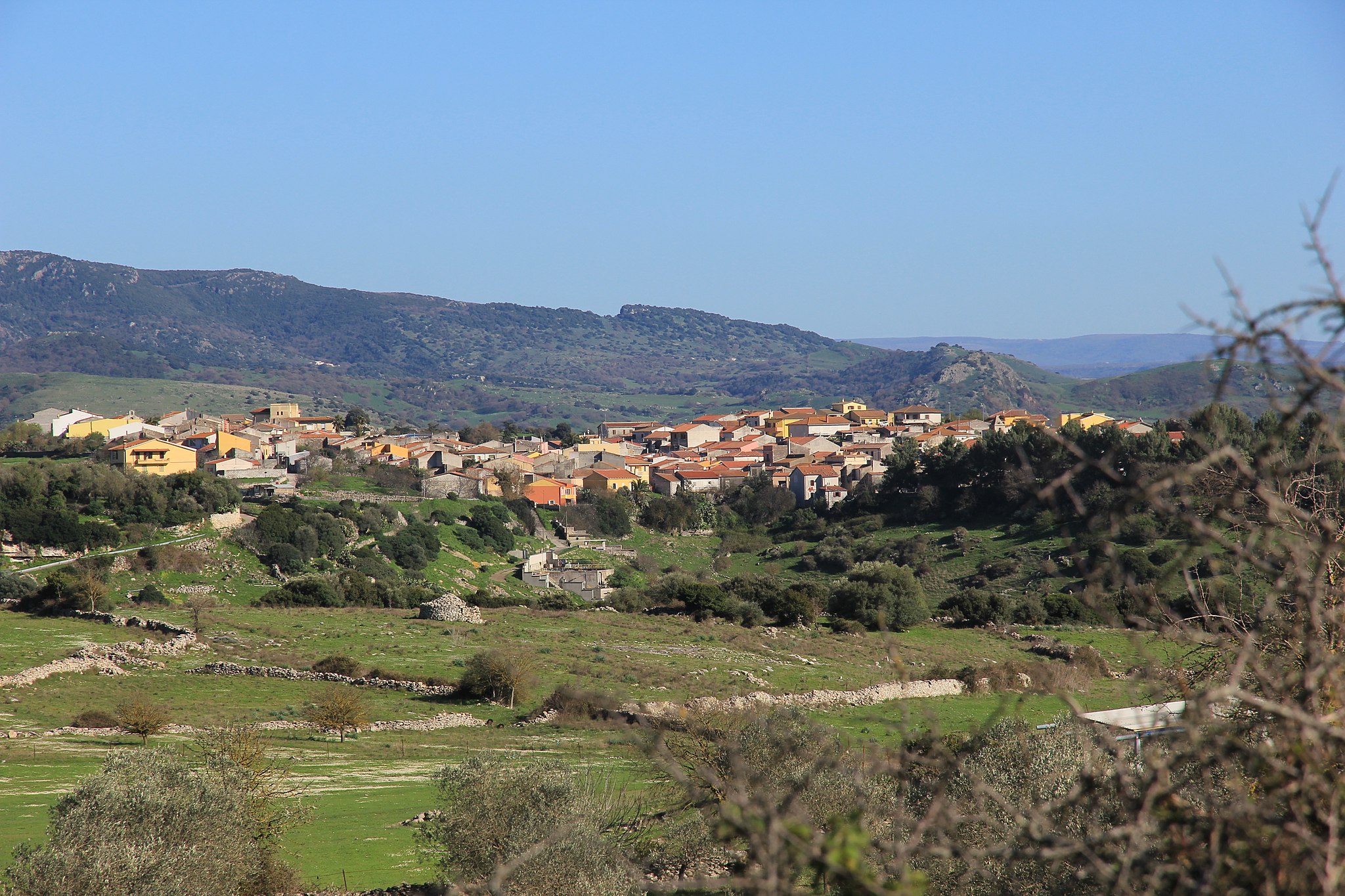
It sits at an altitude of less than 300 metres on a spacious plateau of volcanic and calcareous rocks in a largely flat area rich in prehistoric sites. Romana is a town of about 500 inhabitants in the Meilogu-Logudoro region, surrounded by karst formations, such as the Cave of Inghiltidolzu in the nearby valley of Santu Giagu, and crossed by the Temo River, which flows into an artificial lake near Monteleone Rocca Doria. The territory is rich in water sources. Statues unearthed in the town’s surroundings are believed by scholars to be offerings from people healed by the beneficial properties of the waters of the ancient Abbarghente spring, which has been used from Nuragic age to the Punic-Roman era.
Two churches are inside the town: the Parish of Madonna degli Angeli, with the patron’s Feast Day celebrated in early August, and the small Romanesque Church of Santa Croce. The surrounding countryside contains two sites of interest: the cave Sanctuary of San Lussorio, with a late July feast day; and the Church of Santa Maria de s’Ispidale, dedicated to the Madonna of Health. Other important celebrations include the feast of San Giovanni Nepomuceno in mid-May and of Saint Anthony of Padua in mid-September.
The territory is rich in Nuragic sites, including the nuraghes of Montigu, Chiechrios, Pabirra and Santu Giagu.
San Nicolò Gerrei
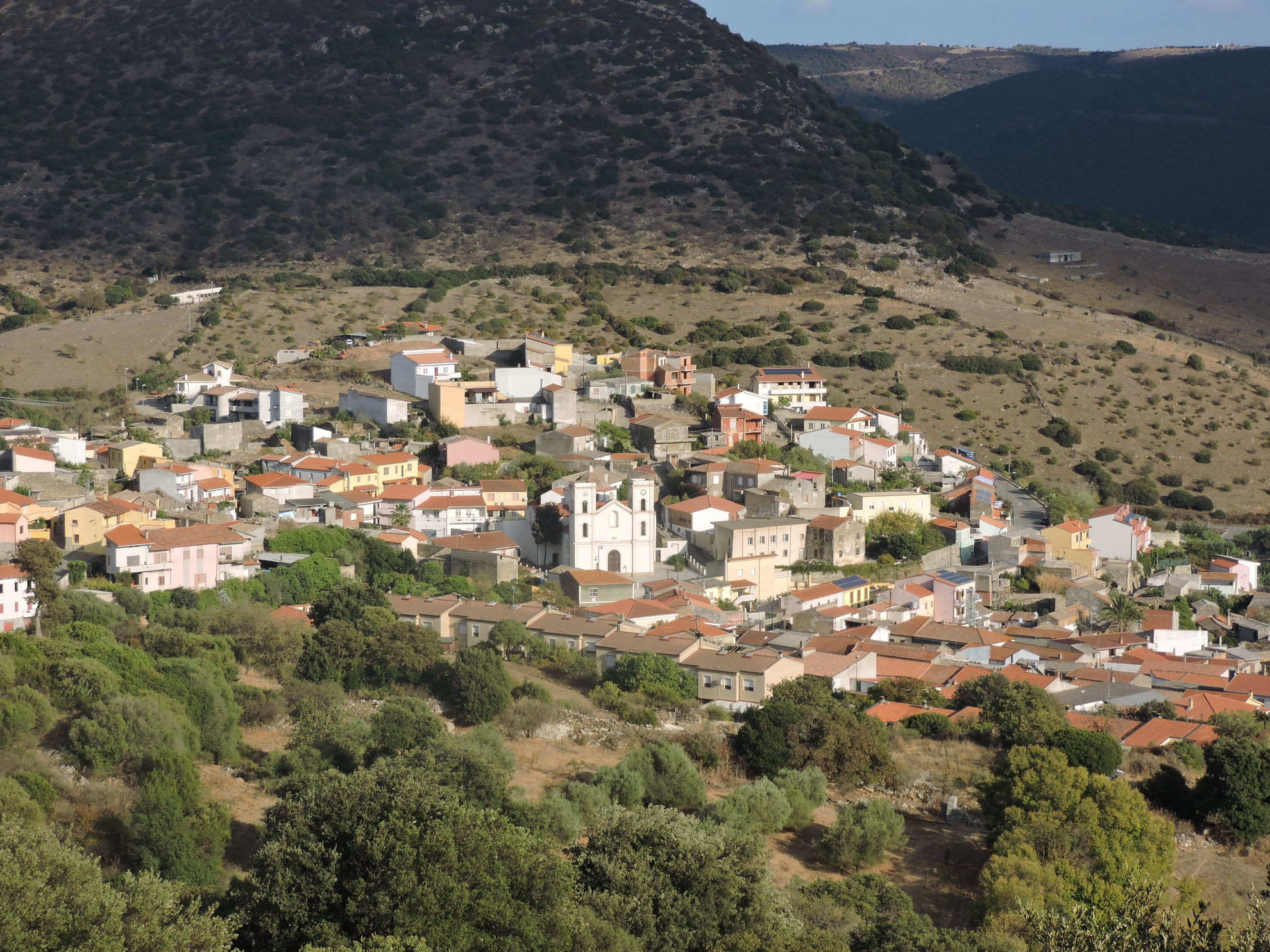
San Nicolò Gerrei reaches 370 metres in altitude, in an area rich in plateaus, south of the river Flumendosa. Populated by 800 inhabitants, San Nicolò Gerrei is the main town in the territory from which derives its name, inhabited since the Neolithic period and with traces of well-established settlements in Carthaginian and Roman times. Farming and mining are the main sources of income, along with the cultivation of grains and vines. The name of the village also comes from the patron saint, Nicola, celebrated twice a year, in mid-May and early December. The existence of the current inhabited area is attested by documentary sources from the 13th century, it being referred to as Padule (or Pauli), names which remained in use until 1863. It derives from the Latin palus, with the inhabited area arising in a basin subject to stagnation and containing numerous springs.
Until the mid-16th century, Gerrei was covered with forests and called Galilla, in the ancient site of the Galillenses who in 69 AD - as evidenced by the large bronze inscription Esterzili tablet - were forced to withdraw from these territories. Considered to have descended from the pre-Nuragic and Nuragic peoples, from which derive the megalithic circle of Mnt’Ixi, the Nuragic Monti Taccu and Su Nuraxi, the great sacred hut of Forreddus and three sacred springs, including the well-preserved Su Musuleu. Noted 19th-century archaeologists speak of Su Putzu de Santu Lacci, a well temple about four kilometres from the town. Behind it gushed a spring of water collected in a well, perhaps once a sanctuary facing towards the ‘healing’ divinity. In 1861, a relic was discovered in its ruins that bought fame to San Nicolò - a bronze column base with trilingual inscription (Latin, Greek and Punic) from mid-2nd century BC. Originally, it was perhaps a crowned cylindrical altar. The three texts are a votive dedication - by a certain Cleon rendered thanks to the god Eshmun (correspondent to the Greek Asclepius and Latin Esculapio) for restored health. The presence of ruins and fragments of ceramics at Santu Iacci ranging from the Nuragic to the Roman age and Punic coins proves that the spring was in continuous use. Today, there are no traces of the temple. Whilst other important artefacts remain from the Roman era, including a treasure of almost 400 coins minted from between 117 and 251 AD, many Roman finds were brought to the Peninsula by the Savoy in the 19th century. One example is an ornately-sculpted Pentelic marble sarcophagus - Apollo the Citharist is represented, accompanied by Athena and surrounded by the nine Muses - amongst the most beautiful to have ever been found in Sardinia. It was first brought to Genoa, then, at the request of Carlo Felice, transferred to a castle in Piedmont. In 1915, the canonical Francesco Lecca made mention of another sarcophagus. The necropolis from which they came would have been discovered in 1932 in Bingia Manna.

Santa Maria Coghinas
Santa Maria Coghinas lies on a bank of the Coghinas river, adorned with hills that surround a fertile alluvial valley, where vineyards and artichokes are highly cultivated as its main resource. The town has 1,400 inhabitants is and located just short distance from the Gulf of Asinara, a fraction of Sedini until 1960 and then of Valledoria until 1983, when it became an independent Municipality. The present inhabited area was repopulated in the 19th century by families of Gallura shepherds, after the medieval village was abandoned in the 15th century. This is why the language, customs and traditions of Gallura live on, despite the town being part of the Anglona. The name of the village derives from the river and the church of Santa Maria delle Grazie, in Romanesque style with a Gothic façade, coeval with the medieval nucleus of the village. To be admired within is the statue of the Virgin Mary, carried in a procession during the festivities held on 1st May. The quaint Romanesque church of San Giovanni is also well preserved.
A thick blanket of Mediterranean scrub and cork covers the landscape around Coghinas. Herein live herons, osprey, partridges and aquatic turtles. A short distance from the village, where the river loops back at the foot of a granite hill, the Casteldoria thermal baths emerge, famed since Roman times for their therapeutic qualities and today a renowned spa. The temperature of salso-bromo-iodic waters varies between 40 and 70 degrees Celsius. On the same hill, called Monti Di Lu Casteddu, framed by bright red rocks, emerge the ruins of Castedoria, a fortress built in the 12th century by the Doria, who had strong interests in the area, especially in Castelsardo. From the peak, you can spy the Anglona region and the coast, an area of intense traffic since ancient times. The castle was the protagonist of intricate events that involved the republics of Genoa and Pisa, the Giudicato of Arborea and of Torres and Crown of Aragon. The first written testimonies date back to the late-13th and early-14th centuries, then belonging to Brancaleone Doria, husband of Eleonora d’Arborea, and restored by Pietro d’Aragona (1354). It passed through many masters, until the slow decline in the 15th-16th century and the demolition by the Piedmonts at the end of the 18th century. Today, the well-preserved Torre dei Doria can be clearly seen from a distance, with a pentagonal layout and over twenty metres in height, with some parts of the walls, the remains of a chapel and a cistern for water supply. The ruins of the ancient village are still standing, perhaps built together with the fortress, around which myths and legends abound, many linked to the last reigning prince, possibly being Andrea Doria. In a story penned in 1894, Grazia Deledda wrote of a secret underground passage, excavated between the castle and the Cappella di San Giovanni di Viddalba, used to reach the church. The Nobel Prize also refers to the Conca di la Muneta, a basin in which the Doria are said to have pounded coins. The tale tells of an explorer who discovered a room full of gold and another closed by an iron door that was to have contained the treasures of the Genoese family.
Segariu
Its name derives from s’ega ‘e riu, meaning the ‘marshy river valley’, or from segau de s’arriu, meaning ‘cut in two by the river’, because of the town’s location in a valley crossed by two tributaries of Flumini Mannu. Segariu is a town of 1200 inhabitants close to the border between the Marmilla and Trexenta historical regions with characteristics of both: the rolling hills covered pine groves and Mediterranean shrubs of Marmilla, and the rugged hills interspersed with cultivated, fertile, flat stretches of Trexenta. The town is known for traditional kaolinite and limestone shaping, with clay bricks and roof tiles being produced. In the centre of town, the Museum of Clay, a testimony to the importance of this tradition, is dedicated to salvaging this craft, which has defined the town for centuries. The exhibition is an accurate reconstruction of a local roof tile workshop. Here, visitors can observe and participate in workshops lead by clay working masters. The Perdas e Minas exhibition also focuses on this activity, atypical with respect to the surrounding Campidano farming reality, with period photographs, working tools and accurate reconstructions of production processes. Another demonstration of this tradition is the Tebajus event in July, which in addition to activities linked to the local production of fired roof tiles, includes craft shows and an exhibition of typical products.
The area has been inhabited since the Bronze Age as seen from the Franghe Morus Nuraghe and the four-lobed Nuraghe of Sant’Antonio, a nearby symbol of Segariu. Built using limestone and marl blocks, it has one central tower and four external towers oriented along the four cardinal points. The area immediately to the east of the nuraghe and its interior have produced artefacts of a large and interesting Late Punic settlement. A Giant’s Tomb was likely located nearby, just as the small country church dedicated to the same saint built between the 12th and 14th centuries in Late Romanesque style over a well temple most probably coeval with the Nuragic settlement. It is one of the many Sardinian expressions of continuity between different cultures and religions. The celebration in honour of Saint Antonio is held in early September, where in addition to religious events, a tasting of typical local products and dishes is held. A 17th century Parish of San Giorgio Martire stands in the town’s centre. It has a presbytery topped with star vault typical of the Catalan Gothic style. The Feast Day of the church’s patron saint is celebrated in late April with religious rituals and music shows.
Senis
At the entrance to the town, two ancient buildings, adjacent but distant in time, draw the eye: the ruins of the tower of a Medieval castle and a large baronial palace, ‘living’ testimony of the 17th century. Senis is a small town of 450 inhabitants in Upper Marmilla territory with a glorious past, particularly as part of the Curatoria of Parte Valenza and Brabaxianna under Giudicato of Arborea. It was the ‘doorway’ to the Barbagia. Hence, around the 13th century a defensive fortress was built on the Funtana Menta hill, a natural ‘balcony’ overlooking the valley of Flumini Imbessu. The ruins of its ten-metre-tall rectangular tower and a buried space for storing water are still intact. Four centuries later, the town was chosen as a noble residence. A courtyard separates the Giudicale tower from a 1662 Baronial Palace, testimony of the central role played by the town and a repository of memories of feudal affairs.
The restored complex is composed of a two-storey villa, stables, small prison and the Is Nueddas enclosure, originally used as a garden. The present-day circular town rests on the slope of Su Casteddu. It is arranged around the 16th century Parish of San Giovanni, which houses the Altar of Rosario and the base of the main altar dating to 1608. The patron’s Feast Day is celebrated in late June with a procession accompanied by goso, religious songs to which the early October Sa Pratza de Preguntas et Torrida Congress is dedicated. The other church in the town is dedicated to saints Cosma and Damiano, whose feast day is in late September. The most anxiously awaited event is the early August Snail Festival with many tasty dishes to try.
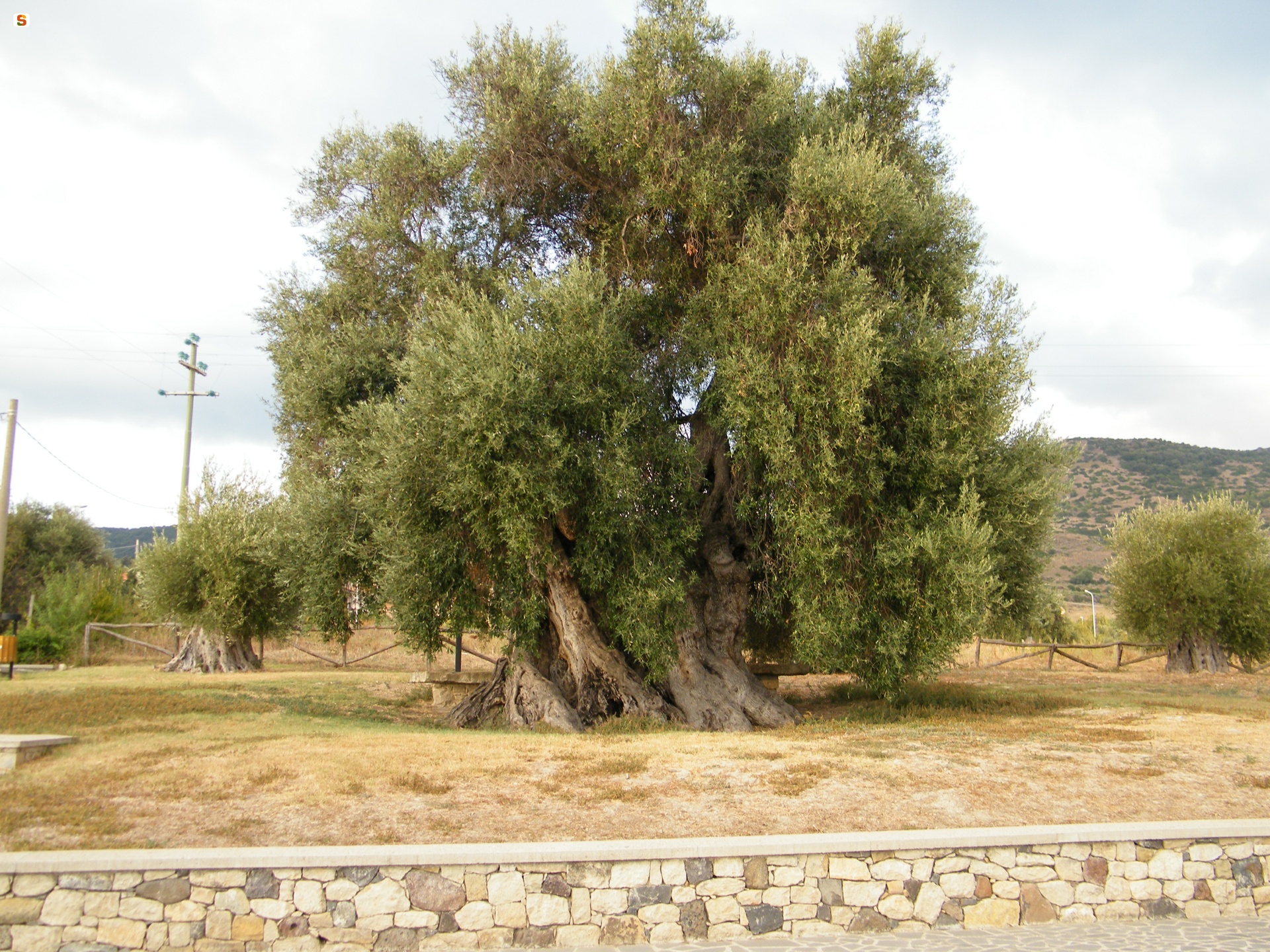
Two more rolling hills overlook the town: the hills of Giuerri and Santa Vittoria. The apex of the latter contains the remains of a mysterious building surrounded by a village where a sacrificial slab was found. The hills are covered by alternating pastures, cultivated fields, cork oak groves and Mediterranean shrubs. Shepherding produces exquisite cheeses, ricottas and meats; while the vineyards, almond orchards and groves of ancient, contorted olive trees produce renowned wines, almonds used in traditional sweets and excellent olive oil. Along the bank of Imbessu, surrounded by tunnels formed by ash trees, poplars and willows, stands the Spanish Fountain. A unique work of architecture and sculpting carved in multi-coloured trachyte by Laconian stonemasons and enveloped by the foliage of downy oaks and ivy in a fairy tale setting. It consists of a mask from the moth of which water once poured, flanked by two bas relief swans and other ornaments.
Traces of the area’s Neolithic past are abundant, especially obsidian chips and pottery fragments. The plateau is known as Bidda ‘e Perda, the country of stone. The name derives from the ruins of three Nuragic towers, anthropomorphic menhirs and rare historiated statue menhirs found in the area, which demonstrate a link to Sarcidano. The other hills are topped by eight Nuragic complexes, including the imposing and well-preserved Senis Mannu nuraghe, with a tholos roof. Another important site is the Casteddu nuraghe, shared with Asuni.

Setzu
‘‘Sitting’ at the foot of the Giara, a basaltic plateau that is home to an unparalleled natural oasis, Setzu is a small agro-pastoral village of about 150 inhabitants, the smallest in southern Sardinia and one of the smallest in the number of residents of the entire island. Its main income comes from farming and shepherding. It is known for its meats, cheeses, wine, mushrooms and snails: the foundations of local culinary specialties, which visitors can taste in mid-August, at the festivals of the Fregola and of Su Pani Indorau. The town name means ‘old’ (from su becciu, su belzu/elzu or s’etzu). The oldest of the nearby towns, it was part of the Giudicato of Arborea in the Medieval Period.
The town’s territory covers an area of about 250 hectares on the south-west slope of the Giara, as well as the rolling hills of the Marmilla. The town’s symbol is a unique species of wild horse: the Giara horse. They can be observed close up as they gallop through forests of cork, downy and holm oaks, wild olives and Mediterranean shrubs. The area is perfect for horseback riding and biking.
The town centre has retained its traditional look with stone Campidanese homes, characterised by arched doorways and internal courtyards (lollas). The buildings are arranged around the Parish of San Leonardo, built in the 13th century in Romanesque style. Fallen into ruin, it was rebuilt in the 17th century with obvious Baroque details. Next to the church, stands a bell tower with a square cross section: evidence of the original Romanesque structure. The church’s patron saint is celebrated in early November. The town’s other church is the Church of San Cristoforo. Setzu has close ties to tradition: the community’s most anticipated event is the Feast of Sant’Ignazio da Laconi in late August. The town’s cultural heritage includes the ex-grain bank and the Filo di Memoria multimedia museum, set up in 2011 in a converted historical residence in the heart of the town. It talks about prehistoric archaeology and the history of the town, using tools that include fables, across three rooms. The exhibition route leads visitors in a ‘live encounter’ with the Mother Goddess and Janas in a virtual voyage from 5000 to 3000 BC, a period during which the area was populated, as seen from the Domus de Janas, Domu ‘e s’Orcu and Grutta sa Perda. The remains of Nuragic towers testify to human presence during the Bronze Age. Numerous Roman ceramic items were also found near s’Uraxi Nuraghe. At Corte Muros, sections of walls and roofing dating to the same period were unearthed. While at Nuraxi ‘e Setzu, the ruins of a Roman Imperial village were found.