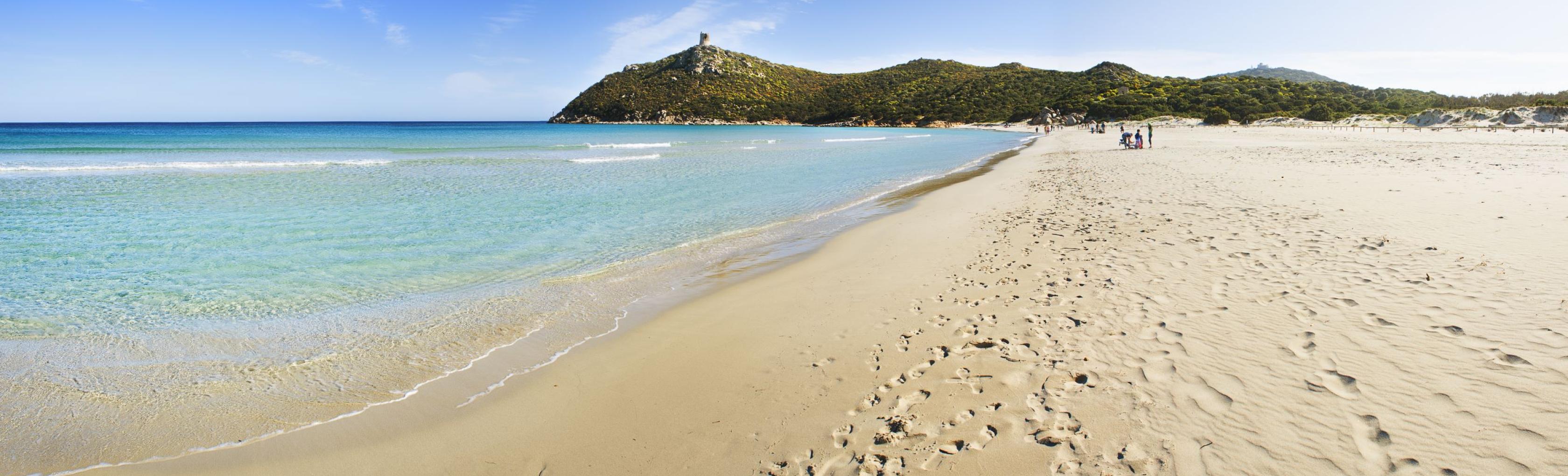
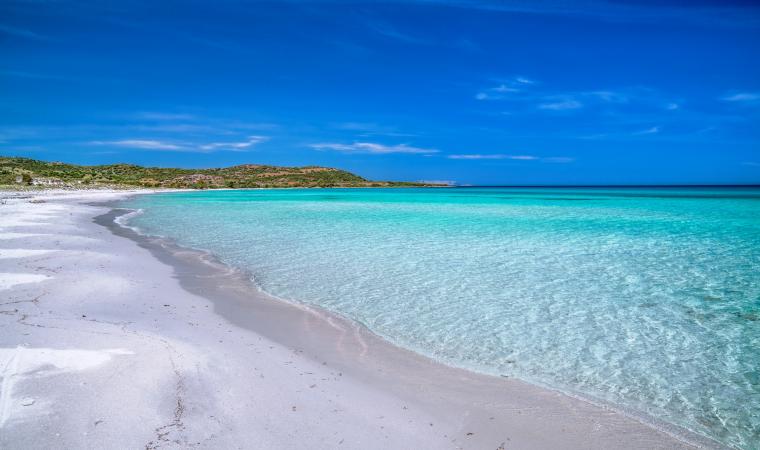
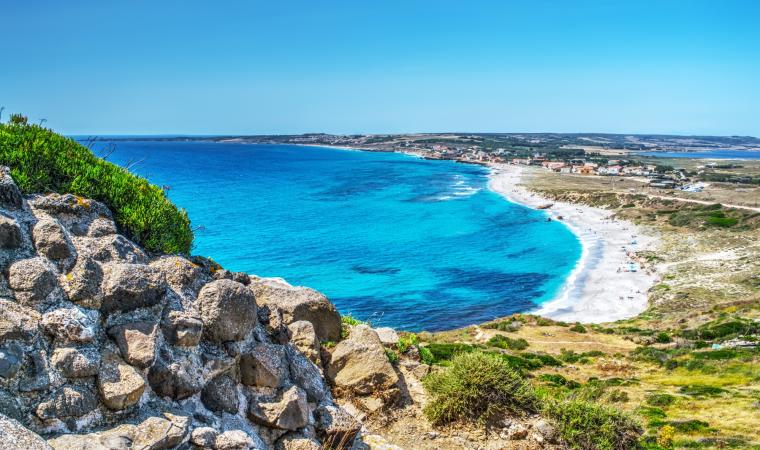
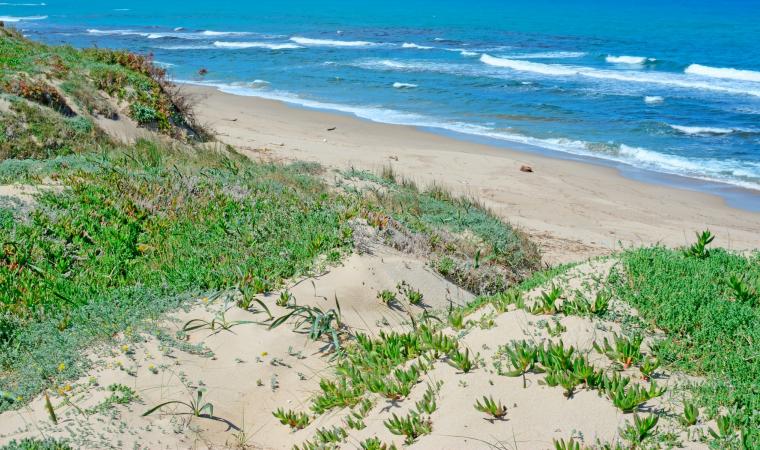
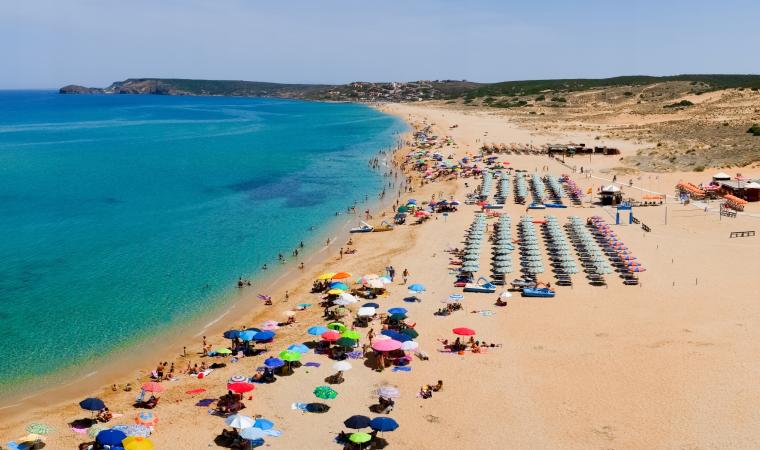
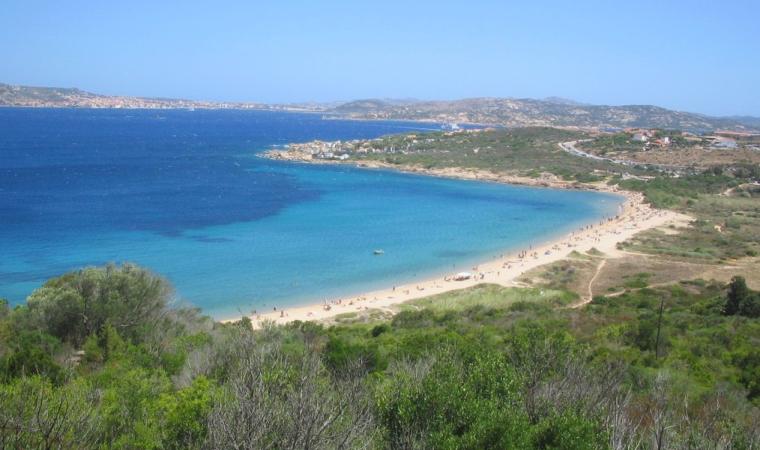
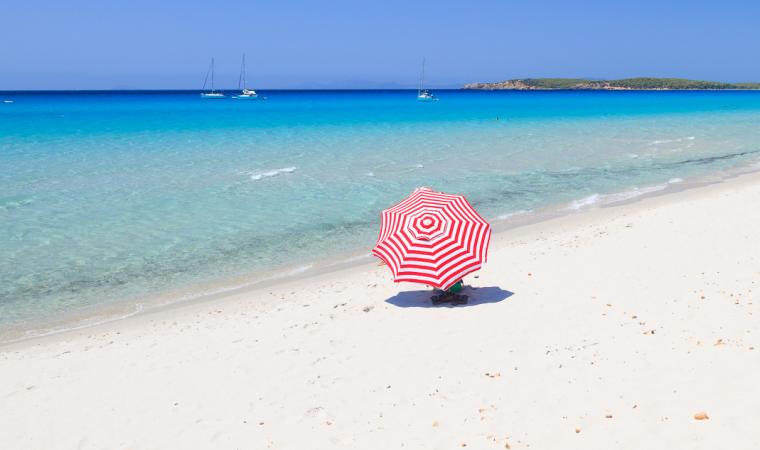
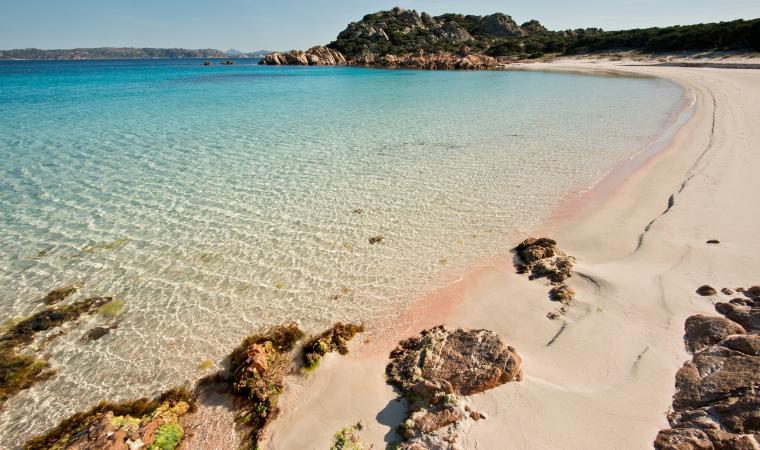
Transparent waters wash kilometres and kilometres of free coastline, with landscapes made up of inlets, reefs, coves and an infinity of beaches. A short walk will take you to some of them and you will never find yourself elbow to elbow with neighbouring beach umbrellas even in mid-August. You will find others set among fantastic reefs, close to cool pine forests, soft sand dunes and natural oases inhabited by pink flamingos. Each speaks its own language: there are precious, delicate ones that it will seem an insult to walk on, while others are so wild that you will feel the thrill of being the first to set foot on them and sometimes their past experience comes before their beauty. You could experience a different one (or more than one) every day, but a lifetime of holidays in Sardinia would not be enough to discover the vastness of its sea.
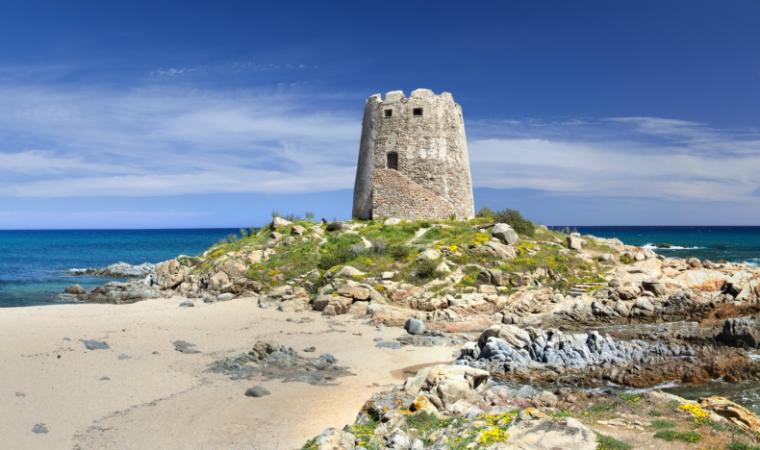
This location unites the infinite shades of the sea and the charm of wild nature that pervades the coastal rocks. Cala Corsara is a bay south of Spargi, a jewel-islet in the Arcipelago di La Maddalena National Park. The cove is divided into four beaches of almost impalpable sand, surrounded by small dunes where the growths of juniper and broom are interspersed with rare plants such as roses and sea lilies. The form of some of the granite rocks is surprising, the result of erosion by wind and water. The northern coast, before the archipelago, was also the protagonist in 2014, when Cala Spinosa, the splendid bay of Santa Teresa Gallura, was chosen as the 7th most desirable destination, and in 2015, the year with the highest number of Sardinian beaches on the list, when the Capo Coda Cavallo beach also ranked in the top ten. This stretch of soft sand extends over a strip of granite terrain, sheltered by the imposing bulk of the island of Tavolara, the rocks of Molara and the picturesque islet of Proratora, which form a protected marine area symbolic of Sardinia. There is also a spectacular underwater world to discover...
“Still little known, obscured by the fame of the nearby Cala Mariolu (...), with which is shares the same characteristics: crystal-clear water in shades of green and blue, a cliff polished by time and a lido of white pebbles.” This is the reason why Cala dei Gabbiani, the less famous ‘pearl’ amongst the many pristine paradises of Ogliastra, came close to the record, awarded second place overall by Skyscanner in 2017. This same placement came in 2014 for its ‘twin’ Cala Mariolu, of which Cala dei Gabbiani is the natural continuation. They share the same scenographic impact, being two of the many gems of the Baunei coast in the southern part of the Gulf of Orosei. Separating them is the flat spur of Punta Ispuligi. Until the end of the 20th century, this stretch of coastline was referred to together as Ispulige de Nie, ‘snow fleas’, in reference to the pebbles polished by the waves, round and flattened like sugared almonds, in an alternation of tones forming a shore of cream, white and pink.
The central-eastern coast of Sardinia, in the territory of Baunei, is a series of incomparable coves, reachable only by sea or via a challenging trek. In addition to Cala dei Gabbiani and Cala Mariolu, others have also been selected in the international portal’s ranking. In 2015, second place went to Cala Goloritzé, one of the most beautiful coves in the Mediterranean and a national monument. It too is composed of polished white pebbles, turquoise waters flowing from underwater karstic springs and marble rocks shaped by time. In the surrounds is the majesty of Perda Longa and the pyramid-shaped spire of Mount Caroddi. Yet another magical location climbed up on the third step of the podium in 2016: the beautiful Cala Biriola. A little further north is this delightful beach protected by a cliff of limestone that forms an arch stretching over two kilometres, covered by a wood of centuries-old holm oaks, maquis shrubland, and junipers clinging to the rockface. A few dozen kilometres further north, in the territory of Dorgali, is the beauty of Cala Fuili which was awarded 10th place in 2015’s rankings. This wonder is so cinematic that it appeared as a set in the film ‘Swept Away’ (1974).
Long, leisurely pine woods that surround the beaches and infinite horizons on the sea. Platamona is Italy’s record-holder with 15 kilometres, followed by su Barone at Orosei, is Arenas at Narbolia and Salamaghe at Budoni, to name just a few. They are a short distance from the villages and frequented by local people: you can find the familiar seaside atmosphere of the past on their beaches.
Far away from everything and with a past made up of sad stories. If you come here, you must be looking for something that transcends the simple beauty of the landscapes. The excessively primordial nature of these areas can go to your head. Scivu, Piscinas, Pistis and Torre dei Corsari are shamanic places that captivate in order to be heard and respected.
An undeclared wildlife oasis and spontaneous meeting place for naturists and kite surfers tells us a lot about the wild and free nature of Barrabisa, Fiumara and Porto Liscia. If you don't play with the waves and the wind, you can reach the coves close to the reefs, with a calm sea and views of the Maddalena archipelago, a private area in the heart of Gallura.