By canoe and SUP, paddling from island to island
You can see them from the beaches of Sardinia, they are small and uninhabited, beautiful and ready to discover


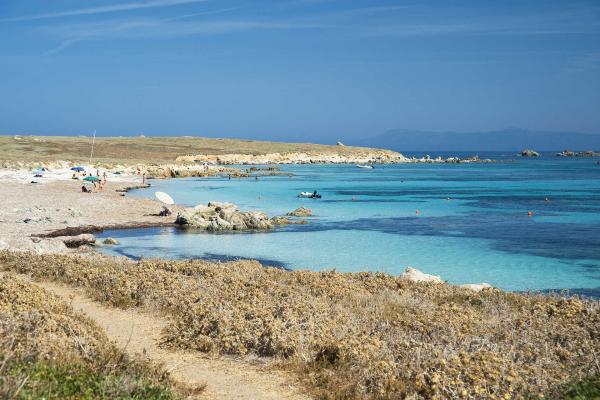
Seen from the land, it looks like a small rock, but as you get closer you will see it unfold towards the sea like a snake, hiding wind-sculpted cliffs in its curves, exquisite beaches of quartz crystals, and spring and thermal waters on its shores. There is even a nuraghe. This is the wild Mal di Ventre, a fantastic landing place, if the sea is merciful, after the demanding crossing of the Sinis coast. There are also islands within reach of all paddlers, just an arm's length away, such as the islet of Ogliastra and the island of Cavoli, which can be reached from the beaches of Santa Maria Navarrese and Villasimius. They are so beautiful and captivating that you could stay there until sunset. If you're feeling energetic, consider them just a pit stop before another trip to nearby islands with a different allure, the scenic red chain of the Cea stacks and the nature reserve of Serpentara Island. And then there is the long Ariadne's thread of rocks and islets that runs along Gallura, unravelling from the sea at San Teodoro to the Maddalena archipelago park, stopping off in small places in the middle of the sea, under the spell of so much unspoilt beauty.
They are all uninhabited islets floating in the green and blue of a dreamlike sky and sea, a concentration of primordial charm, artfully placed there to welcome those who paddle in from the mother island. Here, you need your smartphone so that you don't have to rely solely on your memory to remember the alienating sensation of feeling like Robinson Crusoe for a day, in the middle of the sea on an uninhabited island.
Cavoli is tall and rocky, very close to the coast and very popular, so take a break in the shade of the lighthouse and a dip underwater to see and touch the sculpture of the Madonna di Sciola, before cutting across the gulf to Serpentara. She is on the edge of the protected area, long and winding, one side of which is a conservation area, a safe home for herons, Corsican gulls and tufted warblers. Dolphins swim in the water.

Leave the beaches of San Teodoro and head north without touching the shore. Catch your breath in the islets near the coast, small fragments in the middle of the Gallura sea. The character traits and gifts of its natural environment are concentrated here, the granite to be climbed, the 'good living room' to be shown off, the wild to be explored, the romantic Instragram point and the protected area to be visited on tiptoe.

Cavoli is tall and rocky, very close to the coast and very popular, so take a break in the shade of the lighthouse and a dip underwater to see and touch the sculpture of the Madonna di Sciola, before cutting across the gulf to Serpentara. She is on the edge of the protected area, long and winding, one side of which is a conservation area, a safe home for herons, Corsican gulls and tufted warblers. Dolphins swim in the water.
Cavoli is tall and rocky, very close to the coast and very popular, so take a break in the shade of the lighthouse and a dip underwater to see and touch the sculpture of the Madonna di Sciola, before cutting across the gulf to Serpentara. She is on the edge of the protected area, long and winding, one side of which is a conservation area, a safe home for herons, Corsican gulls and tufted warblers. Dolphins swim in the water.
An unparalleled pit stop: small beaches, rocks, wild animals. Around their perimeter there is a lively sea to explore, so rich that it is strange to think that it is located in one of the most frequented marine crossroads for boats of all kinds. You have landed on the Piana and Cavalli islands, where you may be surprised by the flight of a golden eagle nesting on Tavolara. ‘The mountain rising from the sea' awaits you in spring and autumn, when it will be yours alone.