

Tuttavista
On its peak, which is over 800 metres high, stands a bronze statue of Christ, a work of art created by an artist from Madrid, Pedro Angel Terron Manrique. The sculpture is twelve metres high and it is a reproduction of the wooden statue of the holy Crucifix located inside the church of the same name in Galtellì. Thanks to the symbolic presence, Mount Tuttavista, it is a destination for pilgrimages for those who wish to meditate in a secluded place in contact with nature, along a captivating trail that climbs its slopes.
The mountain is located in Baronìa, in the territories of Galtellì, Onifai and Orosei. Its sides are delimited by the alluvial valley of the Cedrino river. From the peak, you can see a 360 degree panorama of the surrounding territory: to the south, there is Dorgali with mount Irveri, to the west the Cedrino river, Galtellì, Loculi and Irgoli, to the northwest the long Monte Albo mountain range and to the east the Gulf of Orosei. Travelling along the scenic road, up the slopes and along the hairpin bends, you will stop numerous times to observe breathtaking landscapes: the name of the mountain, Tuttavista (meaning 'all view'), is a guarantee. Stopping at 635 metres of altitude is a must: here, you will find a natural monument, Sa Preda Istampada (the pierced stone), a rock face in which there is a hole of 40 metres in diameter created by the wind and rain, practically a window onto the valley below and Supramonte. You can also try your hand at trekking trails, like the one that climbs the mountain from the area of Taraculi.
The limestone rock of the Tuttavista has a rugged morphology, with grottoes and Karst caves where fossils of wildlife and endemic species that lived between ten thousand and two million years ago have been found. Holm oak forests, junipers, mastics, spurge and 32 types of wild orchid - rare endemic species that you can photograph along the trails - bring colour to the mountain. The vegetation is populated by wild boars, weasels, martens, foxes and various bird species: common ravens, kestrels, partridges and buzzards. This natural oasis is also ideal for free climbing enthusiasts: there are various rock faces equipped for climbing, with medium and high difficulty paths.
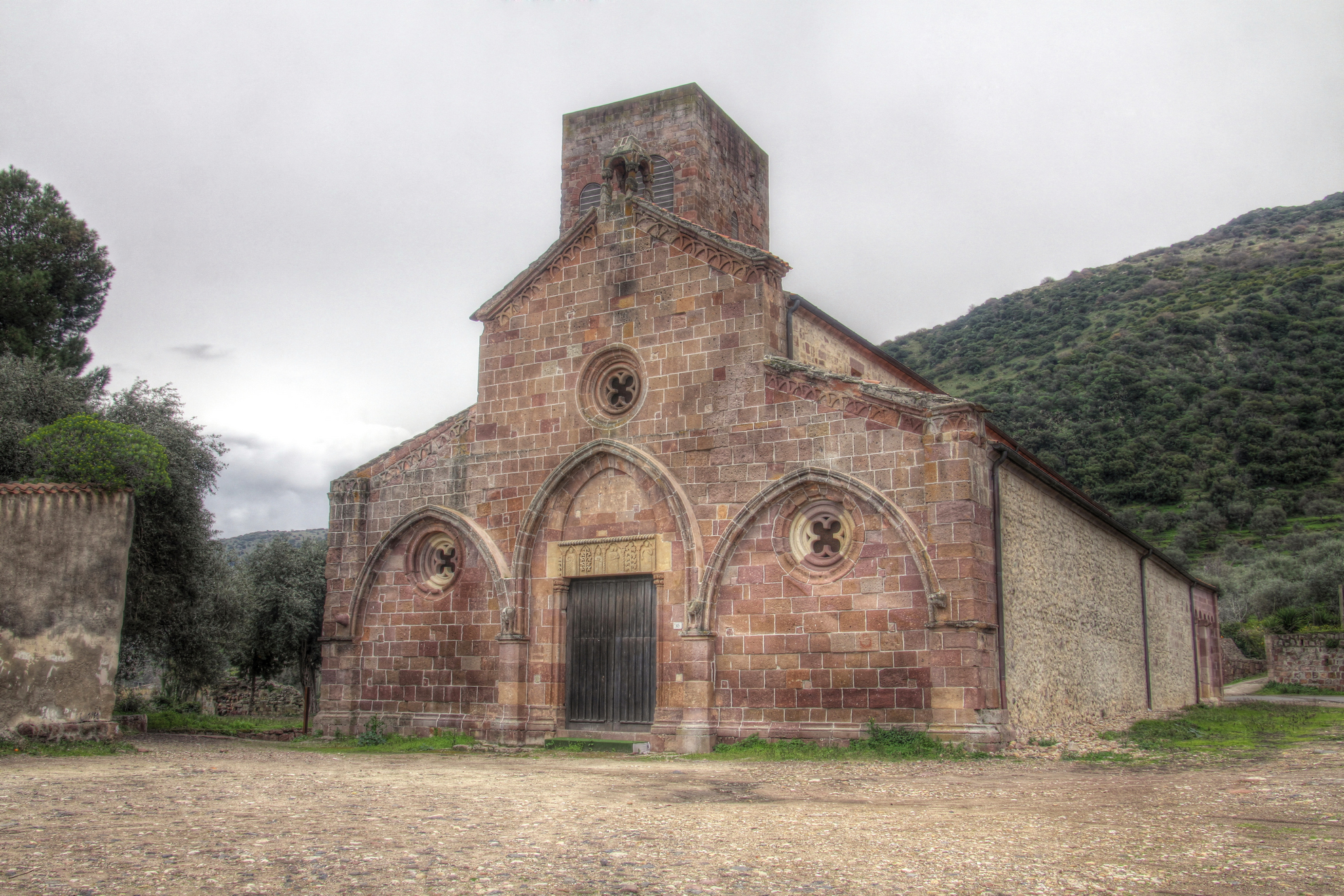
San Pietro extra muros - Bosa
From the colourful houses in the village of Bosa, travelling one kilometre along the Temo river, you will reach the locality of Calamedia, a site that was already inhabited in the Phoenician-Punic age: here, you will find the cathedral of San Pietro, the most ancient Romanesque church on the island. Its red trachyte walls stand near the river banks, on the opposite shore of the hill of Serravalle, dominated by the castle of Malaspina, inside of which you will find another gem of religious architecture: Nostra Signora di Regnos Altos (Our Lady of Regnos Altos). The cathedral of San Pietro is said to be extra muros because it is located outside the castle walls and it is more than half a century older than the castle itself. Around it, there was the original nucleus of the town, which was inhabited until the end of the sixteenth century. When the district of Sa Costa was later completed on the hillside, the population moved. The migration took two centuries: Bosa vetus disappeared.
The sanctuary is the result of a long process. The most ancient part dates back to the 11th century, as is confirmed by the epigraph of its consecration, which refers to the year 1063, while the tribune with a new apse, bell-tower (24 metres high and unfinished) and perimeter walls were created the following century. The overflowing of the Temo river compromised some parts, which were rebuilt in the middle of the 20th century: the complex regained its Medieval appearance. Today, you can admire a church that, despite losing its title of cathedral, has managed to keep its charm intact. The façade (dating back to the 13th century) is decorated with large arches and also with small intertwined arches. On the top, you will notice an aedicule, supported by little columns, with a snake wound around them. The portal is framed by an arch, over which you will be struck by an architrave sculpted with fake loggias and six little arches with bas-reliefs depicting, in a hierarchical composition, the Virgin Mary with Child in the main central aedicula, next to which there is the Tree of Life and a holy bishop (possibly Costantinus de Castra, who consecrated the building), on the right side, there is Saint Peter and on the left Saint Paul, wearing robes with elaborate drapery. The bishop is in the smaller aedicula but he is given a place next to the Virgin Mary. The apse is divided in to five sections by lesenes supporting corbels that, in turn, support little arches. In three of them, you will see single-light windows that help light up the interior, made up of three naves: the middle one is covered by wooden trusses, while the side ones have cross vaults. You can access them via nine rounded arches on each side, supported by quadrangular pillars. In the first one on the right, you will see a white limestone baptismal font.
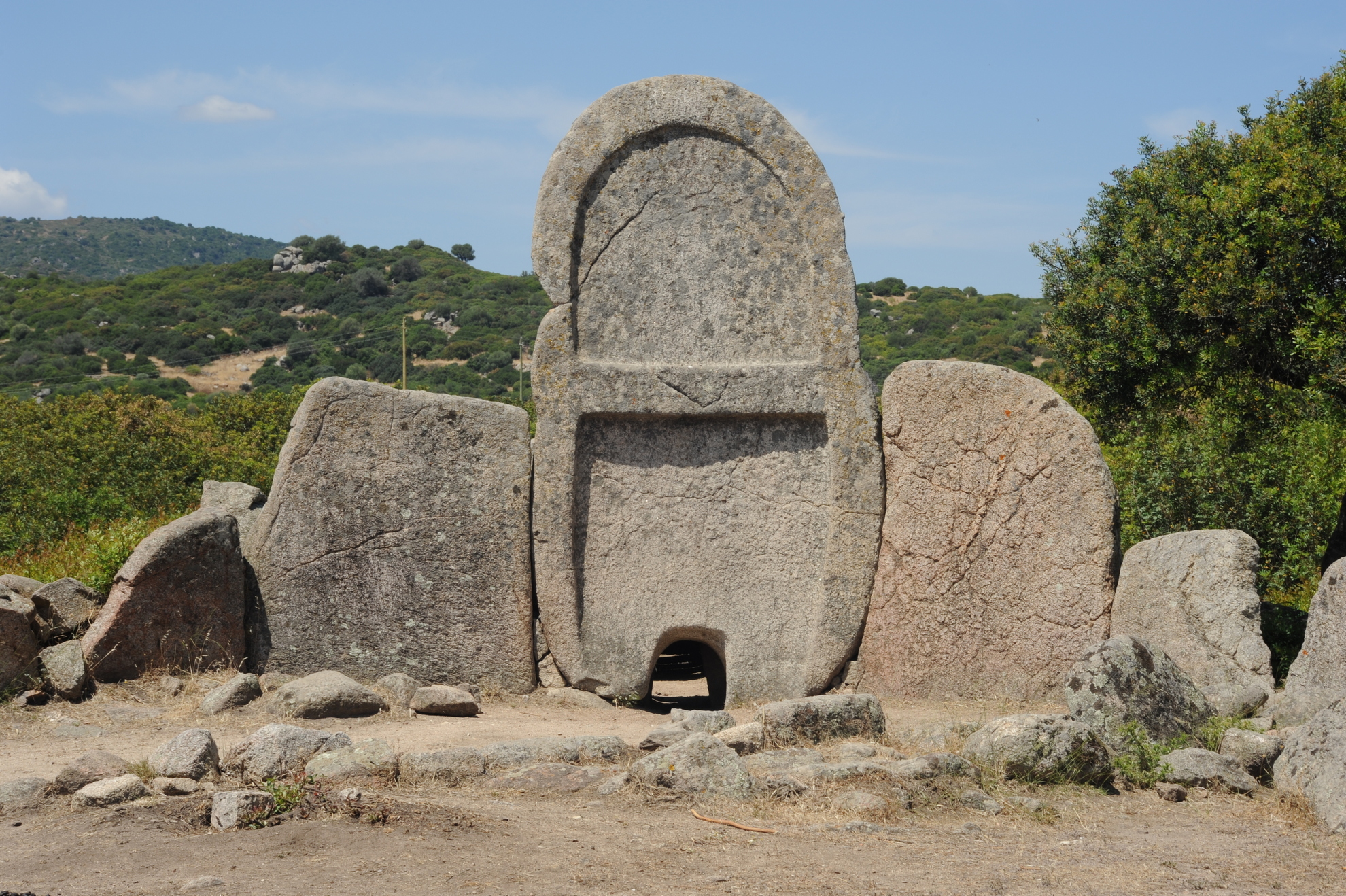
S'Ena e Thomes
You will see its enormous stele, a granite slab almost four metres high, standing out in the valley of the Isalle rivulet, at the end of a trail half a kilometre long and covered in Mediterranean scrub. The Tomb of the Giants of S'Ena 'e Thomes is the most important Nuragic burial monument on the island: it is majestic, just like it was thousands of years ago. Dating back to the Early Bronze Age (1800-1600 BC), it is located in the Dorgali territory, six kilometres from the Nuragic village of Serra Orrios and approximately 17 km from the residential area, along the road that leads to Lula.
Your impression will be one of archaism and monumentality. The granite stele with smooth edges weighs seven tonnes and is at the centre of an exedra, or a semicircle of stone slabs 'laid on edge' set in the ground in the shape of a bull's horn, decreasing in size from the centre outwards. They delimit the sacred area, where ancestral funeral rituals were officiated. A symbolic little door has been carved out of the stele, giving access to the gods of the underworld, and is so small that it is inaccessible to living beings. Behind it, almost intact, there is the dolmen funerary corridor, 11 metres long, with a jack arch roof: the stone slabs are arranged horizontally along the walls. The mortuary is facing south, which is unusual compared to the 'eastern' facing ones in many other Nuragic tombs. This is true also in the burial sites of Goronna (Paulilatino) and Baddu Pirastru (Thiesi). According to legend, the tombs of the giants were used by huge beings: the gigantic size make the origin of the name clear. In reality, they were collective burial places. S'Ena 'e Thomes also confirms the fact that, for the Nuragic people, death made no distinctions: during the excavations, the meagre grave goods that were found do not point to any social disparities. The doubt about whether it was a mass grave or one reserved to a single class (aristocratic) still remains. They are also considered places that emit energy: researchers, spiritualists and people who are curious visit them, seeking physical healing or spiritual regeneration. In the ancient ritual, also widespread in Greek culture, a person would fall into a trance, thus entering into contact with the divinity.
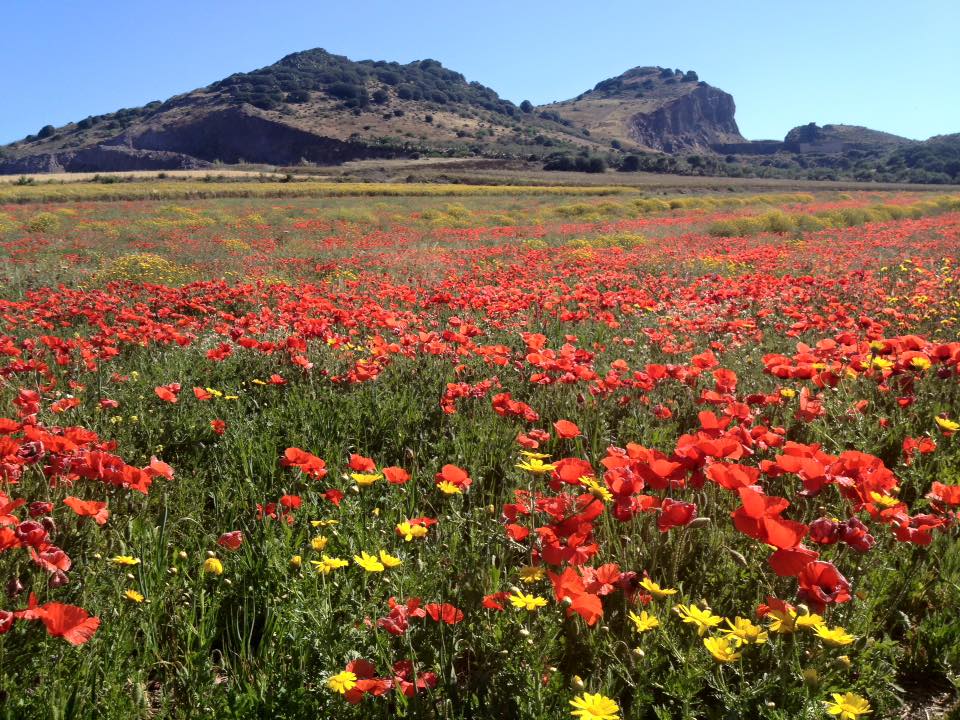
Monastir
The name apparently comes from muristenes, an ancient dwellings for worshipers and traders, or from the Catalan word for monastery. It is not by chance that since the end of the 20th century, near the parish church of San Pietro Apostolo, there was a building known as domu de is paras, 'house of the friars'. Monastir is located on the fertile Campidano plain, between two little hills of volcanic origin, Mounts Zara and Olladiri, which break up the flat trend of the countryside through which the Riu Mannu and Riu Flumineddu rivers flow. This municipality has four thousand 500 inhabitants and is situated twenty kilometres from Cagliari. It has an agricultural vocation: citrus fruits, peaches and potatoes are grown all over its territory.
The present-day village emerged in the Middle Ages around a community of Camaldolese monks. It was part of the Calari Giudicato and, for a short period, that of Arborea, after which it became the property of Pisa. The remains of the Baratuli Castle are an emblem of that period and stand on top of Mount Olladiri. The castle was built in the middle of the 12th century by the Giudici (rulers) of Cagliari, after which it passed to those of Arborea and was destroyed by the Pisans at the beginning of the 14th century. The old town centre extends around the parish church of San Pietro, the patron saint of the village and its Gothic-Aragonese structure dates back to the beginning of the 16th century. The church of Santa Lucia is much older (second half of the 13th century) and it is a Romanesque style church. At the end of August, the celebration in honour of the saint takes place: this is the moment felt most deeply by the community of Monastir, with processions to and from the parish church and the little rural church, accompanied by worshippers, knights, wagons pulled by oxen, groups in costume and launeddas players. The first celebration of the year is that of the Fires of Sant'Antonio Abate (17 January) to whom a 14th century Gothic church is dedicated. Next, a few days later, there is Su Foghidoni for St Sebastian. A 15th century sanctuary is named after him. In this extremely devout village, other religious buildings stand out: the church of San Giacomo, which is the most ancient (12th century) and is embellished with a spiked bell-tower, and the church of the Beata Vergine Maria (or of the 'Madonnina').
Monastir boasts a remarkable archaeological heritage. The oldest evidence is in the hills: in Is Aruttas, a Domus de Janas necropolis (3200-2800 BC), on Olladiri there are the remains of Pre-Nuragic and Nuragic huts, on the Zara there are the Domus de Janas known as Is Ogus de Monti and the monumental flight of 60 steps dug out of the rock, which lead to the acropolis. At the top of the hill, you will see the sacred Nuragic area, two altars and two wells used for worship of the water deities. At the bottom of the steps, there is a 9th century BC circular building, used for various activities, including wine-making. In the area, there are is also the Su Cuccumeu Nuraghe and the village of Mitza Morta.
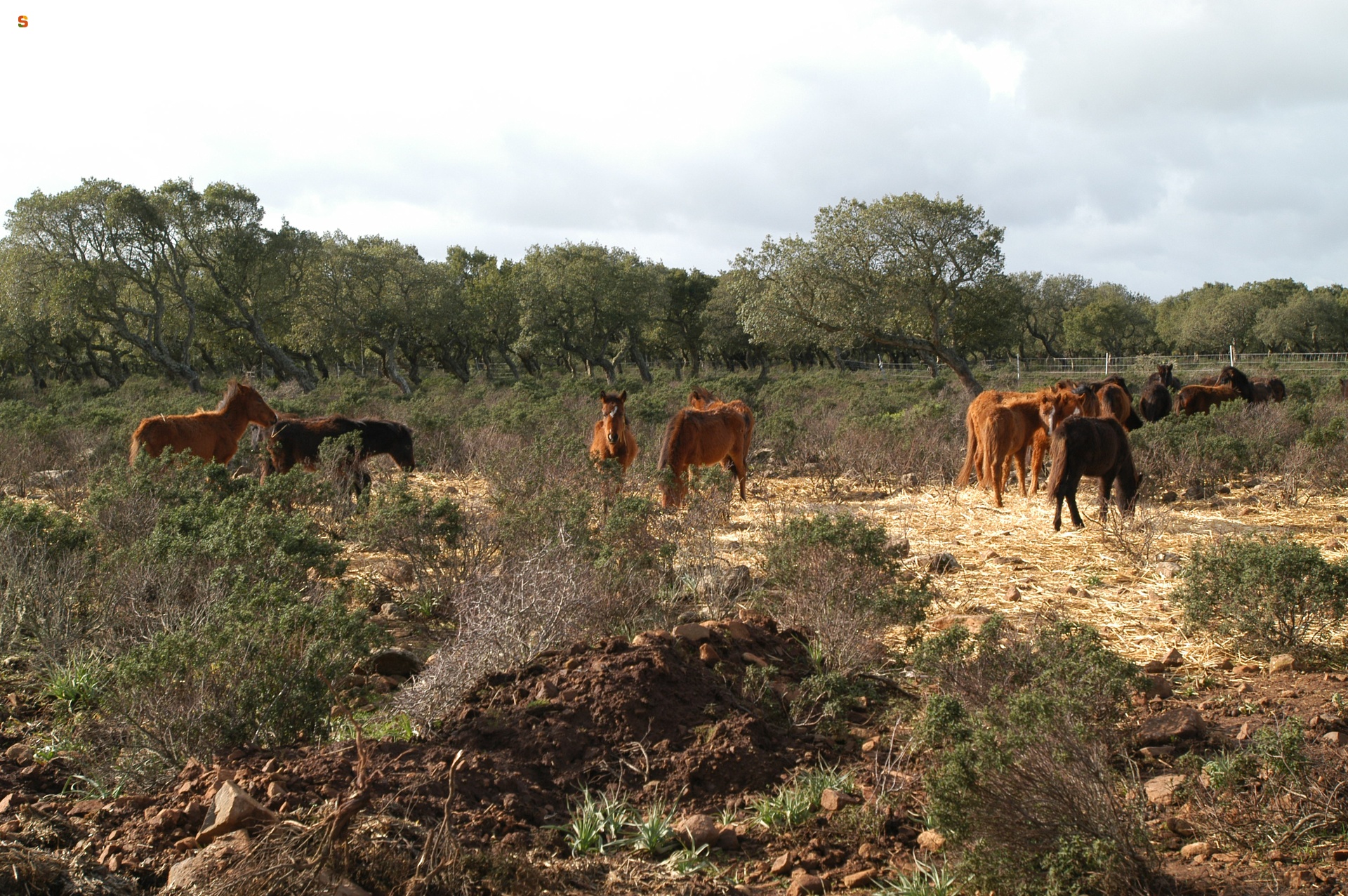
Gesturi
An enchanting landscape where time stands still, a Nuragic legacy and intense devotion. These are the characteristics of Gesturi, the northernmost village in the Marmilla region, with over a thousand inhabitants. Its territory partially occupies the Giara (sa Jara Manna), a plateau 600 metres high, once an impressive volcano and now an unparalleled oasis in the Mediterranean. Vegetation and animals live in symbiosis: a 'natural museum' with a dense blanket of botanical species, rare flowers and plants that adapt to the climate and the territory. They receive moisture from Is Paulis, enormous pools of water, even four metres deep. All around, there are valleys dominated by Mediterranean scrub and hills on which there are olive groves and vineyards, from which excellent quality wine and olive oil are obtained. Then, along the precipitous ridges of the plateau, forests of oak trees and poplars appear and make way for the cork oak woods on top of the plateau, almost all of which are 'crooked', having been bent by the strength of the wind.
This wildly beautiful place is inhabited by ducks, Eurasian woodcocks, Eurasian jays, hares and, above all, Giara horses, a protected species whose origin is shrouded in mystery and of which there are about 500 specimens living in small groups. Rocky elevations stand out on the plateau, interrupting the level trend of the ground. Here, you can walk amidst the signs that man has left over 3500 years, including the 'father of all Nuraghi', the Bruncu Madugui Protonuraghe. There are thirty archaeological sites, among which the Menhirs and Domus de Janas of Sa Ucca 'e Su Paui, the Tombs of Giants and Nuraghi of Pranu 'e Mendula and the Punic and Roman villages of Tana and Tupp'e Turri.
Gesturi is a destination for pilgrimages, thanks to Fra Nicola (1882-1958), who was beatified by Pope John Paul II and who lived in a modest house in the little village, currently used as a museum. From here, you can follow an itinerary along narrow roads with dwellings that have portals and archivolted verandas, churches in the old town centre and rural sanctuaries. Devotion is expressed in six religious buildings: in the centre, you will see the bell tower standing out, 30 metres from the parish church of Santa Teresa d'Avila (1607), celebrated in mid-October. In the outskirts, you will find the church of Santa Barbara, the most ancient (1473), just outside the municipality. The Madonna del Rosario (17th century) is home to the Is Cunfrarius Biancus, a confraternity that, during Holy Week, is responsible for the Madonna. Taking care of the Christ is the task of the brothers of the Holy Sepulchre, who reside in the little church of Santa Maria Egiziaca, which is unusual because of its architecture and its 'dressed statues'. Four kilometres from the village, nestled in a forest of centuries-old trees, there is the church of Madonna d'Itria (1620), with its festivities that are possibly of Byzantine origin and begin on the first day of Pentacost. Along with these celebrations, there is also the lay feast of the sheep. The most heartfelt festivity is the one for Fra Nicola: two days of intense celebrations.
Esterzili
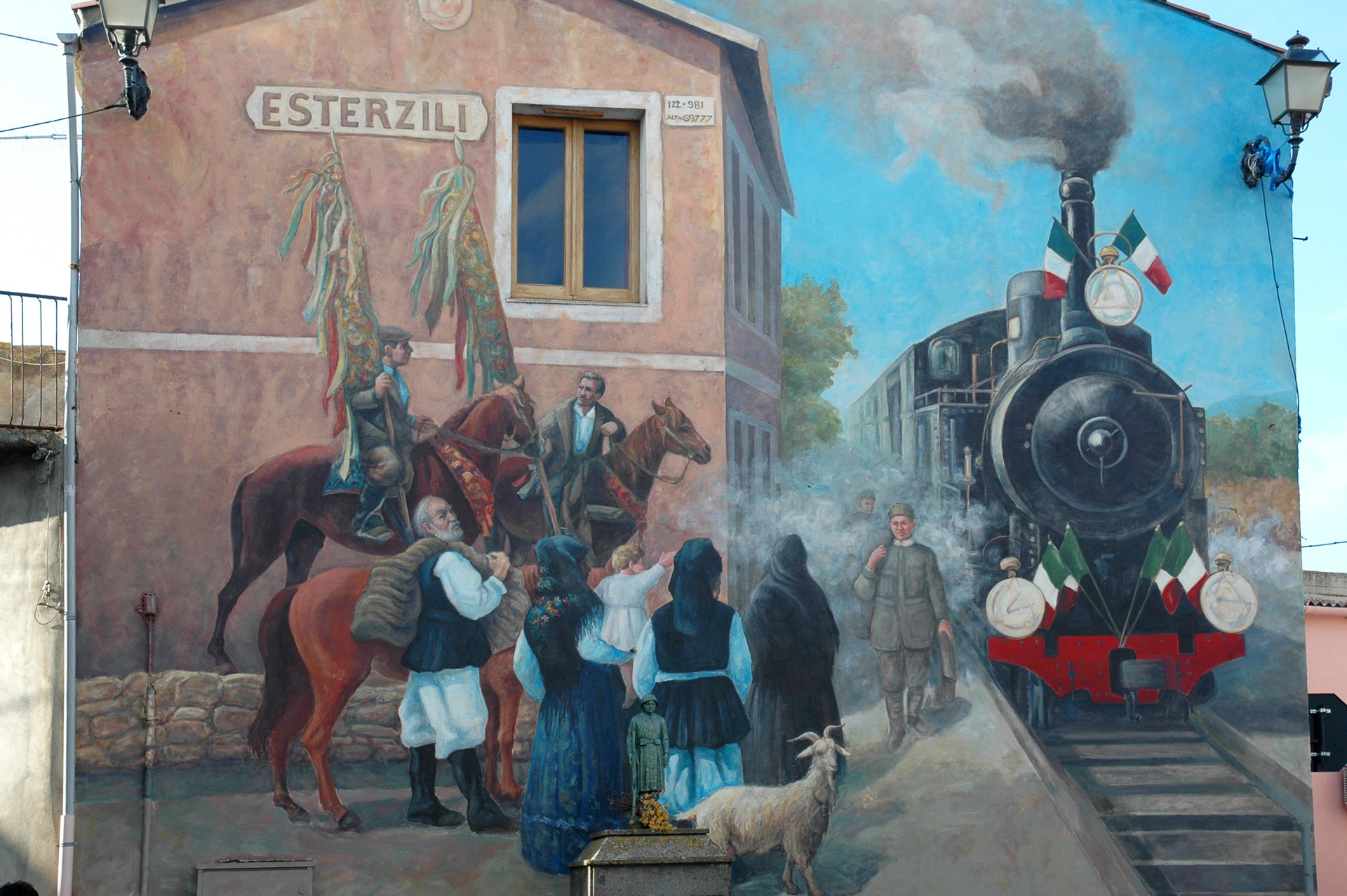
From the village, looking upwards, you will see the peak of an isolated and captivating mountain and then, looking towards the valley, you will be enchanted by the variety of landscapes. Esterzili is a small village with approximately 650 inhabitants located at an altitude of 700 metres on the slopes of Mount Santa Vittoria, the peak of which exceeds 1200 metres of altitude. From up there, at the end of a climb, you can admire a landscape that dominates Sarrabus, Gerrei and Sarcidano and that even stretches as far as Campidano and the Ogliastra sea.
From an administrative viewpoint, Esterzili comes under southern Sardinia, but it is considered part of Barbagia di Seulo. In the old town centre, the charm of the houses featuring murales is still intact. The village and the countryside are dotted with religious buildings. In the centre, there is the new parish church (1972) dedicated to St. Ignatius of Laconi. Inside the church, there is an altarpiece depicting Christ on the cross, a statue of the Virgin Mary of the Rosary (17th century) and an 18th century group of sculptures. The church of San Michele (15th century), dedicated to the patron saint, is a Gothic-Aragonese style church and it is located in the northern outskirts. In the refined façade, there is an inlaid main door and alongside it there is a belfry. The church of Sant'Antonio da Padova (17th century) is located on a hill at the northwestern end of the village. Nearby, inside the park of the same name, there is the seventeenth century rural church of San Sebastiano. Among the festivities not to be missed, in mid-August, there is the festival of Su frigadòri (onion bread baked in the oven) and that of Is cocoèddas (delicacies with a potato filling). Along with the flavours of the cuisine, there is folk music and shows.
The territory of Esterzili was inhabited as early as prehistoric times. 77 archaeological sites have been counted: Domus de Janas, Nuraghi, temples, Tombs of Giants and bronze statues. The most important one is the Nuragic temple of Domu de Orgia, perched at an altitude of one thousand metres. It is the most important megaron-type temple on the island, dating back to the second half of 2nd millennium BC: it consists of two rooms preceded by a vestibule and around it there is a sacred enclosure. During excavations, various bronze statues emerged. The most important evidence of the Roman period, one of the main ones discovered in Sardinia, is the Tavola di Esterzili, a sheet of bronze on which there is an inscription in Latin, describing the controversy between the peoples of the area, the Patulcenses Campani and the Gallilensi.

Palazzo degli scolopi
Along the axis that crosses the old town centre of Oristano, from the Tower of Mariano to porta Mari, lies one of most famous squares in the town, Piazza Eleonora d'Arborea, in which there is a wealth of important and religious buildings. Around statue of the Giudicessa, you can admire the Church of San Francesco d'Assisi, Palazzo Corrias Carta and, on the corner of Corso Umberto I, Palazzo degli Scolopi. In its place, states the historian Angius, there was one a synagogue, 'justified' by the presence of a substantial Jewish colony that, during Spanish domination, was forced to leave the Island.
Other news on the complex dates back to 1536-40, based on reports from the Council meetings that were held here during those years. The building then became the site of the Jesuit convent: the Scolopi, in 1682, opened an institute there, which was financed by a rich merchant. The Piarists occupied the lower floor of the convent and remained active until 1886, the year in which the religious orders were suppressed and replaced by the Regio Ginnasio. Today, the Oristano Town Hall is located here: inside it, there is the council room, with a sandstone entrance portal, and administrative offices.
The complex was renovated in 1830 by Fra' Antonio Cano. This architect and sculptor from Sassari used classical elements on the long, tall façade. He also intervened on the richest monument, the former Church of San Vincenzo, now a council hall: of his work, four statues of the Evangelists still remain and are located in niches on the perimeter walls. During the fascist period, this space was used as a courtroom and the niches were walled over, in order to conceal the symbols of piety, which were not suited to its new function. The hands, which were protruding from the wall, were destroyed. Another typical decoration is the wrought iron balcony overlooking the courtroom. From here, walking along a corridor with arches, you will reach the sala giudicale (judicial room) in which there are two large paintings by Antonio Benini, 'Matrimonio di Donna Eleonora' (Lady Eleonora's Wedding) and 'Proclamazione della Carta De Logu' (Proclamation of the De Logu Legal Code), and a bronze crown donated by the Venetian women in Oristano in honour of Eleonora (1884). Another intervention took place in the mid-19th century, by Gaetano Cima, who designed the other two neoclassical buildings in the square (Palazzo Corrias Carta and the church of San Francesco). The architect from Cagliari tried to create an austere façade, over the previous one, with a Purist imprint: still remaining from this experiment, are the geometric rigour and a search for a compositional rule.
Palazzo Corrias Carta
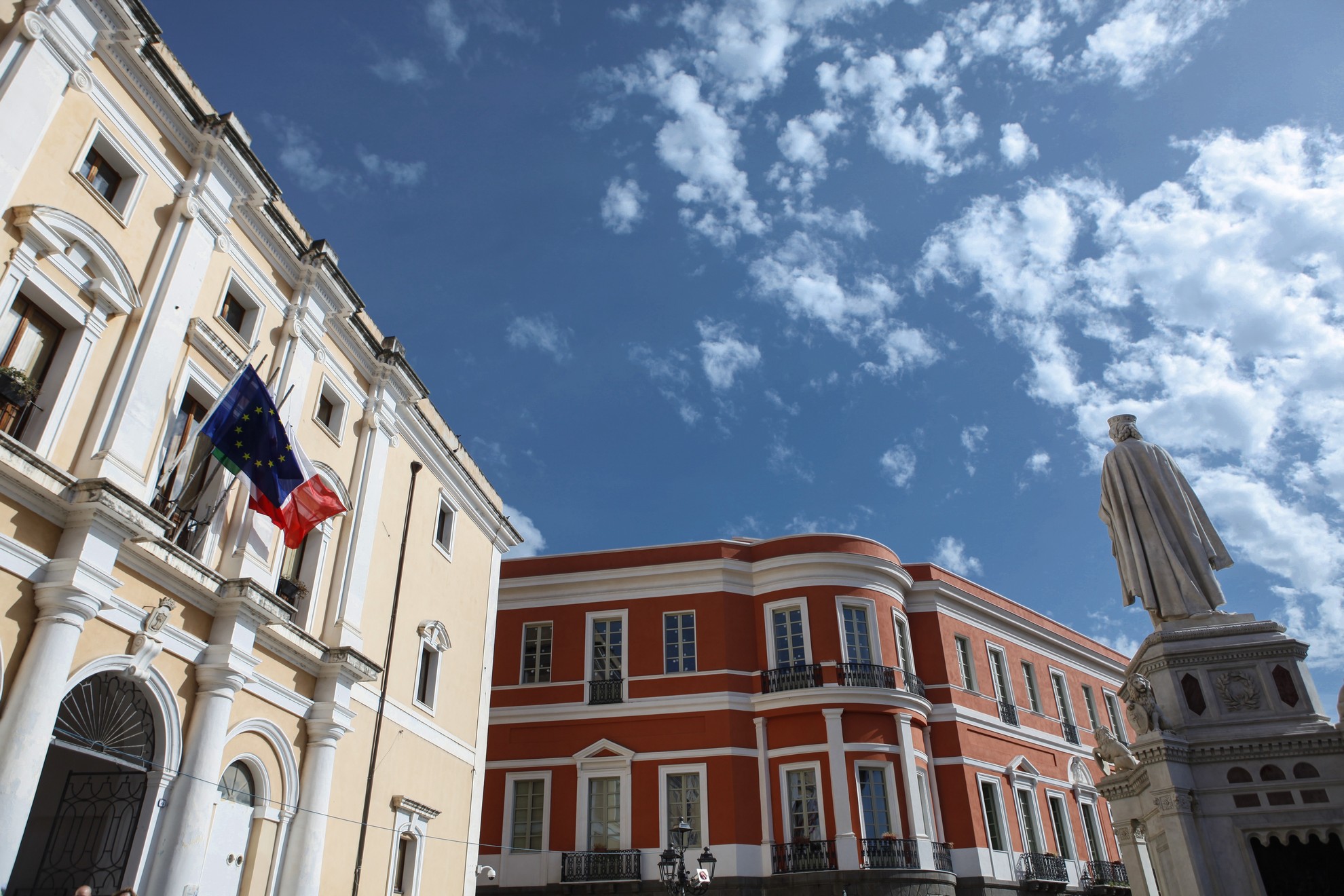
Its unmistakable brightly-coloured neoclassical façade, stands in Piazza Eleonora d'Arborea, one of the most beautiful in Oristano, in the centre of which stands a statue of the 'Giudicessa' (local ruler). Palazzo Corrias Carta dominates the eastern side of the square at the junction with Corso Umberto I, with its elegant and rigorous style, blending perfectly with the noble character of the building. It was built at the behest of Giuseppe Corrias, as a family dwelling, just after the middle of the 19th century, based on a design by Gaetano Cima, who was also responsible for the neoclassical church of San Francesco d'Assisi. Thanks to the famous architect, it is the most valid testament to nineteenth century religious architecture in Oristano and the building also represents, on the other side of the square, a great example of civil construction. The two buildings have in common their neoclassical morphological repertoire and the great care and attention focused on their insertion into the urban context.
This work, completed in 1874, has the typical decoration of the noble palaces of the period and confirms Cima's simplicity and practical approach. It consists of two buildings joined together by a circular element. The lines are designed to create a balanced and homogeneous façade in which the rounded corner that softens and separates the two parts of the building has been skilfully inserted. This cylindrical space also has town planning value, as it is a connection and creates continuity between the areas of the city that the buildings overlook. Its exterior is elegant while on the inside there are precious frescoes and unusual decorations created by Giovanni Dancardi and Davide Dechiffer, as well as original classical decor dating back to a period between the end of the 19th and the beginning of the 20th century.
Piazza Eleonora is the site of other important historical buildings in Oristano, like Palazzo degli Scolopi, also in neoclassical style, once a Jesuit convent and now the site where the Municipal Council is located. Every year, one of the most famous events in Sardinia passes through this square: Sa Sartiglia. Nearby, you will discover other historical buildings and monuments, like the Cathedral of Santa Maria Assunta, and the Tower of Mariano, the most majestic of the ancient medieval fortifications in the city.
Jesuit complex of di san Michele
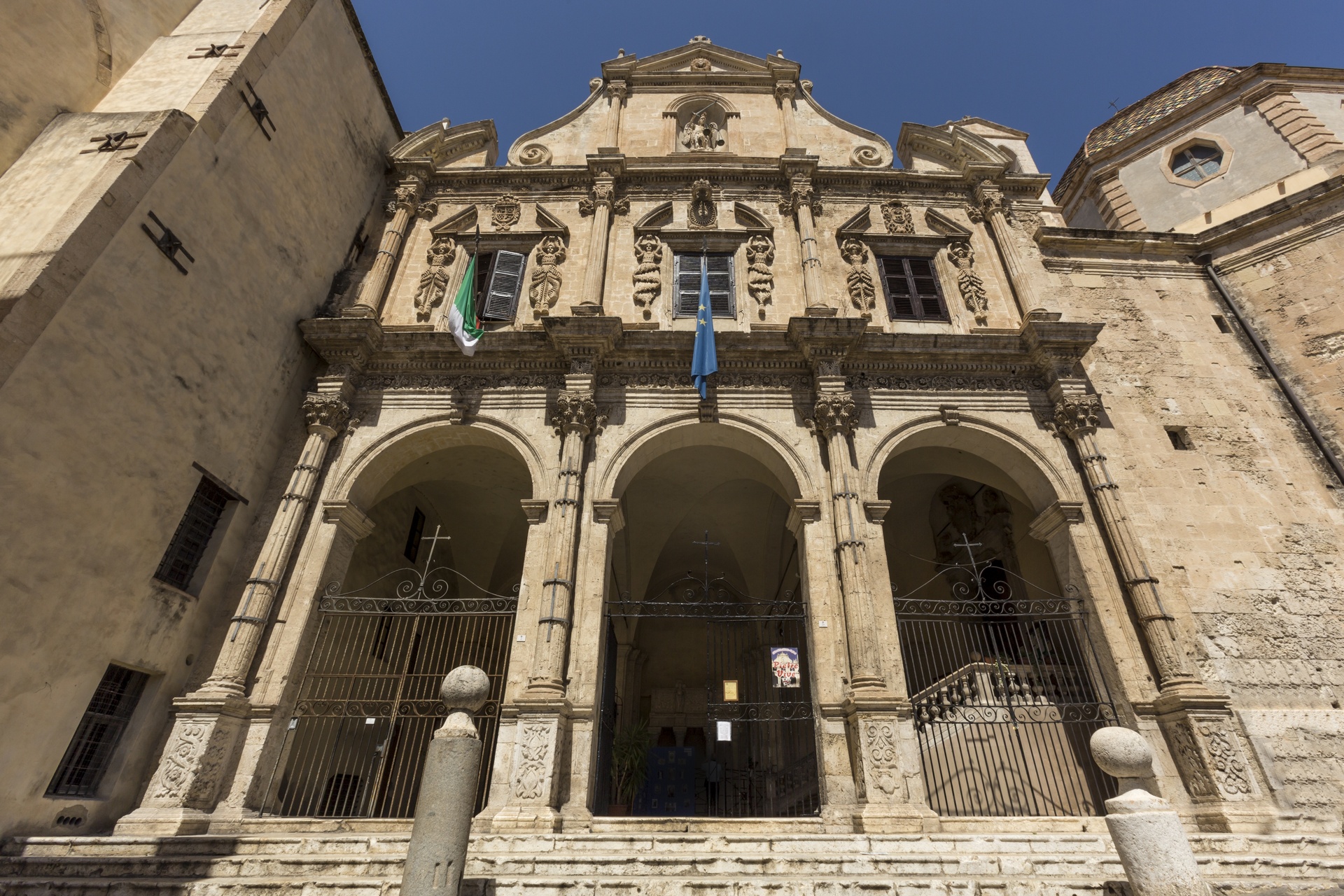
The Jesuit complex of San Michele is located in the upper part of the district of Stampace in Cagliari, near Porta dello Sperone. It consists of three buildings: the convent, preceded by a covered atrium and a vestibule, the former House of the novitiate, active since 1848 and currently the site of the military hospital, and the church, built at the end of the seventeenth century, before the cathedral, over a previous oratory, and consecrated in 1738. The Jesuits were expelled from the Island (1848) and returned to their church eighty years later.
The historical see of the Society of Jesus satisfies the ideological dictates of the powerful and cultured order. Despite the fact that the work lasted almost a century, the complex has a homogeneous appearance both in its architecture and decorations. The Baroque façade, made of tuff, has three orders. The first is divided by four fluted columns into three arcades that look out onto a cross-vaulted portico, from which you can enter the novitiate and the church. The second order is adorned by windows over which there are three coats of arms, of the Jesuit Society, of the commissioning bishop and (perhaps) the benefactor. The third, over which there is a triangular tympanum, is embellished by the niche in which there is a marble and bronze statue of St. Michael: the archangel is holding a sword and scales, symbols of strength and justice.
On the right, you will find the entrance to the church, an eighteenth century-inspired portal over which there is a gable end in the Genoese style of that period. Architectural lines, decorations, sculptures and paintings kept inside the church make it the most important testament to Baroque art in Cagliari. The plan is octagonal and irregular, with a single hall and four chapels on each side, communicating with each other. You will be struck by the rich decoration: sculpted stone elements, stuccoes, frescoes and multi-coloured marbles form a large part of the decor. The walls are punctuated by fluted parastades, adorned with friezes of leaves and human figures and on top of which there is a cornice along the entire perimeter. The cupola is resting on an octagonal tambour in which there are four windows. The roof has overlapping tiles (arranged like fish scales) and, on top of it, there is a lantern.
At the end of the eighteenth century, a rectangular sacristy was added, in Rococo style, with furniture, flooring, frescoes, portals, paintings, among which the Mysteries of the Rosary, and wooden sculptures, namely the Mysteries of the Passion by Sardinian artist Giuseppe Antonio Lonis, which are carried in the procession during the Holy Week rituals in Cagliari.
Cript of san Sepolcro
The church of San Sepolcro, in the heart of the district of Marina di Cagliari, has an ancient and fascinating history, which probably began in the 14th century and is linked, according to some scholars, to the figures of the Knights Templar and, above all, to the events of the Confraternity of the Most Holy Crucifix, also known as that of the Oration or of the Good Death, a religious order established in 1564, engaged above all in giving a respectable burial to the corpses of poor people and outcasts.
In 1992, on the occasion of renovation work carried out under the surface: a large room full of earth mixed with human bones was found. In fact, before the edict of Saint Cloud (1805) issued by Napoleon, bodies were buried within the town walls. It may have been these same religious brothers who dealt with the burials and it seems that they had Roman catacombs brought from the Holy Land so that the deceased could be united with the holy martyrs for eternity.
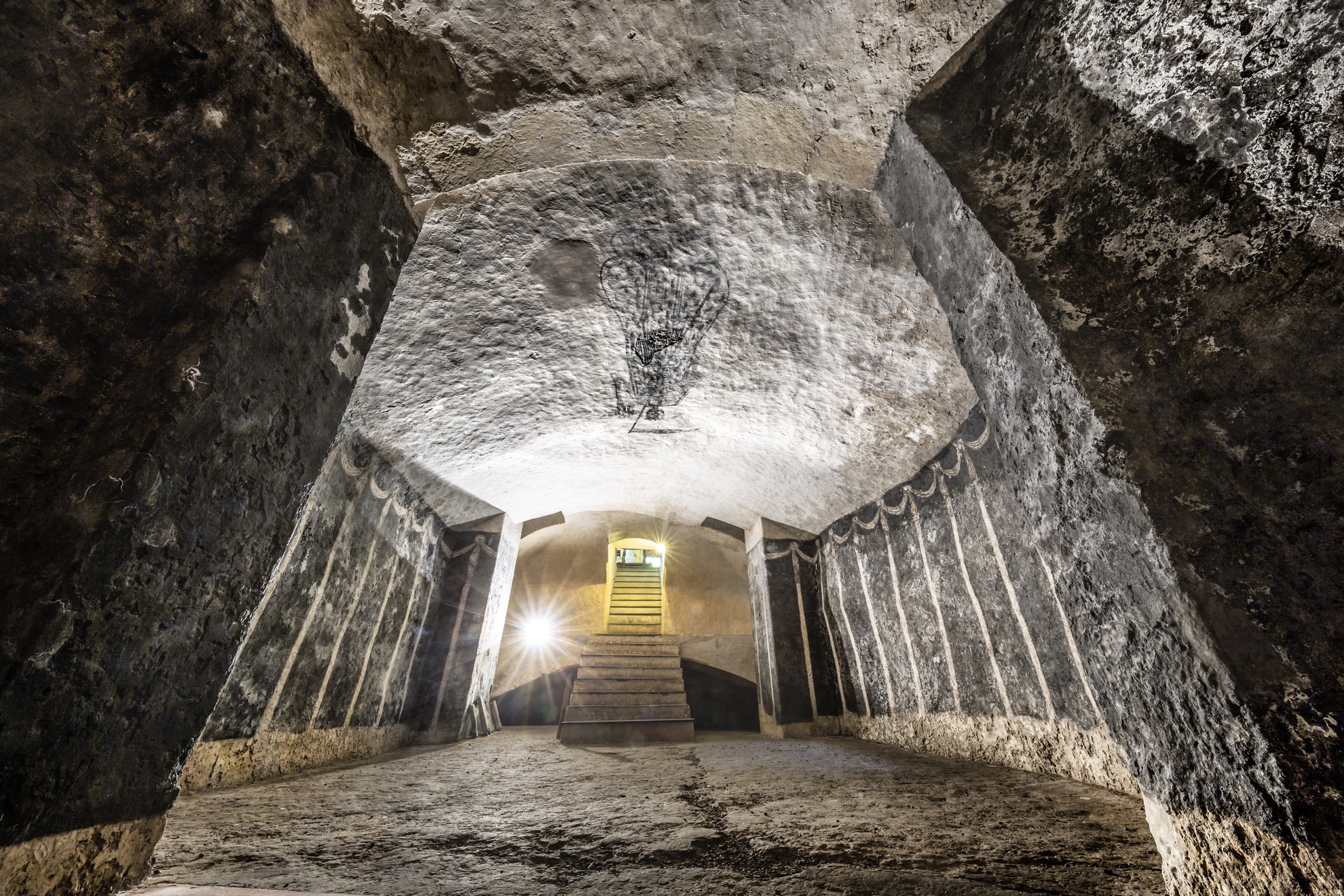
The crypt tells the story of a past of solitude and alienation and of charitable and considerate people who wanted to ensure that the poor and the unfortunate would have a tomb. The Crypta del Santo Sepolcro (Crypt of the Holy Sepulchre) is one of the most fascinating underground spaces in the town. As soon as you cross the entrance to the church, you will reach the crypt via a trapdoor situated in the centre of the nave: going down a short flight of steps, you will enter the three barrel-vaulted rooms that make up the underground vault. The spaces were probably dug out of the rock and burial took place on the floor using mounds of earth. The main room is painted completely black, using the technique of charcoal tempera paint, as if the walls were covered in gloomy drapes. In one of the rooms, you will see a masonry sepulchre, perhaps destined for the body of an illustrious character. You will notice traces of frescoes on the walls: the most significant painting depicts 'Death' portrayed as a skeleton wrapped in a regal ermine robe, with an hourglass in one hand, a symbol of the passing of time, and a scythe in the other. On the blade you will see a grim warning: nemini parco, 'I spare nobody'.