
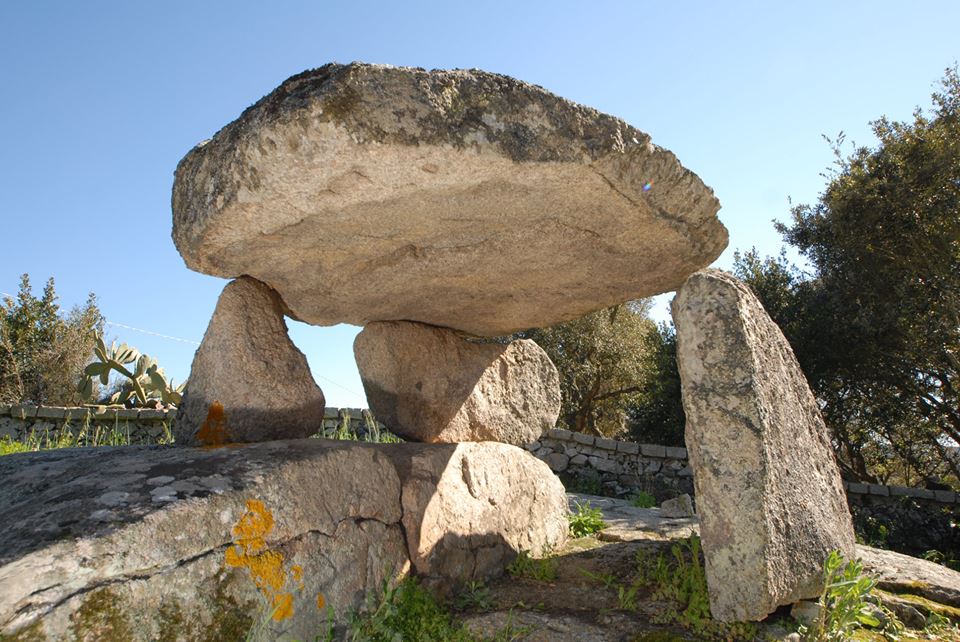
Dolmen di Luras
Sepulturas de Zigantes or de paladinos, as the inhabitants of Luras called the dolmen (from the Breton tol-men, being stone table), the funerary monuments built as of the late Neolithic period (3500-2700 BC), are found in greater concentration in these areas than anywhere else on the island. Here there are four of the 78 in total in Sardinia, located within the town or in its immediate vicinity. There is the allée couverte di Ladas and the simple-structured dolmen of Alzoledda, Ciuledda and Billella. Made according to a trilithic system – horizontal slabs supported by other vertical ones – they served the function of collective burials and, together, of a place of worship, compared with similar examples of Basque, Catalan, French, Corsican and Menorca origin.
Set in a splendid natural setting, the allèe couverte di Ladas consists of a gallery extending six metres in length and more than two metres in height, covered by two large slabs and equipped with an apse. The backing stone has a surface of 15 square metres that has been worked and polished. The walls are formed of regular vertical slabs, flanked by flat masses arranged in obliquely. Next to this is the Dolmen di Ciuledda, similar to that of Ladas but with a semi-circular layout and with reduced dimensions, being less than a metre in height. Found in the two sepulchres were ceramic fragments attributed to the 3rd millennium BC. Both sites are located on granite bases, from which one’s gaze rises up to the massif of Limbara. The simple structure of the Dolmen di Alzoledda rises within the inhabited area, its rectangular form with a trapezoidal chamber more than two and a half metres long and more than one and a half metres in height. The side walls are comprised of slabs surmounted by supporting stones, whilst the back wall is a single flat orthostat protruding from the walls. Amongst the vermentino and nebiolo vineyards, the dolomen di Billella rises, with a rectangular layout, at a length of two and a half metres and a height of 80 centimetres. The right wall is a rectangular slab, the left one has two worked boulders resting on the rock - one having been artificially adapted for the addition of the roof slab that is flattened on the lower surface.
These prehistoric megalithic monuments have bought great fame to Luras. To these must be added the ruins of six nuraghe from the successive age, along with other natural and cultural attractions, starting from the thousand-year-old olive trees. Amongst the trees next to the church of San Bartolomeo di Karana, on the shores of the Lago di Liscia, are two whose age is estimated to be three-four thousand years, perched amidst the twenty century-old trees of Italy. At the centre of the village is the parish church of Nostra Signora del Rosario, which houses precious paintings, and the Galluras ethnographic museum, an expression of the ancient local culture, displaying the macabre hammer used by s'Accabadora (the ‘woman of death’) in acts of euthanasia ante litteram.

Sos Enattos
A long history to be shared and to be discovered. Exploited in Antiquity, rediscovered in the mid-19th century and passing through various concessionary companies until the end of the 20th century, the Sos Enattos mine – the last Nuorese metal basin to cease operation (in 1996) – is now a ‘jewel’ of industrial archaeology and part of the Geominerario della Sardegna park, protected by UNESCO. With wells, washeries and other structures that are in a perfect state of conservation and which can be visited, the mine is immersed within the beautiful landscape, mostly untouched, of the ‘dolomitic’ chain of Mount Albo. Set amidst the woods of badgers, holm oaks, junipers and Mediterranean bush, it is the habitat of mouflon and royal eagles. Sos Enattos is part of a vast mining complex within the Lula territory, which includes two other nearby mines of galena and silver – Guzzurra and Argentaria – with the respective miners’ villages. Originally, the minerals were transported via ox carts to the Santa Lucia beach in Siniscola, then loaded onto ships.
The first signs of exploitation of the area date back to the recent Neolithic period, when the talc ‘steatite’ was extracted then worked to create artistic objects, including statues of the Mother Goddess. From the Roman era are wells and tunnels, from which those condemned to work in Metalla extracted lead and silver. The remains of the settlement were kept intact until 1960. Another ancient footprint is that of Jewish slaves of the 11th century who worked in the mines on behalf of a wealthy landowner, Nabat. As of the 19th century, excavations focused on lead-zinciferous vein and argentiferous galena, then also on sphalerite, in which the territory was very rich. The first turning point of the mine was its passing to the Societé Anonyme des Mines de Malfidano (1905). Its greatest moment of splendour came upon being taken over by the Rimisa (1951) that took the level of production to historical heights, thanks to the modernisation of old tunnels and the construction of a dam, a new washery, warehouses, a workshop, electric cabin, offices, plus housing and services for workers. In 1971, the Rolandi well was completed and the property passed to the Sardinian mining company, which tried to improve production and yields. Then came the decline, amidst strikes of the miners, who set a precedence with one of the first worker protests in Italy, as early as 1896.
Presente e futuro del sito sono rivolti alla scienza: a sos Enattos è stato inaugurato nel 2019 il laboratorio di superficie di una infrastruttura di ricerca, in vista della possibilità di ospitare l’Einstein Telescope, an che osserva e analizza le onde gravitazionali.
Present and future of the site aim to science: here, in 2019, the surface laboratory of a research centre has been inaugurated, in view of the chance that Sos Enattos could host the Einstein Telescope, an interferometer cabable of observation and analysis of gravitational waves.
Near the mine, there is also the Sanctuary of Saint Francis of Assisi, which remained dear to miners and their families. The church, built in 1795 and made famous by the Nobel Prize winner Grazia Deledda in her novels, is a pilgrimage destination for the entire island during the festivals in early May and early October. The faithful are offered on filindeu, a pasta made of super-fine strands dipped in mutton and cheese broth, one of Lula’s attractions.
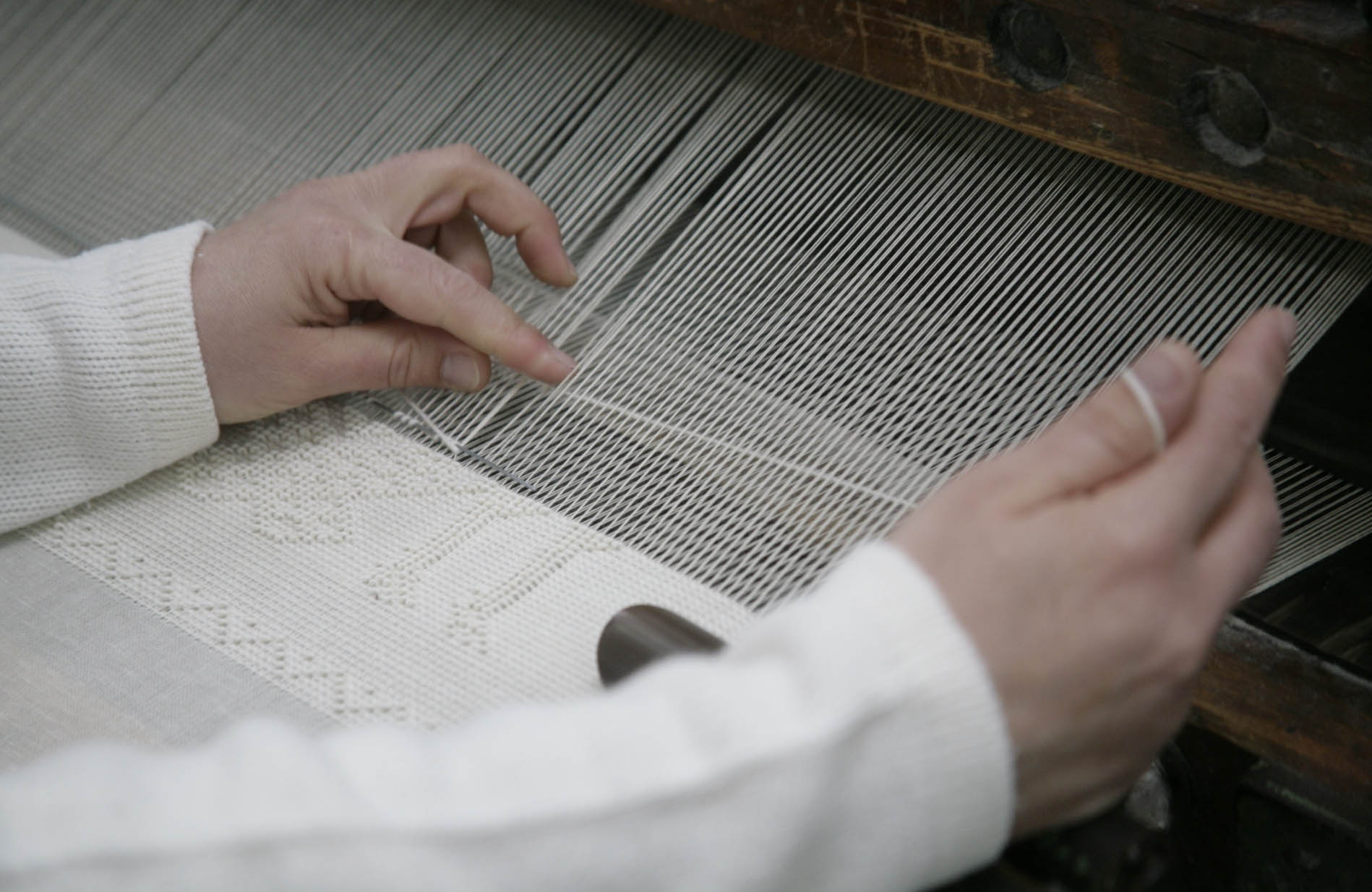
MURATS
The acronym stands for Museo Unico Regionale dell’Arte Tessile Sarda - being the Regional Museum of Sardinian Textile Art – and encompasses the value and vision of an institution that, since 2002, has been safeguarding, displaying and promoting the priceless heritage of the island’s manufacturing excellence. The MURATS is located in Samugheo, a village of Mandrolisai – a territory in the ‘heart’ of Sardinia divided between the provinces of Oristano and Nuoro - renowned to this day for its flourishing textile production. The geographic ‘isolation’ of the town meant that a prolific high-quality craft tradition endured, handed down from mother to daughter.
Created thanks to the discovery of artefacts once enclosed within the settlements of the houses in Samugheo and the rest of the island, the exhibition has been set-up throughout more than 750 square metres of a building in the outskirts. It is divided into three rooms, two being on the ground floor where the permanent collection is displayed, and one on the first floor dedicated to temporary exhibitions, which enhance the variety, value and even modernity of the textile art. The permanent collection consists in a body of artefacts in wool, cotton and linen, coming from various parts of the regional territory and created throughout a period of time spanning from the end of the 18th to the second half of the 20th century. The famous Cocco collection is also included. To be admired are blankets, bed sheets, children’s linens and items for everyday use, blanket chest covers, saddlebags, traditional clothing, shepherd’s garments, attire worn by the locals on a daily basis and for festivals, along with the tools used to make them, especially traditional wooden frames. Amongst the most particular items are the affaciadas, tiny finely-worked tapestries that are spread out along the balconies during the corpus domini. Of note due to their rarity and prestige are five 18th-century tapinos 'e mortu (of twelve found in Sardinia), being carpets on which bodies would be placed during funeral vigils. Discovered in various areas around Sardinia (especially in Orgosolo), they are characterised by bold hues (yellow and black) and by a complex symbology of zoomorphic and anthropomorphic figures that accompanied the deceased on their final journey, discovered in fabrics associated with burials in Anatolia, Peru and Christianised Egypt.
The museum creates a dynamic link between the community, the past, present and new trends. Through exhibitions and events, a cross-section of contemporary art is offered. Accompanying these are the organised workshops, seminars, laboratories, internships and traineeships. During the visit, there will be an educational journey consisting of a weaving trial. The event of the year hosted by MURATS (and Casa Serra in the old town) is Tessingiu, the exhibition of the most anticipated handicraft art in Sardinia, together with the Fiera dell’artigianato artistico di Mogoro that ‘weave’ the strands of know-how on crafts hailing from Sardinian locations that are distant from each other yet united by a common cultural ‘thread’.
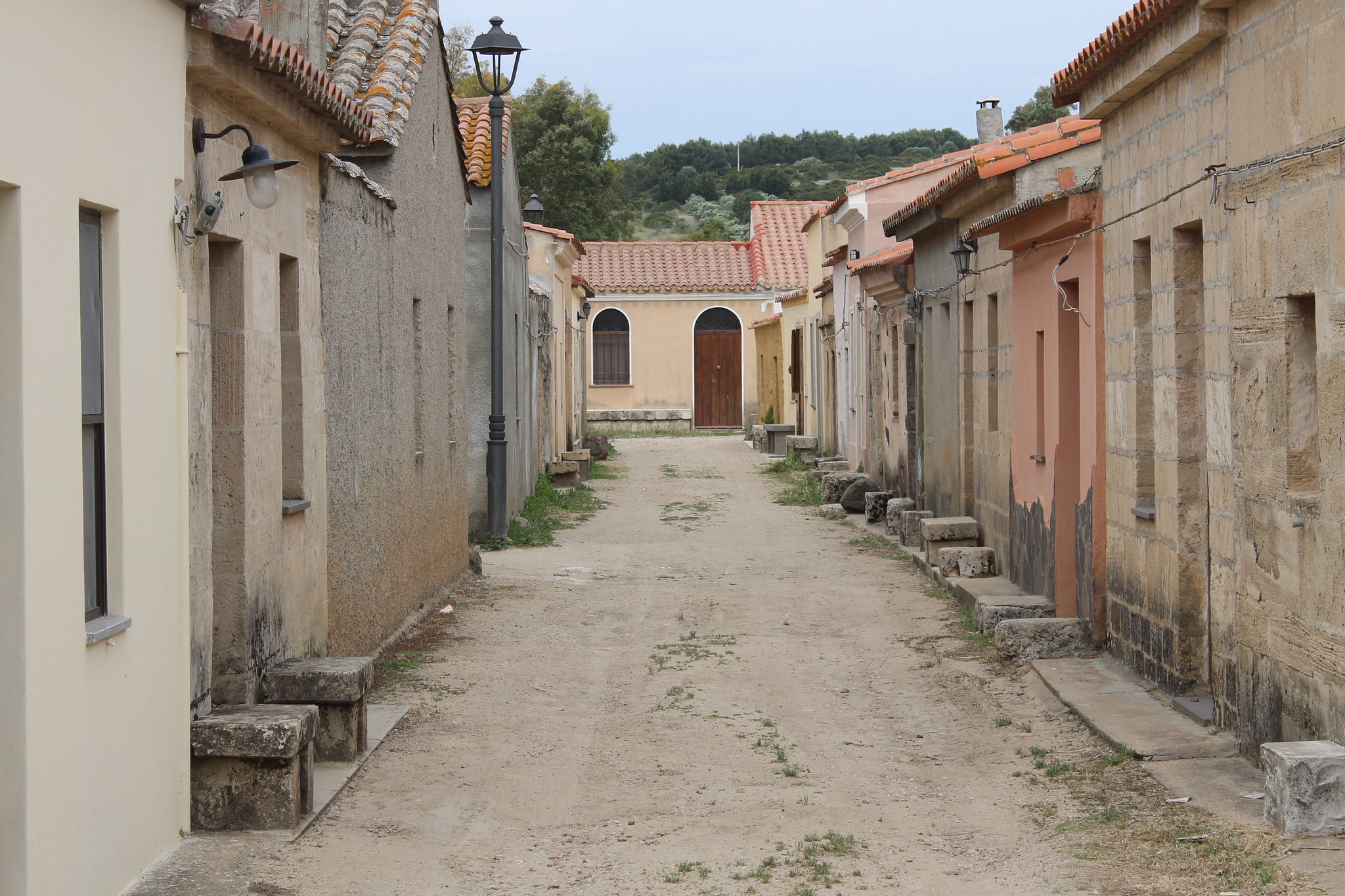
San Salvatore of Sinis
The Sardinian Far West consists in a village inhabited only a few days in September, during the Corsa degli Scalzi – a barefoot-running event. San Salvatore di Sinis, a fraction of Cabras, along a nine-kilometre stretch of road leading to the beautiful beach Is Arutas and the ancient city of Tharros, is a small village built in an area that has been sacred since the Nuragic age. It was transformed for over two decades (1967-1090), into a set for filming ‘Spaghetti Westerns’, due to the resemblance to the landscapes of the American frontier. It was thus used by film producers to become a village of Arizona or New Mexico (saloon included) in films such as ‘Garter Colt’ (1968).
A scenography in the 20th century, after having been a place of worship for thousands of years. The medieval village, whose current appearance dates back to the Spanish domain, owes its name to the Church of San Salvatore, constructed in the second half of the 17th century, built on a prehistoric sanctuary carved into the rock. Under the left aisle is a hypogeum that shows evidence of having been frequented as far back as the Neolithic period, with access via a small staircase. A series of rectangular and circular rooms (one with a well) leads to the main room with a spring source, having been used for the pagan worship of waters in the Nuragic age. Then, in the Punic era, the area was dedicated to the healer god of Sid, and in its wake, the Roman practice of the cult of Asclepius. The Romanisation of the ghost-village is completed by Domu ‘e Cubas, the ruins of baths from the imperial age with a polychrome mosaic floor, and traces of a granary (2nd century BC). From the 4th century, the hypogeum was transformed into an early Christian sanctuary in honour of the Saviour, as can be seen by two rooms with rough altars with a large Nuragic basin to the sides, reused as a holy water font. On the walls of all the rooms are Punic, Greek, Latin and Arabic inscriptions that possibly date back to attacks from Islamic marauders in the Middle Ages. Splendid early-Christian frescoes are to be admired along with graffiti and decorations that can be attributed to scenes of daily life from the Roman era and pagan cults.
The church is surrounded by sas cumbessias, small and unadorned houses built at the end of the 17th century and used as accommodation for pilgrims during the novena prayers in honour of San Salvatore, between August and September. In the twenty-year ‘cinematic period’ of the village, these were an integral part of the western scenography. The highlight of the celebrations commences at the dawn on the first Saturday of September with the Corsa degli Scalzi, one of the most evocative and heartfelt identitary events in Sardinia. The procession involves over 800 curridoris in white tunics, running barefoot along a long dirt road following the simulacrum of the saint from the Church of Santa Maria Assunta in Cabras to the township. The simulacrum is then returned to the parish church the following day.
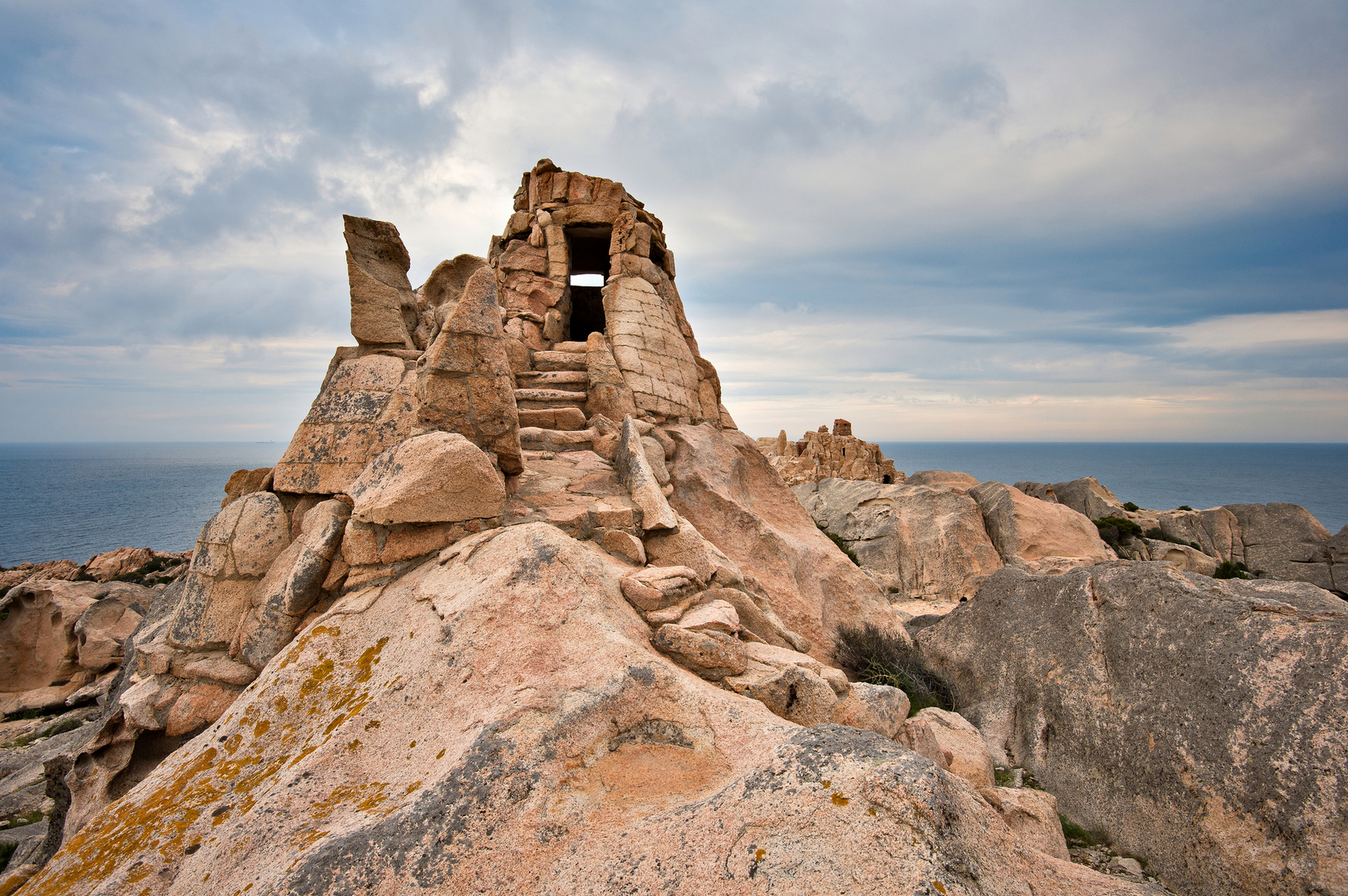
Military fortifications of the Maddalena Archipelago
The Maddalena Archipelago is a land off the border of Sardinia’s north-east, a strategic position that has marked its destiny over the centuries. Along the road that runs along the coastal perimeter of the Maddalena, the ‘older sister’ of a good 60 islands and islets, modern history can be retraced in a place that has been the scene - in Antiquity, as well throughout the last three centuries - of epic naval battles.
In the second half of the 18th century, with the advent of the Piedmontese who made it a support base for Sardinian Navy vessels, La Maddalena, Santo Stefano and other areas of the archipelago were ‘reinforced’ by fortifications - the square tower, the San Vittorio fort, also called the Old Guard, and other forts including the Sant’Andrea, Balbiano, Sant’Agostino and Santa Teresa (also called Sant’Elmo). All are visible from the sea, to discourage pirate attacks.
Commencing in the early part of the 19th century, the defensive system was implemented with the Carlo Felice fort or ‘Camicia’, to protect the Maddalena passage of the Moneta, and with the San Giorgio fort in Santo Stefano. The structures were replaced over time. More recent are other sighting posts and fortifications arising from the late 19th century through to the world wars. More powerful batteries were constructed, occupying positions facing the sea, such as that of Nido d’Aquila and Punta Tegge in the south-western area, Punta Rossa in Caprera, and on the mainland in Punta Sardegna (Palau) and in Capo Tre Monti (Arzachena). Of strategic importance are also other Maddalena forts on high ground, such as Guardia Vecchia and Trinita, which dominates the splendid beach of the same name.
The archipelago, now a national park, hides evocative traces of battles and camouflaged amongst the rocks are anti-aircraft posts. Starting from the splendid Spalmatore cove and in another vast array of strategic locations: Carlotto, Zavagli, Zanotto, Pietrajaccio, Candeo, Cervo Mass, Poggio Baccà, Isola del Porco, Teialone and Punta dello Zucchero. All of these sites can be visited today thanks to the park guides.
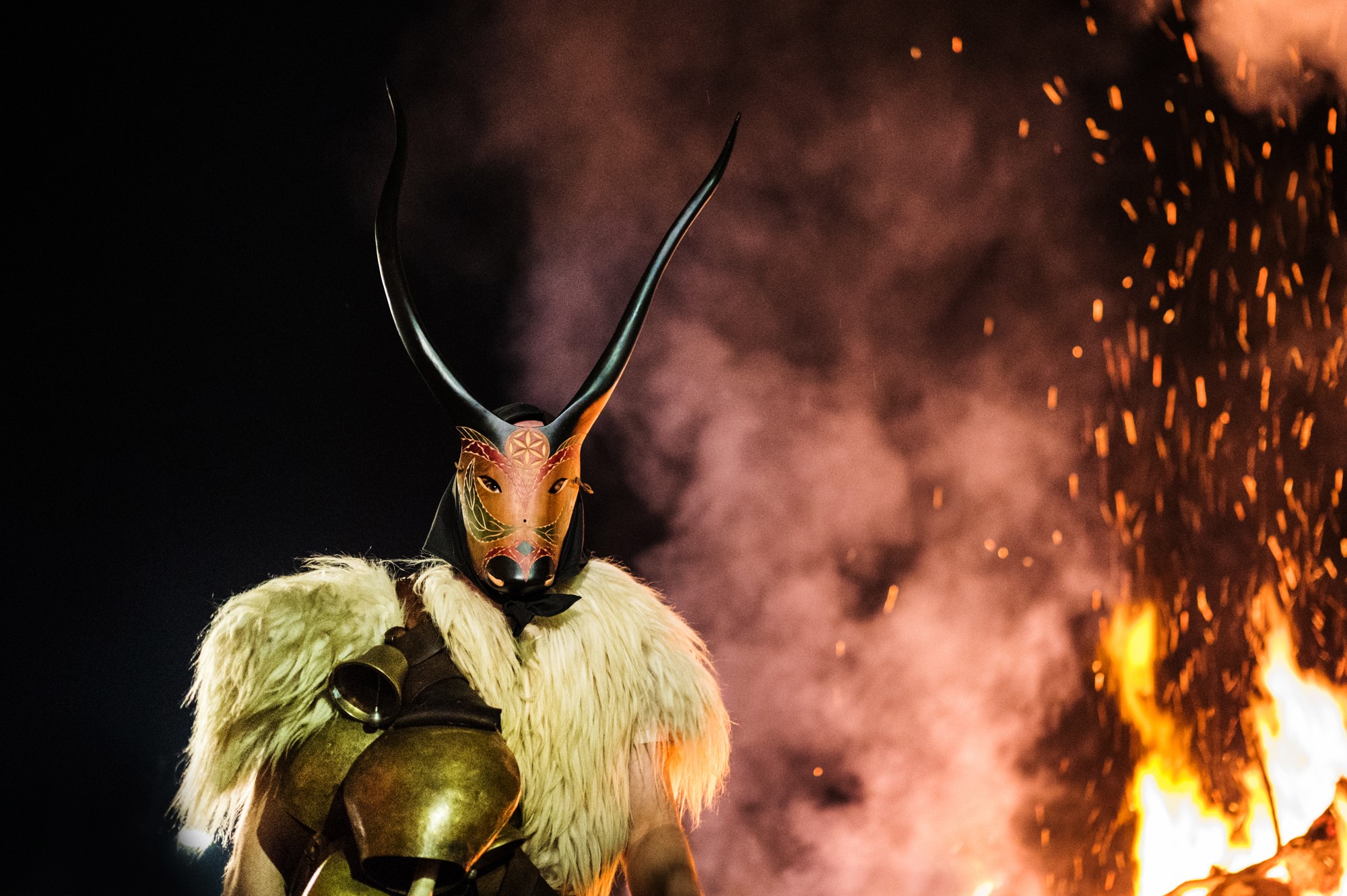
The mysterious beauty of Carnival in Sardinia
With the lighting of the spectacular bonfires in honour of Sant’Antonio Abate, an ancient, solemn rite performed in many of the island’s towns, Sardinia reawakens its spirit and enthusiasm during Carnival. Su Karrasecare has many different sides to it and each community celebrates it with its own traditions, vocations and spirit. January 17 marks the beginning when the bonfires of Sant’Antonio are lit, and Ash Wednesday marks the end, with the beautiful, heartfelt celebrations in Ovodda. They are the first events of the year to enliven winter with ages-old rituals. Sacred and profane, passion and identity, exciting rhythms and magnificent settings like the one at Gavoi, where the tumbarinos (drummers) play. In every town, from the North to the South, you can enjoy typical carnival delicacies like fava beans and lard, pistiddu and coccone, zeppole (doughnuts) and fine wine.
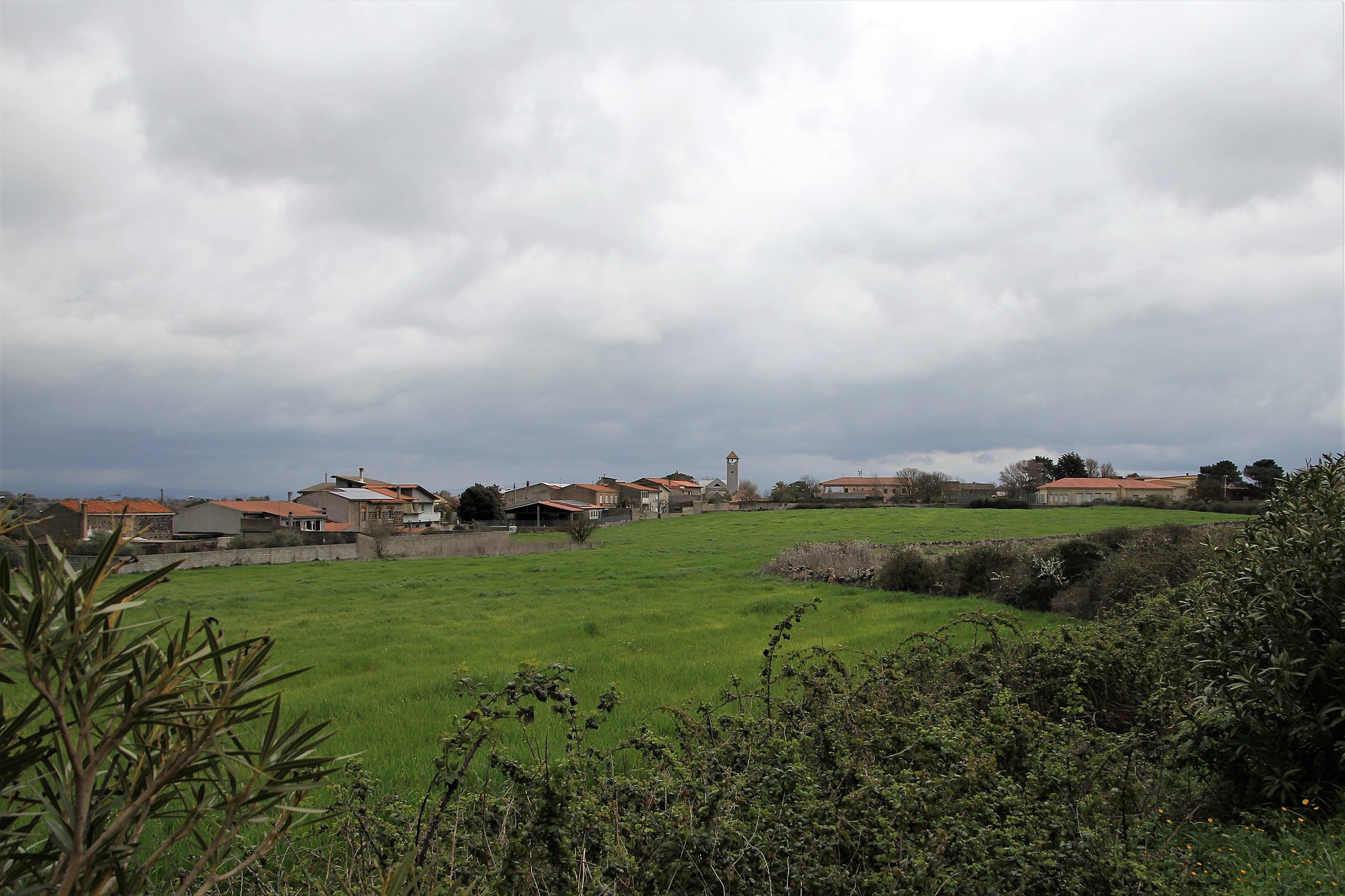
Noragugume
Perching 300 metres above sea level on undulating hills, it prevails over the Ottana plain between Lago Omodeo and the Marghine range, dominated by the imposing Gennargentu massif. The Villa di Noragugume has just over 300 inhabitants, dedicated mainly to livestock, forming part of any authentic village in Italy. The name derives from a Nuraghe structure shaped like a cauldron that stood near the centre. The origins of the village are prehistoric, whilst the current town, well-structured and decorated with murals, dates back to the 15th century with the Chiesa di Santa Croce at its heart, consecrated in 1593. In addition to the modern parish of San Giacomo – the patron saint celebrated in late July – two other churches are of considerable importance. On the outskirts is the ancient country church of San Michele and in the central piazza, that of the Beata Vergine d’Itria, with a Gothic-Catalan layout (1623). The feast of Madonna d’Itria on Pentecost Tuesday is the most heartfelt in the town, accompanied by an ardia, a galloping race around the sanctuary, perhaps dating back to when the town was divided into districts and the knights who represented each one would try to conquer the standard of the Virgin. San Giovanni is at the end of June, whilst at the end of October there is s’Izzadorzu, celebrations accompanied by folklore events, poetic competitions in the Logudorese dialect and tastings of recipes from the pastoral tradition. Stewed and roast lamb are the protagonists, paired with potatoes, peas and wild fennel. The entrails of lamb or goat are prepared in dishes called cordula and trattalia. There is a wide variety of bread, from the types enjoyed on a daily basis such as su bistoccu, to those more elaborated prepared for special occasions. Each festival is accompanied by specific desserts: frisciolas, pasta violada and culinzones de mendula for carnival, casadinas with cheese and tiliccas (sapa liqueur, almonds and honey) at Easter, pabassinos (almonds, walnuts and raisins) and santos de tuccaru for All Saints.
The territory of Noragugume has been populated since Neolithic times, as is shown by the Domus de Janas of Taleri and Iscannitzu and the menhir Sa Pedra ’e Taleri, of the proto-anthropomorphic type, dating back to 3300-2500 BC, which arises isolated and imposing (four and a half metres high) in a flat area. Indeed, there are numerous Nuraghe structures, including the Irididdo with a central tower and two lateral ones, the Muresune and Litzera. The most famous is the Tolinu nuraghe, in a dominant position on a plateau two kilometres from the town. The structure, dating back to the Middle Bronze Age and remodelled in successive periods, was used through to the historical age, being complex with a well-preserved bastion and central tower. Around this, the residential settlement can be seen.
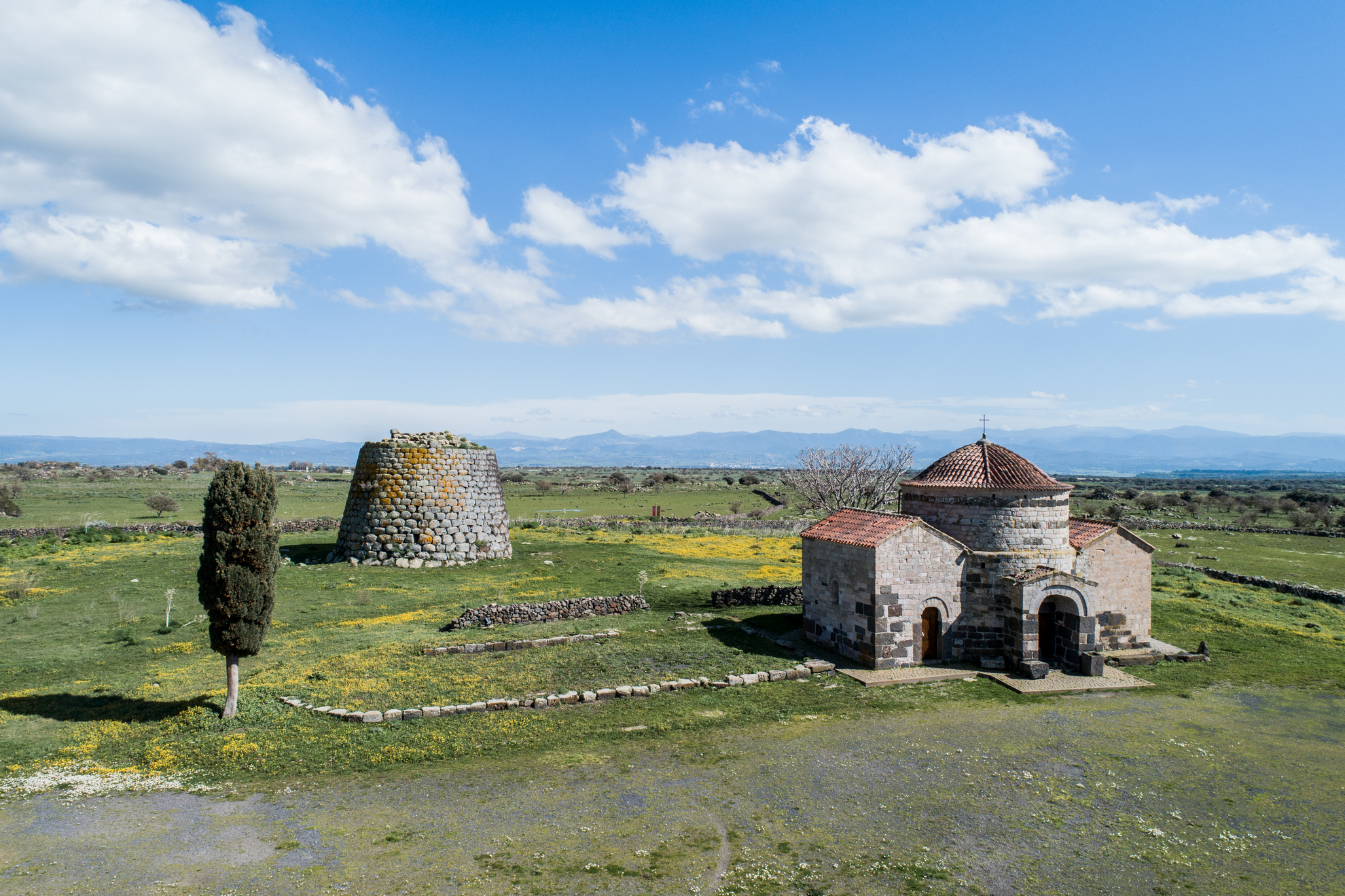
Silanus
The town is perched at almost 500 metres above sea level in the middle of the Marghine mountain range, a fertile region blessed with fields of grain, olive groves and orchards. Some 2,000 people live there and it boasts the world record for longevity – there were seven inhabitants aged over 100 at the turn of this century! Silanus is a member of Italy’s Most Authentic Towns thanks to the nature, traditions and historical monuments. The economy is based on farming and herding, on the lovely rugs they make and on it baked goods, which you can try during the bread and traditional baked goods fair that takes place in May and June. They also make a wide assortment of cheeses: pecorino, ricotta and casizzolu. In the first half of May they hold the su ischidu festival in celebration of the traditional recipes and to award prizes to the best dairy product. The event is held at the Santa Sabina complex, which includes a single tower nuraghe encircled by a village (1600-1000 BC), the Pedra Pinta Giant Tomb, a sacred well with a domed cover and the church of Santa Sabina, built in the XI century over the remains of an earlier Byzantine building that is still today a destination for pilgrims. It is one the most important examples of medieval architecture in Sardinia and documents the continued sacredness of the place. A famous novena is celebrated there in late September, featuring gosos (liturgical chanting), not dissimilar to another novena that takes place earlier in the month at San Bartolomeo (santu Portolu). The church of San Lorenzo was built in 1150 in what was then Sjlano (now the outskirts of town), as part of a Benedictine abbey. The interior is graced with XIV century frescoes. San Lorenzo is celebrated in early August with a hooded procession and bearing of the bandelas (standards), shows and a poetry competition. Behind the church you’ll see some of the betili (relics) found in the sa Pedra Longa Giant tomb and the majestic (and well-preserved) Corbos nuraghe. Other worthwhile Nuragic legacies include the Madrone and s’Ulivera nuraghe, and the Pedras Doladas, Zanchia and Murartu tombs. There is a lime quarry next to San Lorenzo that remains an important local resource. An ancient Roman city may have once flourished here. The Gothic-Catalan church of sa Maddalena, who is celebrated late July, was built in 1582. There are also two remarkable churches from the XVII century: Nostra Signora d’Itria – home to a multi-coloured wooden statue of the Virgin (XVI century) and of various saints - and the Santa Croce. The parish is dedicated to Sant’Antonio Abate, who is celebrated mid-January with bonfires, processions and plenty of food. The event marks the start of the wonderful carnival celebrations in the area, on par with Holy Week. The church also hosts a polyphonic singing event at Christmas. Every two years is the Tenores singing event, a week of popular culture featuring traditional choirs from all over Sardinia. The Funtana Elighe journalism award is also worth a mention, as is the Nois event, which will let you explore the town by way of photography exhibits.
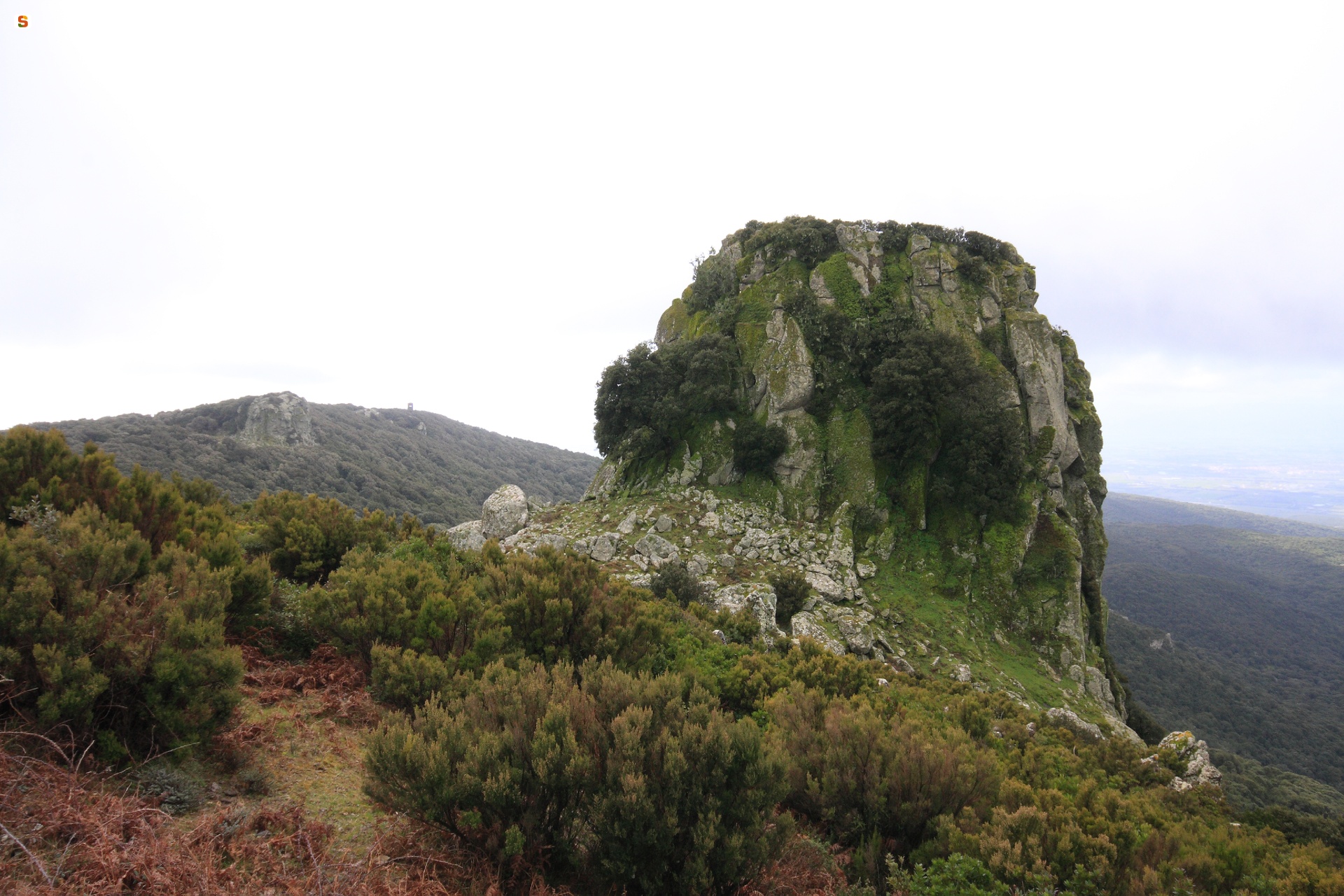
Morgongiori
Morgongiori lies on the southern slope of the Monte Arci park, a naturalistic ‘jewel’ that falls partially within its territory. The town of Morgongiori is in the upper Marmilla region and has approximately 800 inhabitants. It is surrounded by hills covered with oaks and holm oaks, crossed by a myriad of streams and surrounded by harsh rocky cliffs shaped by time, including the Conca Mraxi (‘head of the warrior’). It is the ‘city of stones’, with houses in trachyte and basalt, adorned with arched portals, whilst courtyards and loggias characterise the historic centre. All is gathered around the parish church of Santa Maria Maddalena (1673). The church houses a documentary archive of the village. Along the Arci pathways is the Church of Santa Sofia. In the surrounds arose a medieval village that was abandoned due to Saracen raids. Santa Suia is celebrated in mid-October, whilst the farmers’ festival is held in mid-May. For the procession, horses and oxen are decorated with gutturadas, being fabric collars. Morgongiori is known for its textile craftsmanship. On ancient horizontal looms, a wealth of carpets, tapestries and saddlebags has been preserved in the Museo Vivente dell’Arte Tessile (MUVAT - the living museum of textile art), where women from the village give live demonstrations. In August, there is a tapestry and carpet exhibition. The exclusive local gastronomic specialty is lorighittas, a fresh pasta in the shape of a ring (loriga), to which an eagerly-awaited festival is dedicated at the beginning of August.
At the peak of Monte Arci is sa Trebina Longa (at 812 metres), one of the necks (volcanic fossil ducts) that stand out on top of the enchanting massif. Walking along the park’s pathways (or riding along them on mountain bikes), the is Benas pinewood, springs, waterfalls, caves and rock faces suitable for clean climbing can be admired. It is an oasis populated by wild horses, weasels and martens, with buzzards and hawks flying overhead. Green is alternated with the colours of basalt, trachyte and obsidian, the ‘black gold’ of the island’s prehistory, a mineral processed and marketed throughout the Mediterranean. In the village, there is the environmental documentation centre, which illustrates the geological and cultural riches of the park. The fecundity of the land has always favoured agricultural activity and, together with the presence of obsidian, has attracted people here since prehistoric times, as tens of archaeological sites can demonstrate. To be admired in Prabanta is the menhir su Furconi and two Domus de Janas, sa Sala and su Forru, Neolithic monuments (3200-2800 BC) linked to Luxia Arrabiosa, a character in the popular imagination. On the way to is Benas, in addition to Roman tombs, one can spy s’Omu ‘e s’Orcu, one of the most well-known Nuraghe of the area together with Trunku de is Pillonis, which is associated with a Tomb of Giants. Near the village, there is sa Domu ‘e is Caombus, a vast cleft in the rock from which a basalt staircase commences, immersed in darkness - perhaps once leading to a hypogeic Nuragic temple.

Nuraminis
It extends on a plain dotted with moderate, isolated limestone hills inhabited since prehistoric times. Nuraminis is a town of 2600 inhabitants in southern Sardinia with a tradition of cereal farming, which is reaffirmed by Cereal Festivals in mid-June and by hand sowing in December. Its territory is characterised by rare geological features, destinations for climbing enthusiasts, which can be reached via mountain bike or horse trails. The most notable of these are the lava domes of Mount Leonaxi, the fossils of Genna Siustas and Mount Murroni and the limestone cuesta of Coa Marfine, known as the limestones of Villa Greca. A natural monument that stands out from the surrounding landscape is a kilometre-long rocky ridge, the remains of an ancient coral reef. These geological features also contain archaeological sites. From the top of Matta Murroni, you can admire megalithic walls and by cuesta peak, the ruins of Sa Corona, a proto-nuraghe dating to 3000 BC, a unique example of prehistoric architecture. At the foot of Leonaxi, there is a multi-layered site (‘courtyard’ nuraghe or fortified complex), with walls constructed using a series of different techniques. Santa Maria is another such ‘multi-layered’ site. Inhabited from 3000 BC to the Early Middle Ages, it consists of the ruins of a village, a burial ground, a holy well and a church. In Genna Siutas, stands Funtana ‘e Siutas composed of four large slabs with a hole for drawing water, and a staircase for accessing the pool. Just 500 metres away, there is the Serra Cannigas complex. A corridor nuraghe associated with a tholos and a fortified structure that takes advantage of the rockface on which it is set to form an artificial terrace. On the eastern slope, traces of sheds can be seen. Artefacts found here show that the area has been inhabited for thousands of years. Small vases, fusaroles and copper ornaments now on display at the National Archaeological Museum in Cagliari were found inside two shaft tombs located in the same hill. On another hill there is a Nuragic complex called Nuraxi and an adjacent village. Sa Grutta is a Neolithic site. It is a large cave that opens onto smaller chambers resembling a Domus de Janas.
The Parish of San Pietro Apostolo has great architectural value. It was built in the Catalan Gothic style that was later altered, with the bell tower (thirty metres high) and the starred vaulted ceiling in the apse remaining unaltered. The niches and Byzantine age marble fragments have historical interest. The chancel and the lateral chapels hold wooden and marble altars, statues and paintings, including an altarpiece depicting the Mysteries of the Rosary (17th century). The Church of San Vito Martire, in Villagreca, is just as charming. Built in the 9th century, it is a rare example of Byzantine architecture on the island. It was reconstructed in the 18th century in the Catalan style. It houses the 16th century “sorrowful crucifix” from Flanders and two 18th century altars, one wooden and one marble. In the countryside, there is a small Romanesque Church of San Lussorio Martire that may have been built in the 12th century by Vittorini monks.