

Nostra Signora d'Itria - Orani
The Church of Byzantium ‘evangelised’ Sardinia for six centuries, leaving a profound mark. Today, the veneration of saints typical of Greek Orthodox tradition still remains. In Orani, in the Nuoro area, you will find significant traces of it: Santu Nicolau, name of a place in the countryside, the rural sanctuary of Sant’Elias, where the people of OranI flock to today, like in Antiquity, with processions of horsemen in festive dress and the banner of the saint and, above all, there is the church of the Madonna d'Itria.
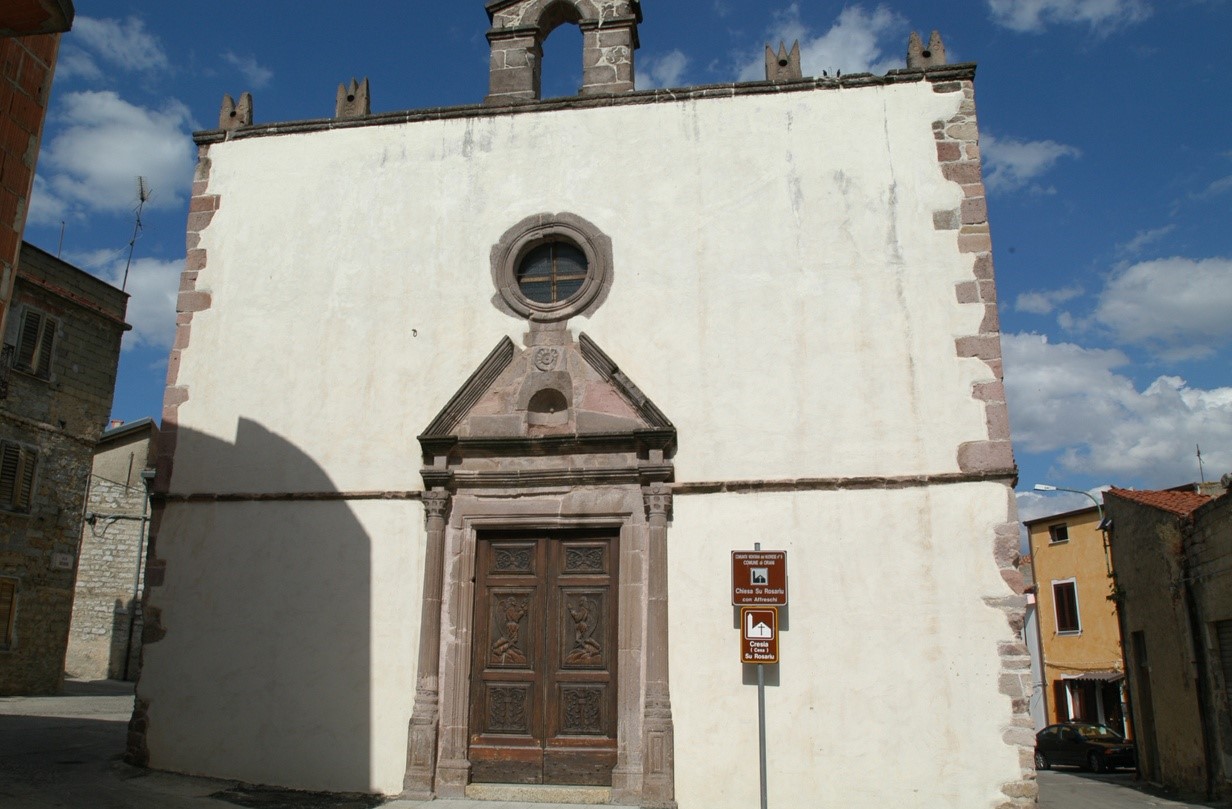
Built in the 17th century, it gives its name to one of the town’s districts and was part of a system of places of worship positioned as a border between the town and the countryside. The architecture is inspired by Gothic-Catalan motifs: the single nave has pointed arches made of trachyte. You will be captivated by the cross vault, which is frescoed with scenes of angel musicians. Also remarkable is the central niche of the altar, where you can see the wooden statue of the Virgin of Itria with the Child in her arms and wearing damask robes.
However, the element that makes Sa Itria truly original is the façade: you can admire an engraving by Costantino Nivola (1958), depicting the Battle of Lepanto in 1571, in which Catholics and Muslims fought against each other. It is commemorated as the victory of Christianity over the infidels. The great Sardinian artist portrayed two human figures that, based on the symbols engraved, symbolise religious belonging. Nivola’s work is complemented by the colour blue: a stripe at the bottom that brings to mind the sea during the naval battle and one at the top, virtually uniting it with the sky that protected the Christian fleet. The work is so well-integrated with the architecture that it is difficult to think of the façade without the engraving.
The veneration of the Madonna of Sa Itria is widespread throughout Sardinia and culminates in Orani on the last Sunday of August with religious functions and a pagan festival. The same devotion is also felt in Gavoi (at the end of July): novenas with the worshippers staying in the sanctuary’s cumbessias, lunches based on roasts, libations, chants and equestrian jousts. The palio de Sa Itria is one of the most exciting and famous on the Island.
Orani
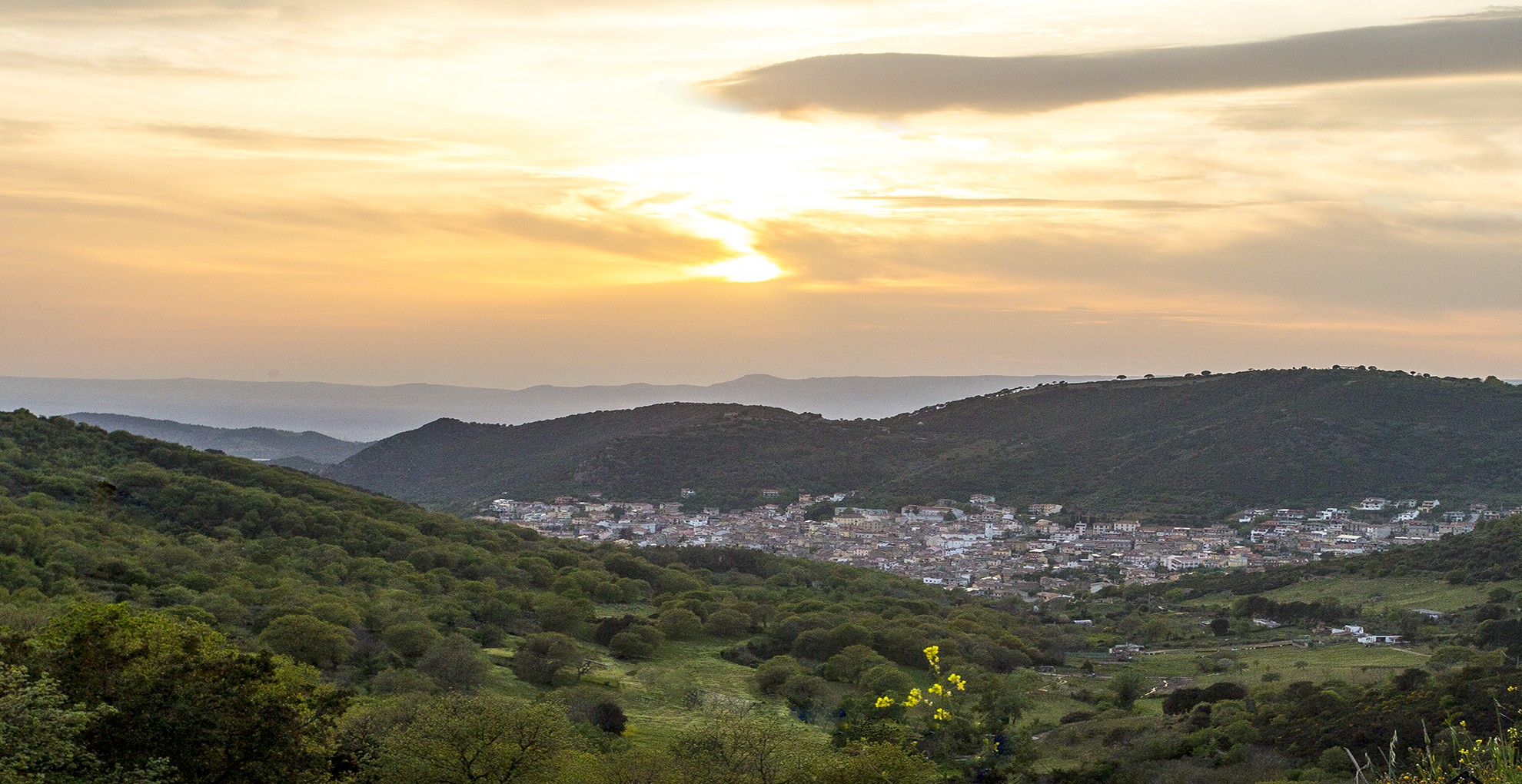
It stands at 500 metres of altitude in the heart of the Barbagia region and is surrounded by green hills. Orani, a municipality with almost three thousand inhabitants, is the birthplace of 20th century internationally famous artists, like Nivola and Delitala, and contemporaries, like the writer Salvatore Niffoi and the fashion designer Paolo Modolo. The Nivola Museum, located on a spectacular hill, is dedicated to Costantino Nivola, one of the all-time greatest Sardinian artists: since 1995, the museum has had 200 sculptures and paintings inside it. The Delitala Collection, in honour of the painter Mario Delitala, has been set up in the Franciscan convent: portraits, sacred representations and scenes of life in Barbagia. Artisan crafts are an artistic expression in Orani: wooden chests, granite and iron artefacts, gold jewellery, rugs and blankets, clothes made of velvet and orbace (coarse woollen fabric) and leather cambales and cusinzos. The Su Bundhu mask, a symbol of the village, is made of cork and, along with Su Maimone, is a protagonist during the carnival. The tradition of homemade pastries and breads like carasau is renowned. In October, you can taste the local delicacies during a stage of Autumn in Barbagia that takes place here. Among the churches, visit the parish church of Sant'Andrea Apostolo, a neoclassical building in which there are works, like the altarpiece made by Delitala, Nostra Signora d’Itria, and has an engraving by Nivola (1959) on its façade. There is also the Franciscan church of San Giovanni Battista and that of the Rosario (17th century), enriched by frescoes dating back to the middle of the eighteenth century. The most distinctive sanctuary is located in a forest on Mount Gonare, at an altitude of one thousand metres: it is Nostra Signora di Gonare (early 17th century), the 'highest' church on the Island, praised by Nobel prize-winner Grazia Deledda in 'Le Vie del Male' (The Ways of Evil) and a destination for pilgrimages. The festivities in its honour are: on 25 March, at the end of May and at the beginning of September, organized alternately with the Municipality of Sarule, with which it shares the church walls. The Gonare is a massif with steep rock faces, covered in woods where you can go on long excursions, with the charm of centuries of religious devotion.
Domus de Janas, isolated and in small groups, confirm the presence of humans from the Late Neolithic period. An exceptional case is the necropolis of Sas Concas with 15 Domus dug out of the cliff. Also worthy of note are Sas Fossas and Badde Roma, with eight and five hypogea. Dating back to the end of the Neolithic age, there are two Dolmens and six Menhirs, four of which are six metres tall. About thirty Nuragic settlements date back to the Bronze Age: some are 'corridor' types, about twenty with a tholos, including the Athethu, and some are complex. The most impressive is the Nuraghe Nurdole: a central tower stands 700 metres high, enclosed by a bastion with four towers. Completing the evidence from the Nuragic age are the Tombs of Giants of Istelenneru and sacred fonts, one of which is near Nurdole.
Museum-Park S'Abba Frisca
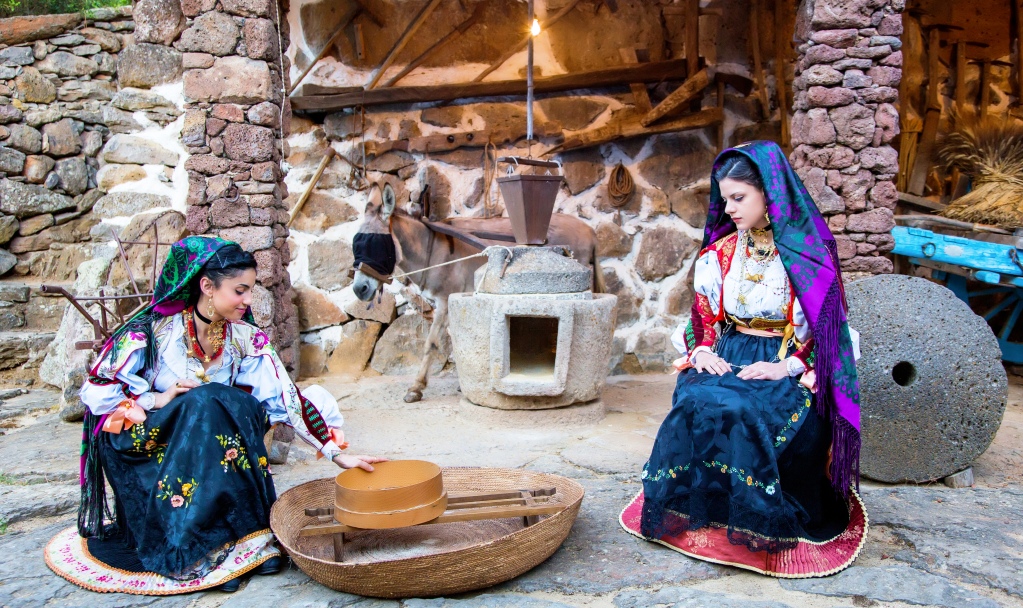
The traditions, know-how, flavours, sounds and fragrances of the Barbagia culture set in a splendid landscape. A combination of nature and ethnography will accompany you on a guided tour - lasting about an hour - inside the s’Abba Frisca museum park, nestled in the Littu valley, a captivating corner of the Dorgali territory, the most extensive in the Nuoro area (226 square kilometres). Surrounded by a dense forest and dominated by the limestone bastions of the Ruiu and Irveri mountains, the northern offshoots of the Supramonte mountain range, the park is four kilometres from the town centre. The same distance separates it from Cala Cartoe and from the village of Cala Gonone, a paradise for outdoor activities - trekking, biking, climbing, kayaking and diving -, with a tourist port where mini-cruises set off for the Grotte del Bue Marino (Sea Oxen Caves), the enchanting Cala Fuili and Cala Luna, as well as the other splendid coves in the southern part of the Gulf of Orosei.
The park-museum itinerary emerged from the redevelopment and enhancement of an old farm and it unwinds for 400 metres between megalithic walkways, centuries-old trees, hedges of Mediterranean scrub and officinal or dyeing plants. The dominant element is water: the spring of S’Abba Frisca not only gives the park its name, but it also supplies fountains, waterfalls, spouts and a small lake, populated by mallards, ducks, moorhens and turtles. Once past the majestic stone entrance, you will be welcomed by holm oaks, junipers, carobs, laurels, viburnums, tamarisks and Mediterranean species. Metaphorically representing the balance between man and nature, the botanical aspects, displayed in 15 spaces, are intertwined with around 5000 objects from the rural and agro-pastoral civilisation, which recreate a snapshot of life in Sardinia between the 17th and early 20th centuries.
Thousand-year-old knowledge comes to life again in the milling of wheat, the processing of Carasau bread and cheese, the shoeing of horses, the forging of iron, spinning and weaving - which you can see on pre-arranged days. You can observe traditional workplaces and homes, starting from the cuile, a centuries-old shepherd’s hut, made of basalt blocks and a cone-shaped wooden roof, a reminder of the Nuragic age, with a hearth in the centre and tools for cheese production. In the farmer’s courtyard, next to the cart and plough, there is the stone donkey-driven grain grindstone. Not far away is the blacksmith’s corner with a smelting furnace, a forge and a machine for shoeing oxen. In s’orriu, the storeroom, you will see a small wooden hoist used for making cheese and cork silos for storing grains. The environment is completed by branding irons, measuring utensils, saddles and harnesses for beasts of burden, particularly for the equine breeds that enliven the park: Sardinian donkeys and White Asinara donkeys, Anglo-Arab horses and hinnies, a rare cross between a horse and a donkey, which you can admire inside the animal enclosure.
The next stop is a two-bedroom space, complete with linens and furnishings from the past, including eighteenth-century chests. Then comes the spinning and weaving room with ancient looms, fabrics, traditional clothes, a carriage, nineteenth-century weapons, filigree jewellery and musical instruments. Then there are wine presses used for making Cannonau wine and an oil mill and olive press for making olive oil, excellent products of Dorgali, along with pecorino cheese and traditional sweet products. Also not to be missed is the corner, where medicines were made from officinal plants, and the old well, above which there is an animal-powered noria, the only one still functioning on the Island. The last stop is sa coghina (the kitchen) with an oven for making Carasau bread. Towards the exit you will see a series of stone troughs, made by the stonemasons of the past. An avenue with dwarf palms, myrtles, strawberry trees, mastics, wild olive trees, oleanders and cypresses closes the itinerary. Along with all this, there are also educational workshops and demonstrations by artisans.
The park is one of the ‘pearls’ of the Dorgali area, which is dotted with natural attractions like the park of Palmasera and the cave of Ispinigoli, as well as archaeological sites like the Nuraghic villages of Serra Orrios and Tiscali, a trekking destination halfway between the territories of Dorgali and Oliena, the Giants’ Tomb of s’Ena ‘e Thomes and the nuraghe Mannu.
Fonni
“A fabulous horizon surrounds the village, the high mountains of Gennargentu, with luminous peaks that shine like silver, dominate the great valleys in the Barbagia, that rise, immense grey and green shells up to the crests where Fonni, with its flint houses and pebble alleys stand up to wind and lightning.” That is how the Nobel Prize author Grazia Deledda describes that what is now the largest town in the Barbagia di Ollolai (4,000 inhabitants) in her book Ashes (1903). The town sits at a thousand metres and is also a celebrated ski resort, thanks to the ski lifts that rise to the summits of Spada and Bruncu Spina (in excess of 1800 m). The snow falls thick in winter, the peaks turn white, while other seasons are graced with enchanting colours: peonies, gentian, rosehip and purple that surround the forest. It’s an area perfect for long hikes through woods and over brooks in nature reserves where rare species can be spotted along the trail. It is home to the Fonni Shepherd a breed of dog that specialises in protecting land and herds.
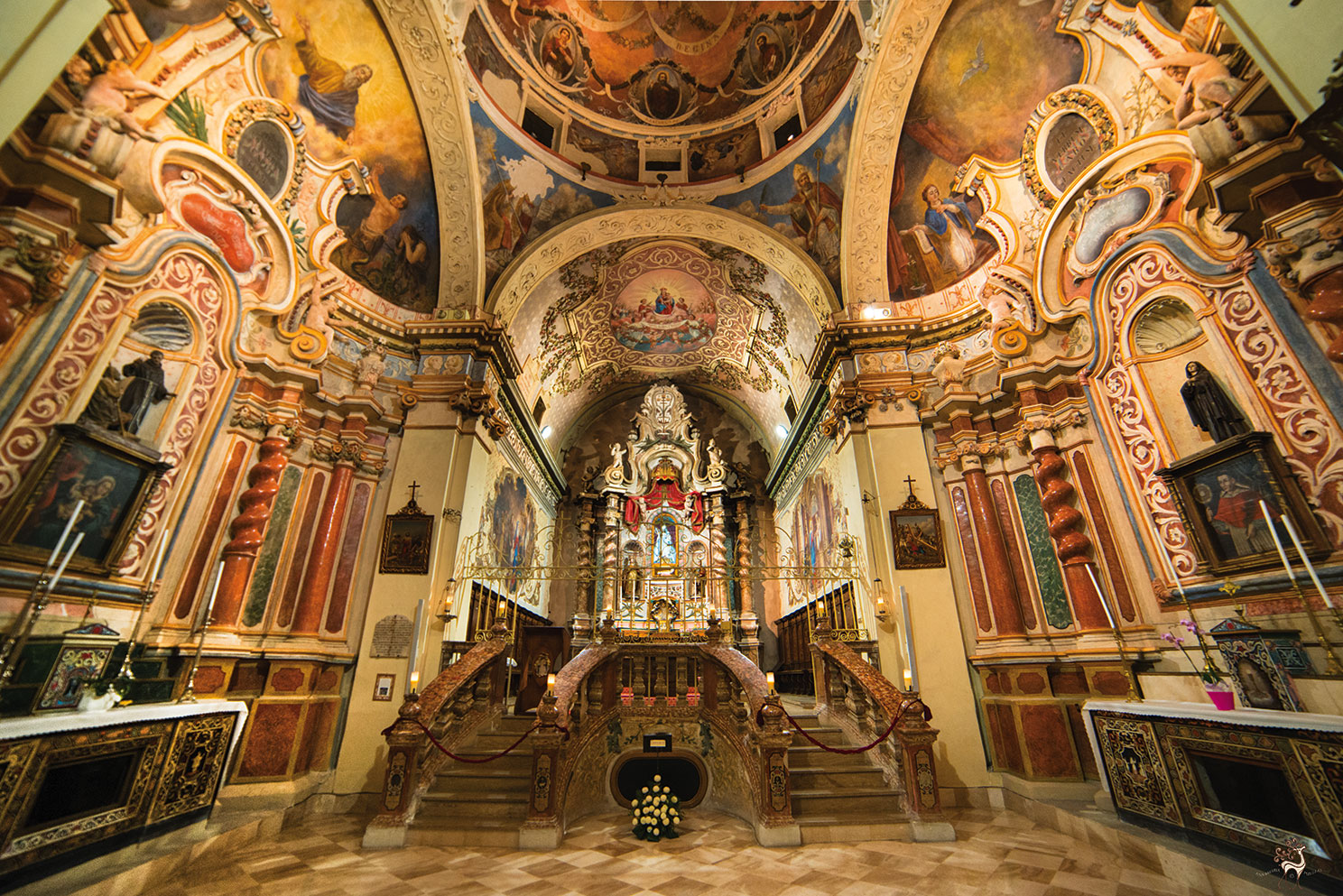
In the historic districts of town you’ll find mountain houses covered in scandulas, old wooden tiles, and admire the picturesque murals. During the Autumn in Barbagia festival make sure you visit the loggias and cantinas open to the public for the occasion. In the centre of town are the late-Gothic church of San Giovanni Battista, the basilica of the Vergine dei Martiri, surrounded by cumbessias and flanked by a Franciscan convent (1610) and the oratory of St, Michele (1760). It is enriched with frescoes, silver reliquaries and an underground sanctuary. Next door is the Museum of Pastoral Culture, set up in an 1800s residence. Here you can get an idea of what life was like in the country. Other churches in this devout and traditional town include del Rosario, Santa Croce and the Sanctuary of the Madonna del Monte. You will appreciate the delicious sweets produced here (called savoiardi), you will enjoy the Fonni Palio in early August and the Fonni Carnival festivities, featuring Urthos and Buttudos masks. The area’s archaeological gem is just outside of town, as you head to Pratobello, a Nuragic Age complex known as Gremanu. Set in a thick oak woods, it is the island’s only Nuragic aqueduct, associated with the Madau necropolis, made up of four Giant tombs with a shape resembling a bull’s head and horns. The settlement dates to between the XV and IX century BC and, further down towards the valley, has three temples (a large circular one, a megaron and a semicircular one) built with alternating basalt, limestone and trachyte to create pleasant chromatic effects. There are sacred enclosures, some one hundred huts and, further up, an articulated system to use the water from the springs for both sacred rites and daily use.

San Nicola - Ottana
The alternation of austere black-purple basalt of the walls and of dynamic pink trachyte in the arches and columns forms a unique two-tone that renders it mysterious and fascinating. From its vantage point atop a knoll in an isolated yet prominent position, the church of San Nicola stands above the village of Ottana, in the heart of the island. It was constructed in the Pisan-Romanesque style on the site of a pre-existing early medieval building, as was confirmed by burials discovered during excavations. The date of consecration (1160) is ‘branded’ on a parchment found during the restoration of the main altar. The imposing building was the cathedral of the Ottana diocese from 1112 until 1503, when the site was suppressed and transferred to Alghero. In much of the interim, between the institution of the diocese and the completion of the works, the nearby San Giovanni di Orotelli took on the role of cathedral.
The complex, 28 metres in length and nearly half that in width and height (15 metres), shows an impressive architectural unity, despite having undergone two phases of construction. The apse, transept and northern flank all belong to the initial phase. Subsequently, another master created a façade and a southern flank with perfect Pisan decorative styles, with the junction points of the two works being quite clear. A staircase precedes the gabled façade, high and narrow, unfurling over three orders with pilasters that form three large arches in the first two orders and a false loggia in the third. At the centre of the lower order, there is an architraved portal surmounted by a round arch comprised of polychrome wedges and a pink stone bezel. In the median order, a mullioned window illuminates the space within. The gables and hanging arches articulate the entire external coverage of the temple: the southern side takes on the style of the façade, the bi-chromatic nature standing out, with the alternation of trachyte in different colours. In total, there are 27 small arches that decorate the San Nicola perimeter.
The interior with a crux commissa, built in dark trachyte, is striking due to its simplicity and severity, accentuated by the height of the walls enclosed by wooden trusses. The arms of the transept and presbytery are barrel-vaulted, with a large semi-circular apse filling the eastern end of the nave. At the head of the transept are two single windows, whilst a Greek cross is in the middle of the apse.
The church houses a 16th-century wooden crucifix and, most importantly, a 14th-century Polyptych, the Pala di Ottana attributed to the master of Franciscan tempera (active in Naples between 1330 and 1345). Scenes from the life of Saints Francis and Nicholas are depicted, with two historical figures represented - the bishop of Ottana Silvestro and the heir to the Giudice throne, the future Mariano IV of Arborea.
Montes
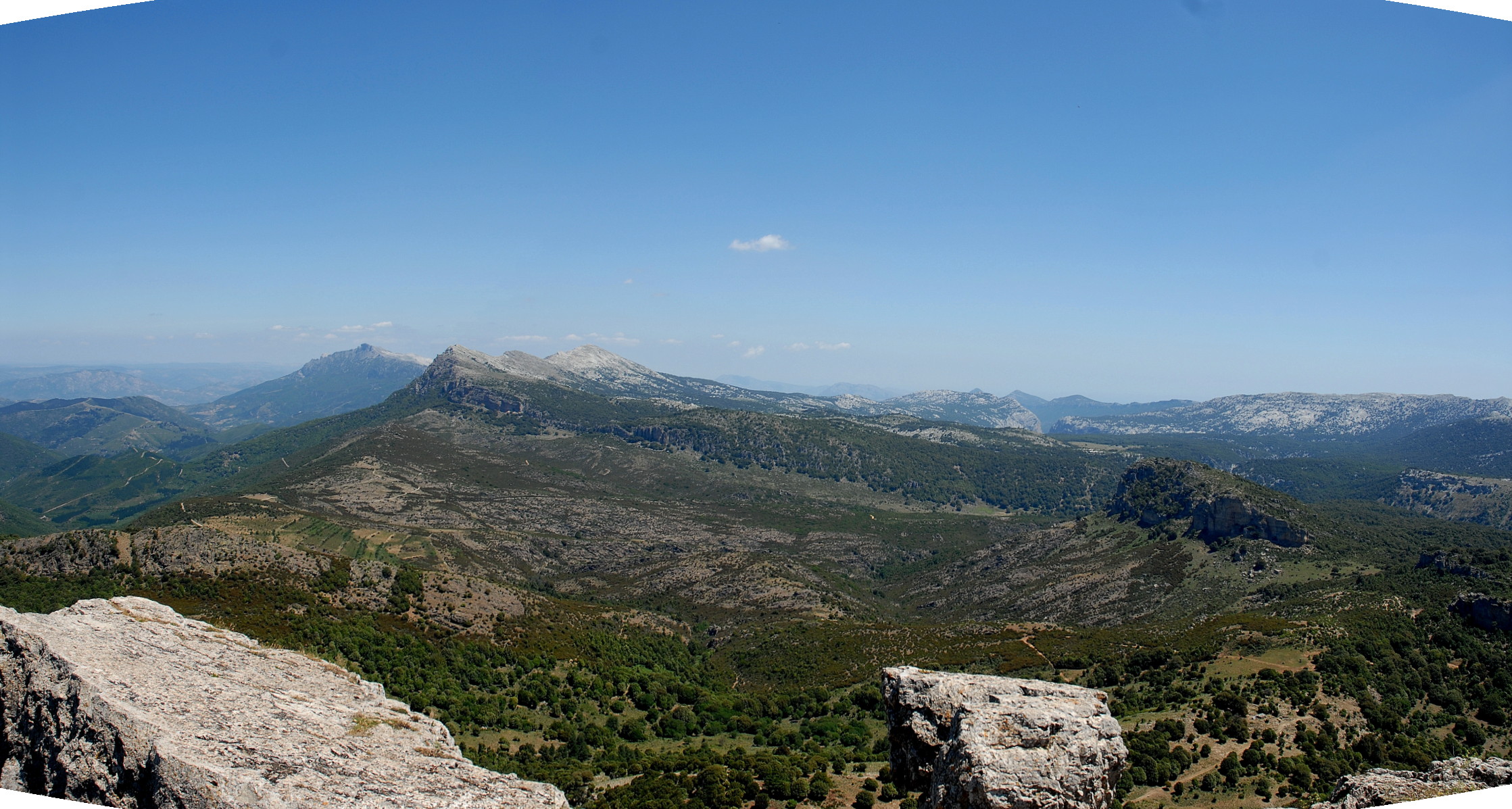
In it, there is a centuries-old holm oak forest and it is unique in the Mediterranean basin for extension and characteristics. The forest of Montes, access to which is a few kilometres from Orgosolo, extends for 4500 hectares on elevations around a thousand metres high, from the first spurs of the Gennargentu massif, passing through the high valley of the Cedrino river and the Orgosolo Supramonte area, as far as the Rio Flumineddu river, on the eastern border. A thousand hectares are occupied by an expanse of holm oaks, 20-25 metres tall: it is Sas Baddes, feather in the cap of the state-owned forest, one of the most ancient and extensive holm oak forests in Europe, which coexists with maple trees, holly trees, strawberry trees, phillyrea and yew trees. In the undergrowth, there are peonies and the wild Gennargentu rose, which will enchant you: it is usually a plant with magnificent crimson red flowers, which are pink only at the beginning of spring.
Taking a walk in the forest, you can admire wonderful landscapes, among which the natural monument of Novo San Giovanni - which can be reached from a trail that may be prehistoric - that has aiguilles up to 70 metres high, where rare endemic flowers grow, some of which are unique. The forest is an oasis of protected wildlife: the shy, elegant mouflon is the symbol of Montes and the wild boar is the species with the most numerous population. In the wild habitat, there are also wild cats, dormice and martens. Hares, partridges and foxes live on the edges of the forest. The golden eagle dominates the peaks. You will be able to admire it in flight, along with the goshawk, the common raven, the peregrine falcon, the kestrel and the Eurasian sparrowhawk.
There are numerous springs in this location: from the Funtana Bona, the Cedrino river starts its course. Here, you will notice sheepfolds featuring pinnetos, shepherds' shelters made of stone with cone-shaped roofs made of branches. You will find various Nuragic ruins: the village of Sas Baddes, inside the holm oak forest, two Tombs of the Giants, near the valley of Sa Senepida, and, in the heart of the forest, the Nuraghe Mereu, built from white limestone rocks. You will be struck by its unusually light appearance and, from its location, there is an exceptional view overlooking the walls of the Gorroppu canyon. Of the natural monuments in the area, a visit to the Su Suercone is definitely worthwhile.
Once you have concluded your visit to the natural and archaeological attractions, you can enjoy a visit to Orgosolo, a village with ancient traditions, the land of the Canto a Tenore polyphonic folk singing (UNESCO World Heritage), which stood out in the twentieth century due to the cultural ferment, which is still active, of muralism. Many artists have contributed to the creation of a true outdoor museum: hundreds of murals colour the streets and tell the story of customs and traditions.
San Pietro apostolo - Onanì
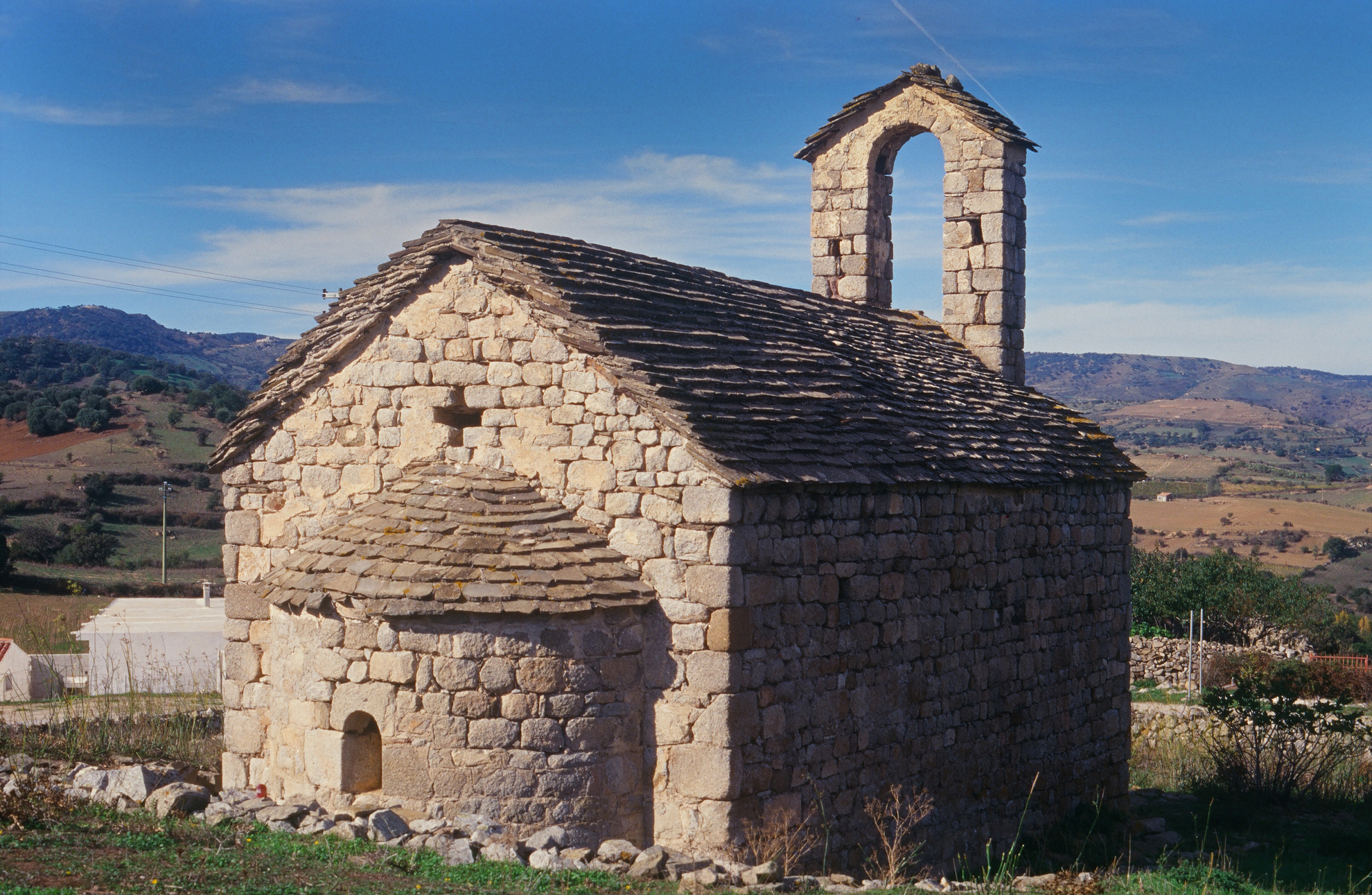
It was the Parish Church of Onanì and the centre that the ancient village revolved around. Today, however, it stands on a hill on the western outskirts of the town – on the road to Bitti -, and continues to be its symbol, as well as representing a symbol of Romanesque style in the Nuoro area. The Church of San Pietro Apostolo is a building constructed almost entirely from small granite ashlars, while its external cladding is made from schist slabs. It dates back to the second half of the 12th century and is an example of ‘minor’ Romanesque architecture, characterised by a single nave, with an apse facing south-east. On the façade, you will notice the portal with a raised relieving arch and, on the same axis, a cross-shaped opening. Up above, at the top of the slopes, stands a bell gable. The cross-shaped window is repeated on the back, just above the roof of the apse, where another single-lancet window appears. The interior is no less surprising: the dome of the apse and the barrel vault are, in fact, decorated with frescoes and, particularly on the ceiling of the church hall, you can admire the sacred scene of Saint Peter receiving the keys to Heaven.
The devotion of the inhabitants of Onanì to the small church is also demonstrated by a grim legend told in the village, according to which all the perpetrators of a series of raids that took place in the 1960s and 1970s inside the sanctuary came to a tragic end. It is very likely that the position of the church allowed it to act as a point of reference for medieval travellers and as spiritual ‘protection’ for the surrounding countryside. It also served as a way of ‘Christianising’ an area where there were ruins considered pagan. A few dozen metres from the church, to the west, are the remains of the nuraghe Santu Pedru (or Pretu), one of the many elements proving human presence in the Onanì territory during the Bronze Age. There are also Giants’ Tombs and a sacred well, while several Domus de Janas date back to the previous pre-Nuragic phase.
In addition to religious architecture and archaeology, Onanì, included among the Borghi Autentici d’Italia (Authentic Villages of Italy), is worth visiting for the murals that embellish the village streets, the work of the painter Piero Asproni and students of the Brera Academy, and for the artisan and food and wine traditions, which you can discover during a stage of Autumn in Barbagia.
Nuraghe Voes
It is by far the most significant Nuragic legacy of Nule, an area with a high density of prehistoric remains and one of the best preserved in central-northern Sardinia. Perched at 700 metres at the south-western high plain of Buddusò, the Voes nuraghe dominates a panorama that spans all of the mountains of the Goceano, all the way to the valley of the lower Tirso river. The monument is located about six kilometres from the small town famous for its textiles and, above all, for its elegant carpets graced with framas designs, whose roots can be traced to the late Roman-high Middle Ages.
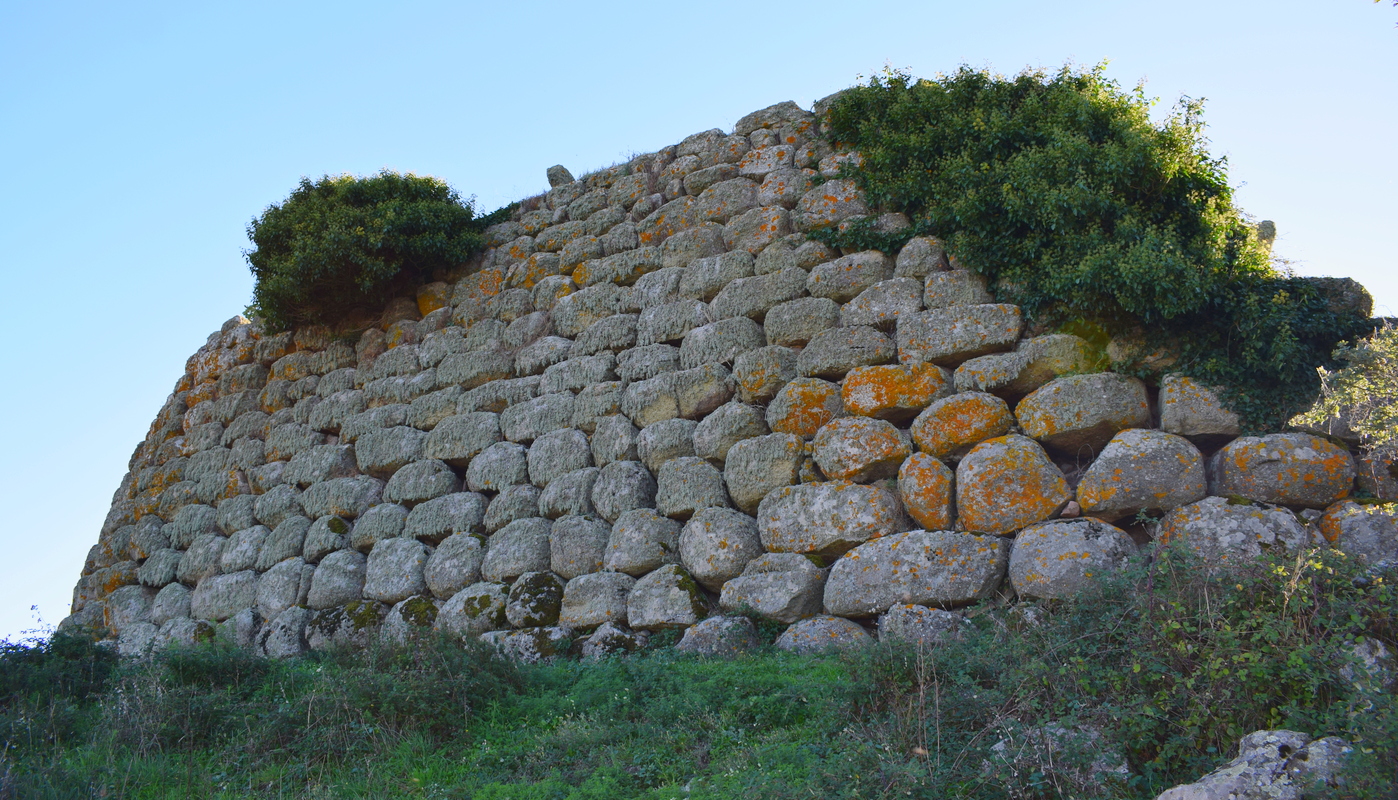
The monument is grandiose and its fundamental components remain intact, although they were never maintained or even the object of archaeological digs. Dated to the between the middle and late Bronze Age (1600-1000 BC), Voes was subsequently inhabited in later eras, as proven by a fragment of Punic ceramics and a hoard of copper and silver coins from the Imperial Age found there. The structure is a complex one, made up of a central tower which, it is believed, was once composed of three storeys. Around it, added at a later date, is a tri-lobed bastion: the three towers are connected by a corridor and laid out concentrically. At the entrance is a short corridor that leads to a small rectangular courtyard. The walls have openings that lead to the corridors that provide access to the rooms of the central tower and secondary spaces. The tower, aside from the circular room, has three niches set in a cross pattern with a tholos roof. To the left is a spiral staircase that leads to the rooms of the upper floor, where there are another three corridors that lead to the three secondary towers. The curved line of the tower makes it similar to the famous Santu Antine nuraghe at Torralba, while the bastion bears resemblance to the Losa nuraghe at Abbasanta.
The entire area around Nule is an open-air archaeological museum that includes a wide variety of Neolithic settlements, from dolmen to menhir, and plenty of Bronze Age remains: 18 nuraghe with surrounding villages, three giant tombs. The village of Santu Lesei is also of great importance, famous for the little bronze statue of Nule, an image featuring the body of an animal with the head of a man. It can be seen at the National Archaeological Museum of Calgari. At the end of the archaeological excursion, in the centre of Nule, a town made up of narrow streets lined with ancient stone houses, you can visit the XVI century former church of Santa Croce and the new church of Santa Maria Assunta, built in Gothic-Aragonese style, home to a wooden Baroque altar and valuable paintings.

Ritual Bread Museum
In a short story dedicated to bread-making, Grazia Deledda says that it was “a domestic tradition: and in our house, domestic traditions were religion and law”. After all, bread is the emblem of artisan knowledge in Sardinia, handed down from generation to generation, especially among the women of the families. Today the secrets of making it, the typical shapes and the meanings behind traditional Sardinian bread-making are also told in the Ritual Bread Museum in Borore, a small village on a plain of the Abbasanta plateau, at the foot of the Marghine mountain chain, and it is listed as one of the Borghi Autentici d’Italia (Authentic Villages of Italy).
Bread is described not only as an essential nutritional element, but also as a protagonist on special occasions, through the typical products made in numerous Island villages. During your visit, you’ll be on a journey through the various exhibition centres. The first stop is the exhibition dedicated to the bread production cycle, where you will see the tools and equipment used for work in the fields and in the kitchen. The next rooms will show you the breads produced to celebrate and honour the phases of life: births, baptisms, weddings and the memory of the deceased. There is no shortage of exhibitions of typical breads for the main holidays like Easter and Christmas, or for patron saints’ day celebrations. You will also find products dedicated to particular saints, considered healers of illnesses or linked to good omens, as well as breads created specifically to amuse and entertain children. There is also an educational workshop for the little ones, where they can try their hand at making simple shapes and decorations, bake the products in the oven and take home the bread they have just made with their own hands. The building is surrounded by a garden with a playground, where you can relax or stroll.
Borore is a village rich in traditions, with evidence of its long history in the countless archaeological sites, including the Stele of Perda Longa, one of the most famous menhirs on the island, eight Giants’ Tombs and thirty nuraghi, including the Duos Nuraghes complex, made up of two towers ten metres apart. In the historic centre, you can admire the murals, visit the Parish Church of Beata Vergine Assunta and observe sa Piedade, a building made entirely of stone that contained the monte granatico (wheat bank). In the countryside, you’ll find the little Church of San Lussorio with the muristenes, small houses that come alive with worshippers during the novenas, the Holy Week rituals and the Fires of Sant’Antonio Abate event.