Lakes and nuraghes
A discovery tour of Sarcidano and Barbagia di Seulo, including lakes, natural monuments and relics of a mysterious and ancient past


The still pristine landscape surrounding the lakes of Flumendosa, Mulargia and San Sabastiano is home to the remains of ancient civilizations, both pre-Nuragic and Nuragic. A journey into the heart of Sardinia, an area of gorgeous scenery to be enjoyed on a Mississippi-style river boat or in one of the old carriages of the green Trenino Verde train, an experience that is as memorable as it is exciting and relaxing.
Route: 80 Km
Driving time: 2 h
Exploration of the Nuragic sites of Sarcidano begins with the Arrubiu nuraghe of Orroli, which owes its name to the mantle of red lichen that covers most of it: arrubiu means red. The nuraghe is the old stone guardian of the territory, one of the most majestic in all of Sardinia, and one of the few with five towers.

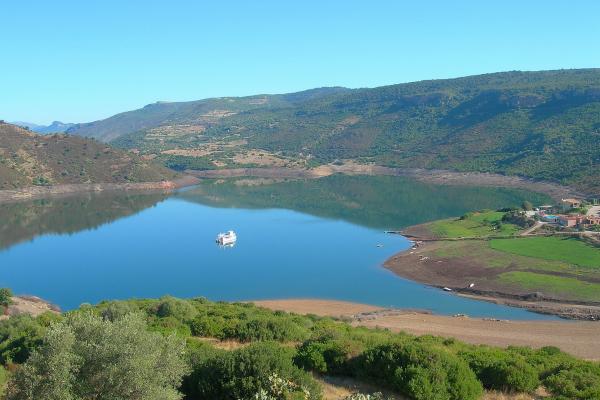
A great place for fun boating excursions, the lake looks like a glimmering gem as the water of Flumendosa sparkles nestled in the mountains. Its narrow valley sits on the crystalline foundation that makes up the backbone of the entire island. The shadows cast by the mountains and the outcrops that rise from the surface come together to create scenic beauty that is absolutely not to be missed.
This sacred monumental complex dominates the area surrounding the stone giaras of Serri. The archaeological site is nestled in nature and dates back to the early settlements of Nuragic civilization in 1600 BCE. Between the Late Bronze Age and the Early Iron Age (1100-800 BCE) the area became one of the most important expressions of Nuragic religious belief.

The dike at the is Barrocus gorge holds back the water that flows in from the Mannu river and, in the area of Isili, created the Lake of San Sebastiano. The name comes from the church dedicated to the saint built on a rocky outcrop in the middle of the lake. The church’s reflection in the water makes for a truly gorgeous landscape with plays of light and colour.

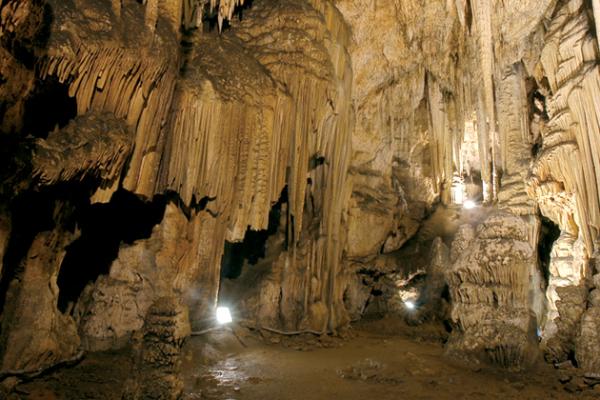
These caves are easy to explore even though its entrance is surrounded by a thick wood of holm oak trees. Legend has it that it was the home of three janas, or fairies, that were turned to stone after having killed a friar. The walls of the grotto are covered in sagging geological drapery and marble-like designs while a veritable storm of white stalactites hangs downwards from above.
One of nature’s masterpieces. Along a steep cliff wall between Sadali and Seulo, falling water carved a sinkhole through which it flows underground and then resurges as a lake in a cave from which it dives down from a height of 8 metres into a pool of crystalline water. The scene is complete with streams of clear water and rare vegetable essences.


