

Olbia
The ancient Greeks called it olbìa, ‘happiness’. It is the gateway to the island and the driving force behind the economy of the Gallura area. Vestiges of the past dot the city. Many of the relics archaeologists have brought to light, like the 900 gold coins, are now safeguarded at the Archaeological Museum on the islet of Peddone. The Punic-Roman, and later Christian, necropolis includes 450 tombs and comprises the museo della necropoli, located at the feet of the altar of the beautiful Basilica di San Simplicio. Built between the late XI and early XII centuries, it is this region’s most important church, as well as being the oldest vestige of Christian presence on the island. The patron saint is celebrated in mid-May with the heartfelt Festa di San Simplicio, when the faithful, in costume, take part in a procession. The celebrations include the palio della Stella joust. You will also be struck by the Baroque architecture of the Church of San Pablo, with its brilliant ceramic dome. Traces of man’s presence here date to 4000-3500 BCE in the form of dolems, menhirs and circular mageliths. Some 50 Nuragic settlements date to the Bronze Age, including the Tomb of the Giant of su Monte de s’Aba, the riu Mulinu nuraghe, the village of Belveghile and the sa Testa sacred well. The Phoenicians came here in the VII century BCE, followed by the Greeks. The first stable settlement was Punic (V-IV century BCE). The Carthaginians surrounded the settlement with walls and towers, remains of which you can still see on Via Torino. The town became the east coast’s largest city when the Romans took over. Under them, Olbia got paved roads, thermal baths, and a forum, traces of which remain near the palazzo comunale, as well as an aqueduct in Tilibbas (I-II century CE). Then there are the remains of the s’Imbalconadu villa (1st century CE). In 1999 twenty-four shipwrecks came to light, some of which had been sunk by the marauding Vandals.
The city looks out over a spectacular gulf that encompasses the Tavolara Marina Area. It is the access point to the exclusive Emerald Coast. The seemingly endless Olbian coastline is home to a myriad of turquoise inlets from which to choose, among them are the four beautiful bays of Porto Istana, within the confines of the protected area, the Lido di Pittulongu, especially La Playa, a local favourite. Next to it, one after the other, are the beaches of Squalo, Pelicano and, further north, Mare, Rocce and Bados, which borders on the Golfo Aranci. Another long stretch of shoreline follows, offering visitors sandy or pebbly white beaches and crystalline water at Porto Rotondo, Marina di Cugnana and Portisco, in particular, sa Rena Bianca. Southwards, headed towards San Teodoro, are the yellow-ochre sandy shores of Lido del Sole, Le Saline, Bunthe, Li Cuncheddi and Punta Corallina. To this fascinating array of sea and archaeology add fine food in the form of Olbian clams, to be paired, of course, with a glass of vermentino.

Tortolì
Tortolì is the port of Ogliastra, the gateway to a surprising world with a wide variety of landscapes. Around the city, where 11,000 people live and to which tens of thousands of tourists flock in summer, you’ll find tropical beaches, dense woods and Mediterranean brush, fertile plains and marshes, gently rolling hills covered in tilled fields and an oddity, a wide stripe of porphyry red rock that runs parallel to the coastline. The Rocce Rosse, literally red rocks, in the Arbatax area are the most spectacular example of this phenomenon, a natural monument that sticks straight up out of the emerald blue sea along the shore offering a truly amazing colour contrast. It is here that the Rocce Rosse Blues festival is held. The adjacent harbour is where the tourists arrive and take off on excursions to explore the enchanting coves and inlets of Ogliastra. The sea around Tortolì is magnificent, it is the shoreline that has most often been awarded the FEE’s Blue Flag. Behind the Rocce Rosse is Cala Moresca, the city’s pride and joy, a beach of golden sand edged with granite boulders. A bit further south you’ll find the many shades of blue of Porto Frailis and the long Lido di Orrì beach: sixteen kilometres of hidden coves and little beaches, including the lovely Cala Ginepro, blessed with fine sand, polished pebbles and a stand of juniper trees, and San Gemiliano. The red rocks also appear in the little slice of heaven that is Cea, four kilometres of soft white beaches. This spectacle of nature is complemented by lovely green areas: like the town’s La Sughereta park and Batteria park, perched on the top of a hill with views over the entire gulf.
There are more than 200 monuments here that date back to the Nuragic Age, and the s’Ortali ‘e su Monti is an exemplary site. Its seven hectares includes a Nuragic complex, a Giant’s Tomb, two menhirs, huts, a domu de Janas chamber tomb, a wall and the remains of another nuraghe. The port of Sulci Tirrenica was built to accommodate navigators with the arrival of the Phoenicians (VII century BCE) and the Punic peoples. Traces of Punic settlement were found in the marshes of Tortolì, while vestiges of Roman domination take the form of shipwrecks in the depths of the gulf. The ancient control towers, like the torre di San Miguel, were built by the Spaniards. The city’s landmarks include the su Logu de s’Iscultura museum of modern art and the former Cathedral of Sant’Andrea, a classic building from the XVIII century built over an older church. Two chapels of the older church remain, and in one of them they found the simulacrum of St. Elisabeth of Hungary. Inside the church is an elaborate altar of multi-coloured marble. The town’s most heartfelt festival is Stella Maris in late July at the church of Arbatax and features a procession that leads to the water’s edge.
While in the area, make sure to eat some culurgiones, typical ravioli, the stews, porcetto, roast lamb and boiled sheep meat along with a glass of cannonau, the most authentic of Ogliastra’s experiences.
Carloforte
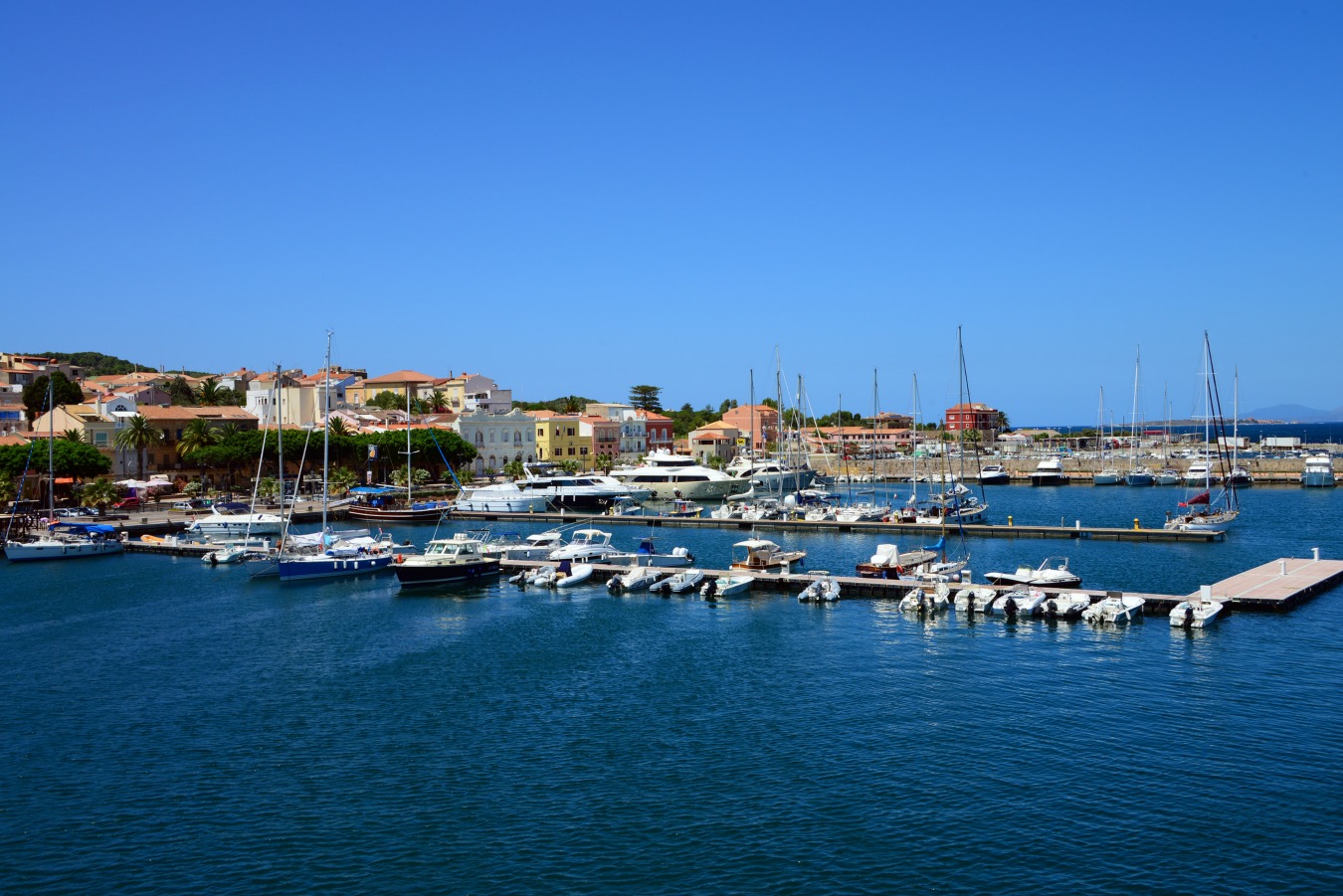
U pàize is a Ligurian enclave in Sardinia: it preserves the language and culture of its founders, the fisherman families originally from Pegli, and from the Tunisian island of Tabarka (where they lived since the 16th century). The tabarchini in 1738 obtained permission from King Carlo Emanuele III to colonize the island of San Pietro, which was uninhabited and known as belonging to 'the sparrow-hawks' since the Phoenician settlement (8th century BC), followed by the Carthaginians, with temple and necropolis . The same fishermen, 40 years later, also founded Calasetta on the facing island of Sant'Antioco.
Carloforte, still closely linked to Pegli and Genoa, is the only centre of the island, with six thousand inhabitants: it will captivate you with narrow streets and alleys that climb up a slight slope, with colourful sea views, marina and ancient defensive fortifications, of which remain watch towers and stretches of walls with forts, including the Lion's Gate. The architecture of the village, which is in the club of the most beautiful in Italy, we note the early 20th century a Palassiu , today the Giuseppe Cavallera cineteatro (cinema and theatre), and the church of the Madonna del naufrago, which houses the wooden statue revered by the tabarchini, a symbol of faith and solidarity union of the community. The devotion to San Pietro, protector of coral divers and tuna fishermen, solemnly celebrated on 29th June, was also deeply felt. On the seafront stands the monument to Carlo Emanuele III, a marble group of three statues (1786) with the sovereign from which the name of the village derives, while the parish church was dedicated to San Carlo Borromeo. At Spalmadureddu there is the San Vittorio tower, a defensive outpost built with blocks of trachyte, converted in 1898 to an astronomical observatory. Since 2016 it has been used as the multimedia museum of the Sea, which tells the story of Carloforte. After all, the sea is an essential part of it: the coasts of San Pietro are a succession of jagged rocks and inlets. To the north, you will find the romantic Cala Vinagra; to the north-west the deep fjord that is closed by the enchanting Cala Fico; to the west the impressive promontory of Capo Sandalo, dominated by the nineteenth-century lighthouse, and the one that is furthest west in Italy; to the south lies the scenic La Bobba beach, Conca beach with its sheer cliffs, and Le Colonne, two sea stacks sticking up out of the water and the symbol of Carloforte.
Carloforte cuisine is an unmissable experience. Between May and June, an international gastronomic event known as the Girotonno promotes the local specialties with culinary competitions and live cooking shows. Tuna is revisited in imaginative recipes. No less fascinating is the picturesque tabarchino cous cous festival, held on 25th April. From cooking to cinema with Crêuza de mä, a Carloforte event dedicated to film soundtracks.
Alghero
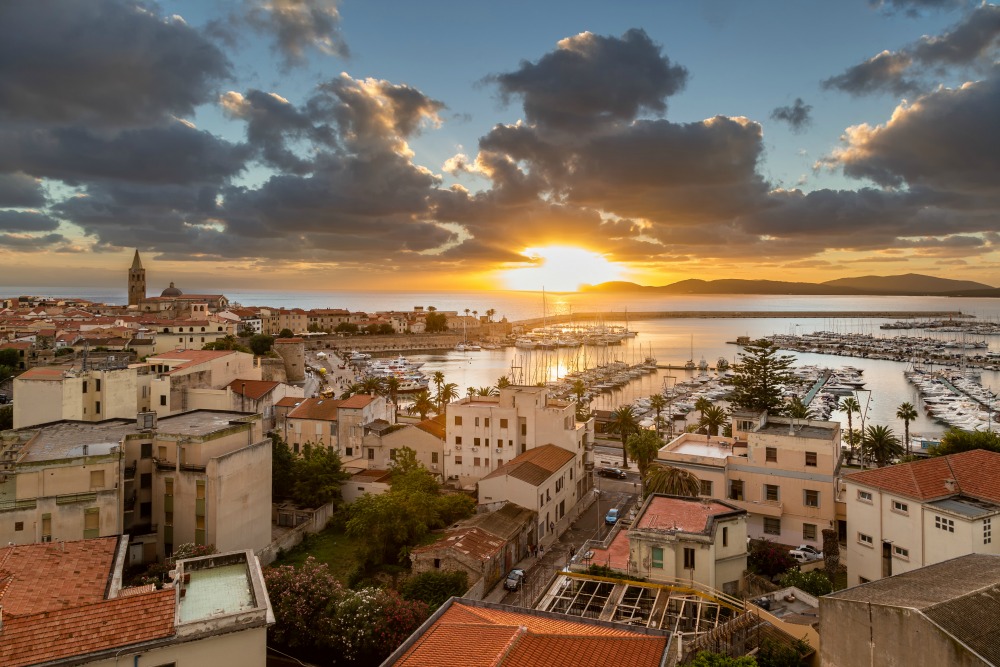
With its 44,000 inhabitants, it is the 5th largest city of Sardinia. Alghero is the island’s main harbour town, home to Fertilia airport and one of its best-loved cities for the popular walkway along the port’s bastions, the red roofs that touch the sky and the gorgeous natural bay that flows into the emerald sea. The shoreline is some 90 km long and known as the Coral Riviera, home to a major colony of the finest coral. The most famous beach here is Le Bombarde, blessed with crystalline water and a clean sandy bottom, it is a favourite destination of families, young people and surfing enthusiasts. Just a kilometre away is Lazzaretto, ten inlets with soft sandy beaches. A bit further away in the bay of Porto Conte is the leisurely Mugoni beach, graced with golden sand and the still waters of a sea that is always calm and crystalline, a completely protected oasis. The shoreline at the city’s centre, on the other hand, is home to the splendid Lido di San Giovanni beach, while just outside of town are the Maria Pia dunes, dotted with centuries-old juniper trees. Much of the coastline is within the protected marine zone of Capo Caccia – Isola Piana, where hundreds of treasures are safeguarded, including the grotta di Nettuno, which can be reached over land via the Escala del Cabriol, and by sea with boats that depart from the harbour.
The Porto Conte park will amaze you with its expanses of Mediterranean brush, dense woods and the laguna del Calich. The domus de Janas of santu Perdu, the Anghelu Ruju necropolis and the complexes of Palmavera and sant’Imbenia bear witness to Alghero’s prehistoric origins, starting in the Neolithic era. The historical centre is the city’s most interesting area, a labyrinth of narrow streets that connect piazzas bustling with life. The yellow walls and ancient houses echo the Catalan origins of the city. As do the churches: the Cathedral of Santa Maria (XVI century), the churches of Carmelo (late XVII century) with its great gilded retablo, that of San Michele with its coloured ceramic dome, and the late Renaissance Sant’Anna (1735). If it’s culture you’re after, then visit Casa Manno, a research centre full of important paintings, furniture, books and manuscripts. Alghero is famous for its fine coral, which is used locally with gold to make every manner of adornment. Do stop in at the Museo del Corallo and learn more about the history of coral and how it is used. The big event in 2017 will be the opening race of the great multi-city Giro d’Italia cycling event. Another great time to be here is at Cap d’Any de l’Alguer, or “New Years at Alghero,” when a myriad of shows enliven the city centre. The most passionate time of year is Holy Week, with heartfelt religious rites from the Spanish tradition.

Budoni
The hills surround the town, which features a beautiful medieval stone village. The old town, full of history and public places, is the heart of a lively nightlife: clubs, places to meet and restaurants make for a cheerful atmosphere all year long, and especially during the summer season.
Among the wonders of the area are Li Cucutti, Baia Sant'Anna and Cala Budoni. The soft white sand and the Mediterranean brush, which surrounds beaches of extraordinary beauty, capture and inebriate the gaze. Cala Ottiolu, with its shallow and green waters, is one of the most popular bays and is located near Porto Ottiolu, the main tourist starting point for inshore trips.
The feast of the Assumption in Budoni is undoubtedly the most beloved and anticipated: piazzas awash with music and joy where visitors join in one single celebration not to be missed, with dancing in discos and dreamy clubs. The tower of Su Entosu, a nuraghe-look-out located on a granite peak, the Conca and Bentu nuraghe and the Domus de Janas Agliola are of great historical value.
If you love the old charm, the animal pens of St. Peter will take you back in time; a path through ancient pastoral houses, built with thousand-year-old stones, mortar and mud, that bear witness to the look of nineteenth century countryside Sardinian villages. The colorful charm of the rooms and courtyards still tell stories of ancient life.
Palau
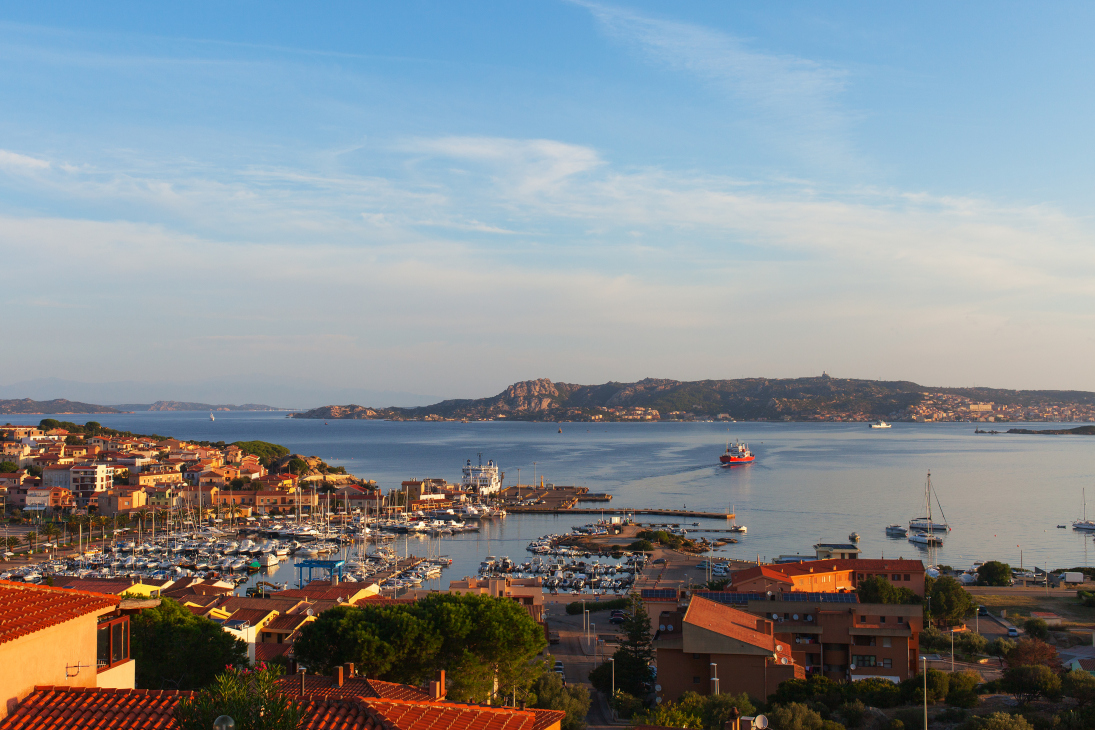
Clear blue water and boulders sculpted by weather and time. Palau is nestled in an inlet well repaired from the northern winds, adjacent to the exclusive Costa Smeralda and looking out over the beauty of the enchanting Maddalena Archipelago National Park. This tourist resort and harbour town came about in the late XIX century and counts some four thousand residents. Summer evenings bustle with night life and events. The main religious festivity here revolves around Santa Maria delle Grazie in early September, and winter is enlivened by a spectacular Carnival celebration that is reason enough to come for a visit. On a granite promontory chiseled by time just outside of town is a natural sculpture that seems crafted by an artist. It is Orso rock, the symbol of Palau, and looks out to distant horizons over the sea. The II century CE geographer Tolomeo claims that it had already been known since the days of Antiquity, and that even then sailors used it to guide them along their way. The seascape around Capo d’Orso is as beautiful as it is interesting, thanks to the tafone tombs and remains from the Neolithic Era. The sea bed here is resting place of shipwrecks from a variety of periods. Other sites well worth a visit are the Luchìa nuraghe, set as a guardian to the Bonifacio straits, and the Giant Tombs of Li Mizzani and Sajacciu, near the church of San Giorgio. As you head towards Don Diego, stop at the Batteria militare fortress at Talmone. There is another fort on Mt. Altura, a belvedere that looks out over the sea.
As you go from one end of Palau to the other, the shoreline alternates between granite coastline, sandy stretches, like Sciumara beach, and the lovely Porto Faro, with its Nordic atmosphere. Headed west you’ll come across the renowned and exclusive Porto Rafael, with its luxurious villas and a tourist harbour framed by wild olive trees, myrtle and lavender. Then there is the enchanting beauty of Punta Sardinia and the exotic atmosphere of Cala Trana, a little beach of light pink sand protected by dunes and flanked by huge granite boulders. Further towards Santa Teresa Gallura you’ll find the wild natural haven of Isuledda or Isola dei Gabbiani (Seagull Island). It is actually a peninsula held together by an isthmus of sand and surrounded by a turquoise sea. Two beaches fan outwards to the water’s edge: Arenaria and Porto Pollo. There is always a pleasant breeze here making it ideal, along with nearby Barrabisa, for windsurfing, kitesurfing and fun-boarding. International competitions featuring world champions are held here every year. Isuledda is also great for camping and campers. The view from here includes the little island of Cavalli and, further in the distance, Spargi and Budelli.

Pula
If you want the sea all year round, for bathing and getting a suntan in the summer and for the poetic atmosphere in the autumn and winter, Pula is the ideal destination for you. There are over seven thousand inhabitants in the residential area, from the metropolitan city of Cagliari, which is just 35 kilometres away. Pula is a treasure chest of natural, archaeological and cultural wealth without equals on the Island. As well as Pula's summer nightlife, with events and aperitifs in the squares, there are also excursions and sporting activities. For example, you can do some jogging along the tree-lined avenues that lead to the archaeological park of Nora, where you will get to know Pula's origins. Not far from the village, you will find yourself in one of the most well-known sites in Sardinia: Capo Pula contains the ruins of an ancient town, the first Phoenician one in Sardinia (8th century BC), which then became a flourishing Punic town and was later conquered by the Romans, becoming a municipium in 1 AD. Over the next two centuries, it enjoyed the maximum splendour: caput viae of all the Sardinian roads. ‘You will travel' through traces of three thousand years of history: you will admire a Phoenician-Punic tophet, the remains of Punic and Roman temples, a forum, noble dwellings, spa baths with mosaics and an amphitheatre that seated a thousand in the Imperial age and that is now the setting for the La Notte dei Poeti (Night of the Poets) festival. At the Giovanni Patroni Museum in Pula and at the Archaeological Museum in Cagliari you can admire the relics found during the excavations. After the archaeological excursion, you can take a walk on the beach of Nora: golden sand washed by a crystal clear sea and delimited by the promontory of the Tower of Coltellazzo. In the bay, you will also find history and traditions. The little church of Sant'Efisio stands here and is the place of the martyrdom of the warrior saint commemorated every year on 3 May during the Festival of Saint Efisio, to whom the population of Pula is extraordinarily devoted. Behind the bay, before having a plate of spaghetti 'allo scoglio' (spaghetti with seafood) and figs with cured ham, don't miss the lagoon of Nora at sunset, the habitat of rare birds. To the east of Nora, there is the beach of Su Guventeddu, popular with kitesurfing and windsurfing enthusiasts even in the winter. To the west, along the coastline, you will find Santa Margherita di Pula, consisting of a series of fine, white sandy coves with splashes of pink granite - Cala Marina, Cala Bernardini, Cala d'Ostia, Cala Verde, other smaller beaches of the resorts - looking out onto the crystal clear sea. A realm of relaxation with an immense pine forest behind it, which stretches as far as the marvellous Chia (Domus de Maria). You will also be by enshrouded by nature in the forest of Is Cannoneris and Pixinamanna, havens for trekkers, with their holm oaks, Mediterranean scrub and conifers. You can explore them while walking along the well-marked out trekking trails, through dense vegetation with rare plants, rocky formations shaped over time by the weather, watercourses and evidence of prehistoric civilizations. The forest complex is a wildlife oasis that has been repopulated with deer and fallow deer.
Santa Teresa Gallura
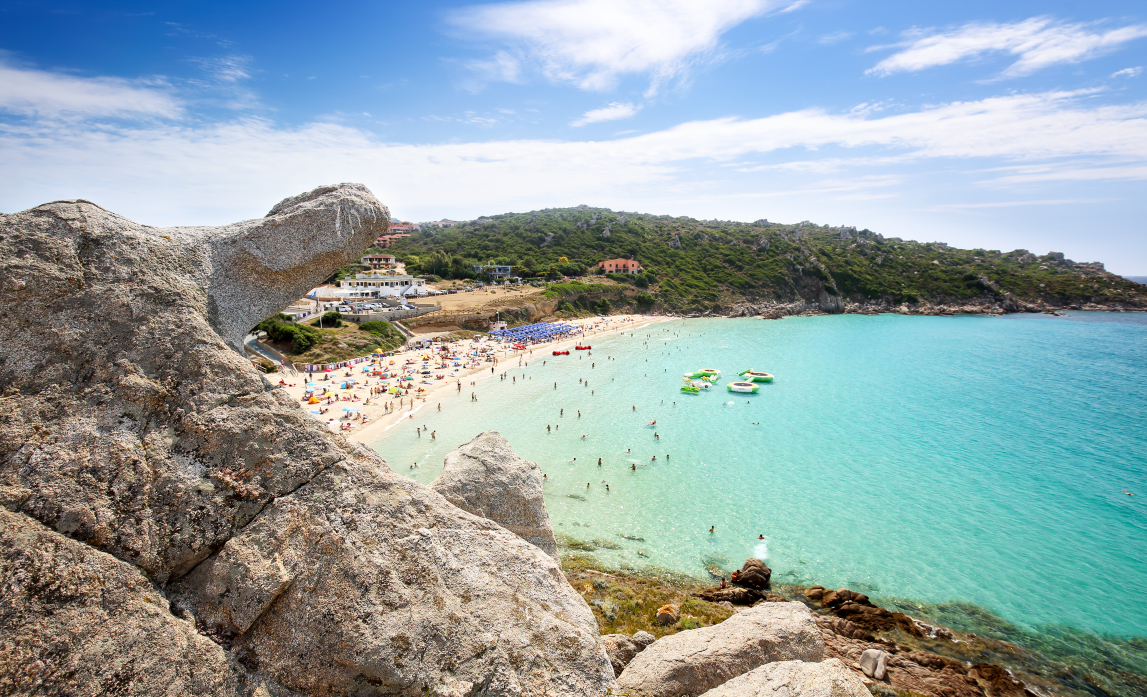
The sea is the undisputed star at Santa Teresa Gallura, a town of about 5,000 inhabitants that in the summer swells to include tens of thousands of tourists who enliven it with aperitifs in chic bars and live music. It looks out over the rocky shore of Bonifacio and was founded in 1808 by King Vittorio Emanuele I of Savoy on the site where the village of Longosardo (or Longone) once stood, then renamed after his wife, Maria Teresa. The town’s edge follows that of two inlets: Porto Longone to the east, where the tourist harbour is, and the bay of Rena Bianca to the west, a stretch of ultra-fine, brilliantly coloured sand located just a short walk from the town’s main square. The crystalline waters here sparkle with a thousand hues, proud recipient of the FEE’s Blue Flag of excellence. Above it rises the historic Longosardo Tower, built at the behest of King Philip II of Spain in the XVI century. There are a variety of other lovely beaches for you to enjoy: the wide La Marmorata, the picturesque Cala Balcaccia and Santa Reparata, known for its particularly clean water and rocky shore, ideal for diving. Heading westwards you’ll come across Capo Testa, the northernmost extremity of Sardinia. Along the isthmus that links the peninsula-promontory to the island are two gorgeous beaches: Rena di Ponente and Rena di Levante. Depending on how the wind is blowing, you can enjoy a calm sea at one or the other. From the western beach you can reach Capicciolu (or the “Beach of Auntie Colombo”) covered in warm golden sand. Here (perhaps) ancient Tibula (and its harbour) once rose, the docks from which ships laden with granite to adorn the palazzos of ancient Rome departed. At the western edge of the cape is the spectacular Cala Lunga - Valle della Luna, the symbol of Santa Teresa Gallura: hidden coves protected by high granite walls shaped by nature. It is the setting for the magical Musiche sulle Bocche music festival, even more beautiful in the soft light of the full moon. When you head towards Palau you will find the natural granite pools of the Valle dell’Erica, the long Porto Liscia-Sciumara, where surfing reigns supreme, and the enchanting peacefulness of the Conca Verde. The splendid copper dome of the XX century church built over the remains of a smaller medieval one glimmers in a romantic stand of pine trees three kilometres out of town. Don’t miss the Batteria Ferrero, the remains of a WWII fortress compete with artillery positions, bunker, garrison and mines. The most interesting remains, however, are the Nuragic ones: Lu Brandali and sa Testa.
San Teodoro
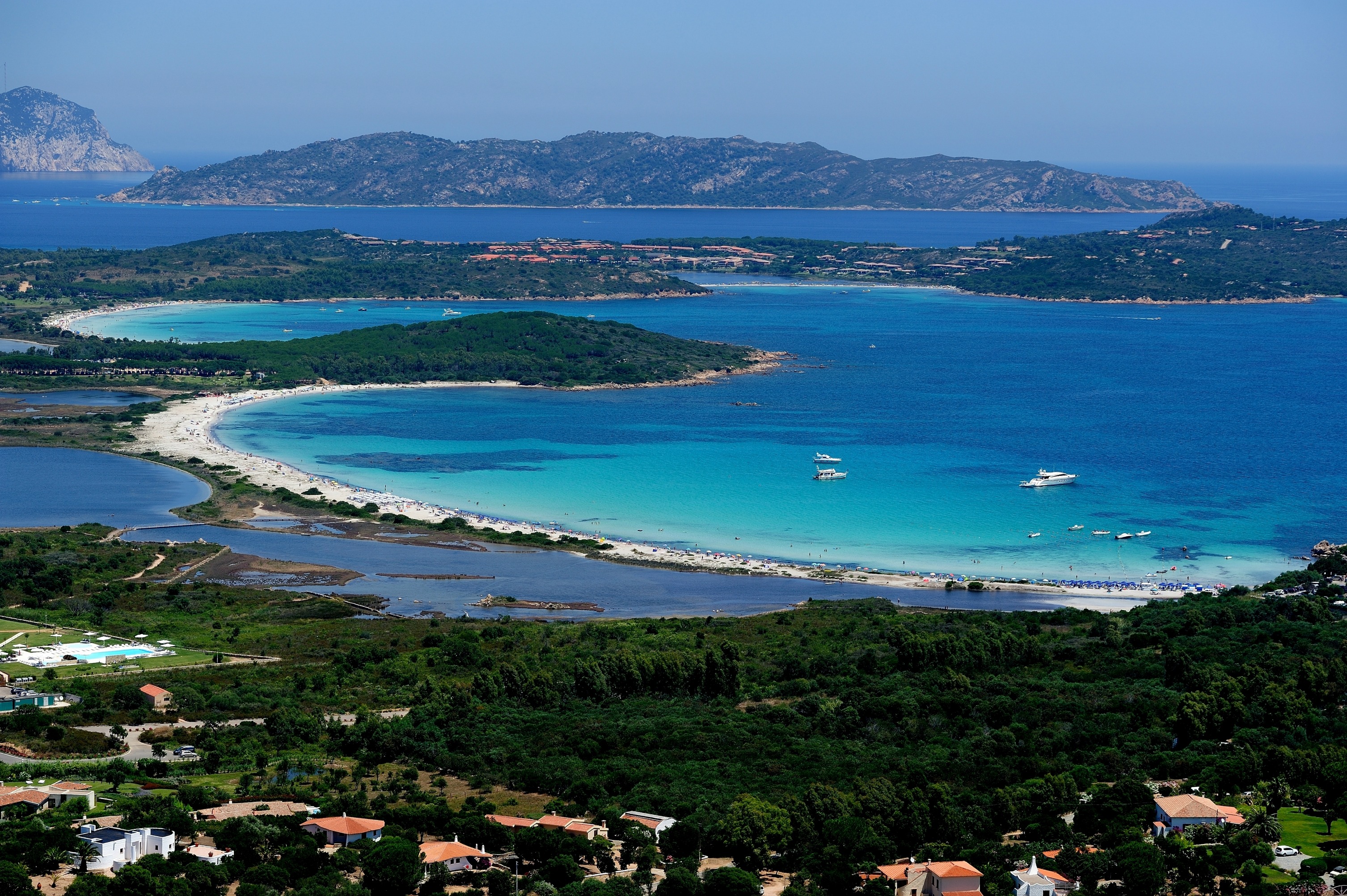
La Cinta, a long, thin stretch of golden sand bathed by a crystalline blue sea, Cala Brandinchi, a white shore with water that resembles a tropical paradise nicknamed, for good reason, Tahiti, Lu Impostu, its natural progression, the magnificent Marina di Puntaldìa, with its modern tourist harbour and the Caribbean-like s’Isuledda beach. These beaches are the symbols of San Teodoro, a celebrated resort town that is a favourite among young people for its night life. The coastline here is home to a variety of beautiful seashore ‘gems’: Cala Ginepro, its air fragrant with the aromas of the native Mediterranean brush, Coda Cavallo beach, which will amaze you with views of the grand Tavolara and its protected marine area, Cala Ghjlgolu, where the wind and the sea moulded a boulder into the shape of a turtle, an attraction very popular with visitors, especially children. Other places may be less famous, but they are no less beautiful: Baia Salinedda, Cala d’Ambra, Cala Suaraccia, Li Corri di Li Becchi, Li Marini and Seghefusti. The spectacle is completed by, behind the beaches, the San Teodoro lagoon, where flamingos come to rest during migration and home to the long-legged black-winged stilt. It’s a wonderful place for a nice walk and a spot of bird watching.
Known all over Gallura as Santu Diàdoru, this town is home to less than five thousand people in winter, a number that rises to tens of thousands in summer. Although man’s presence here dates to prehistoric times, the town came about in the XVII century, just inland from the eastern slopes of Mt. Nieddu, when shepherds and fishermen populated this amazing stretch of land. The nuraghe in the area of Naracheddu is its most important relic. People had also settled here in Roman times, as documented by archaeological finds now at the Museo del Mare. Among the events not to miss are the festivities surrounding patron saint San Teodoro, whose church was rebuilt in the mid XX century, and festivities of Sant’Andrea, which take place in the Montipitrosu quarter. The bonfires of Sant’Antonio Abate during the Lu Fuculoni festival are especially spectacular, when the faithful gather around the raging flames in honour of their saint. San Teodoro is a town of culinary delights: in May there is the Agliòla, during which local specialities are celebrated. You will love the Gallurian zuppa made with bread and cheese in a tasty beef stock. At meal’s end you’ll be tempted by such delicacies as cucciuléddi milàti, honey rolls, frisjióli léti, fritters and niuléddha, with almonds and grated orange peel. All of it to be washed down with, what else, a glass of vermentino di Gallura!
Stintino
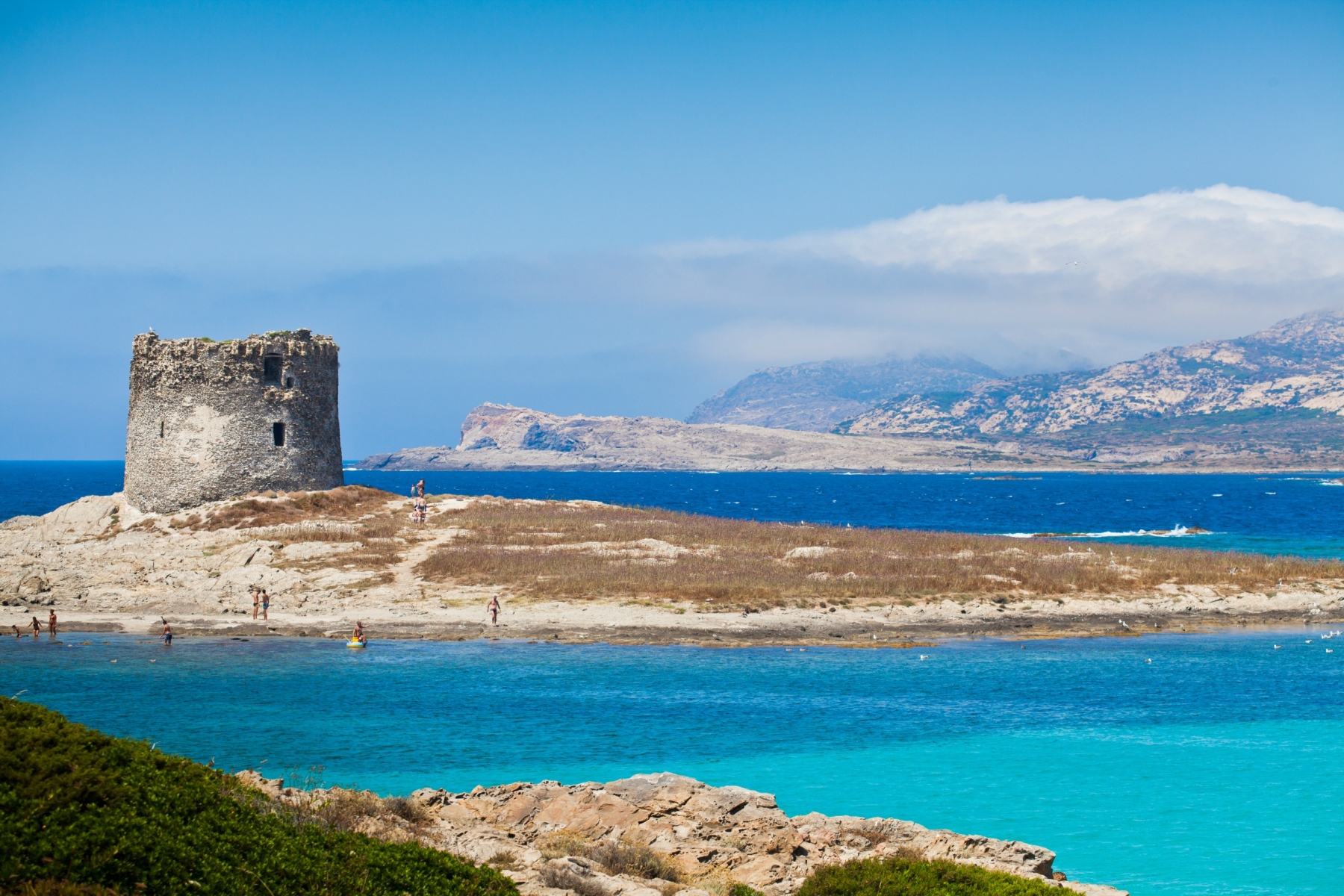
Located on a strip of land in the extreme northwestern part of Sardinia, Stintino stretches out towards Asinara, almost touching it. Right there, exactly where it touches it, lies its masterpiece, La Pelosa: with its clear seabed and shallow waters for dozens of metres, weightless white sand and a dazzling, calm sea with waters in every shade of blue. Next to its 'big sister', there is La Pelosetta, closed in by a little island dominated by an Aragonese tower (dated 1578), symbol of La Pelosa. From a ‘terrace’ on the ‘tropical’ beach, at an altitude of two hundred metres, you can enjoy a unique view of Isola Piana and the Asinara National Park, which is unspoilt and wild: Stintino is the nearest place of embarkation if you want to visit it.
The Stintino territory is a strip of land between two seas. To the west, there is the evocative 'mare di fuori' (outer sea), with a high and jagged coastline and little coves of sand and pebbles: from Capo Falcone, a wild place that also has a Spanish tower watching from above (the tallest in the Nurra region), while the peregrine falcon and the Eleonora's falcon fly overhead, as far as Cala del Vapore, through Valle della Luna and Coscia di donna. To the east there is the 'mare di dentro' (inner sea) within the gulf: a low and sheltered coastline that stretches from La Pelosa, passing by L'Ancora and the rocks of Punta Negra, as far as the round, white pebbles of the long shoreline of Le Saline and Ezzi Mannu. In the middle, there is a natural oasis with ponds (Cesaraccio and Pilo), where the purple heron, the little egret and the kingfisher live.
In the beginning, Stintino was a fishing village, very similar to Cala d'Oliva on the island of Asinara, a village that originally emerged thanks to 45 Ligurian families, who founded it in 1885, when the Kingdom of Italy established quarantine station and a penal colony there, 'evicting' the inhabitants. The village, which became a Municipality in 1988, is located on a strip of land between two inlets - isthintìni means 'intestines' - the 'Old' and 'New' ports, where the wooden gozzi lateen sailboats are moored, of which Stintino is the 'capital'. Since 1983, a famous lateen sailboat regatta has been held there. The history of the village is inextricably linked to fishing and tuna processing: you can experience this at the Museo della Tonnara (Tuna Fishing Museum), which emerged in the tonnara ‘Saline', active until the 1970s. Once the main economic resource, it has been telling the modus vivendi of Stintino since 2016: your itinerary will lead you along the 'rooms' (the same ones that make up the tuna nets), equipped with original instruments and images. After the tonnara, or tuna fishing, came tourism. In the early 20th century, the village was the destination of illustrious families from Sassari, like the Berlinguer and Segni families, and there was a boom in the 1960s: a myriad of tourist residences and hills appeared along the coast. The village, inhabited by one thousand 600 residents in the winter, is populated by tens of thousands of tourists during the summer. Stintino's culinary tradition is based on fishing: octopus in garlic sauce and Stintino style, lobster soup, tuna roe, seafood and fresh fish, all of which can be enjoyed at the restaurants located in the little lanes of the village and the coast.