
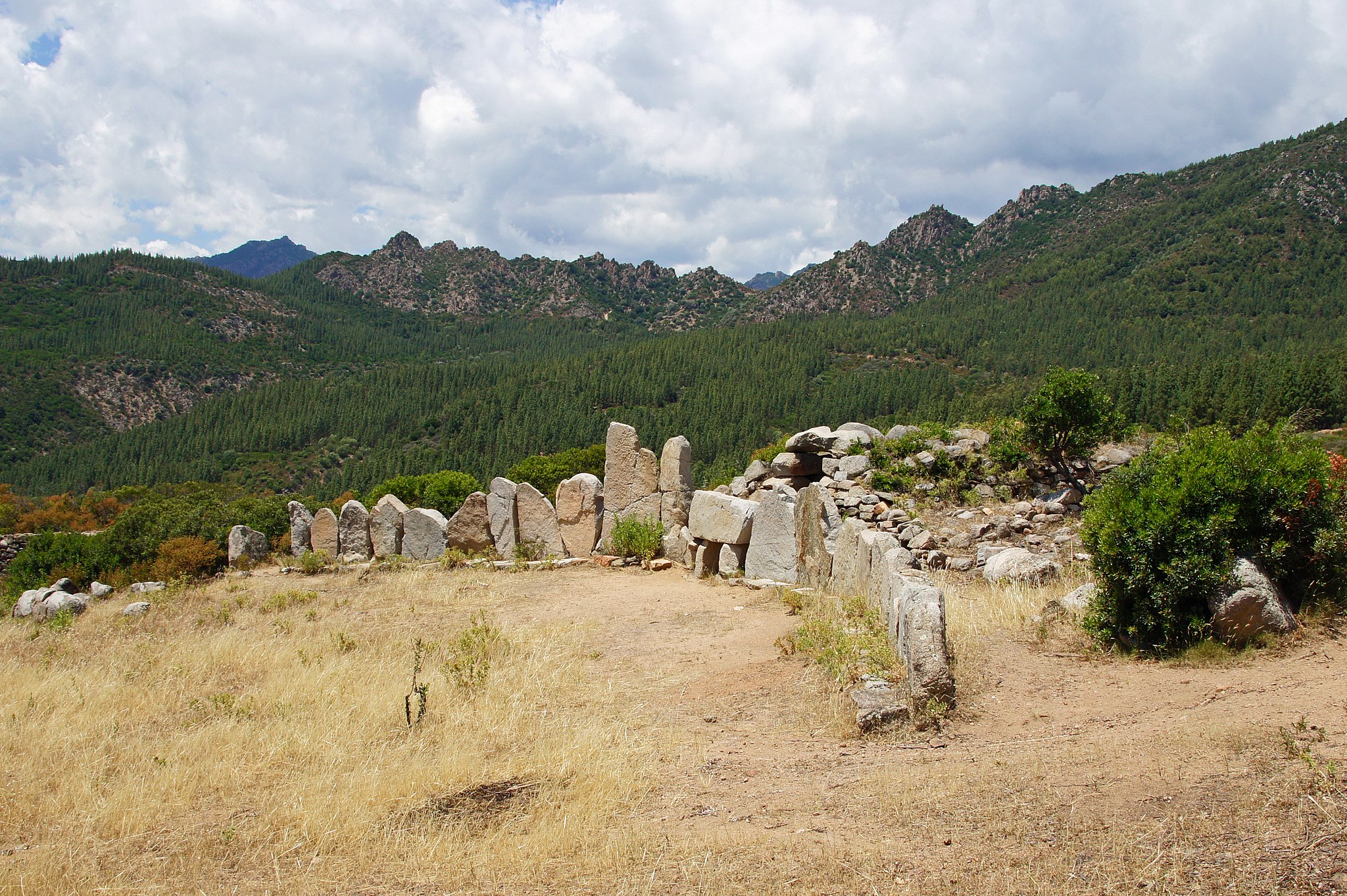
Triei
The panorama over the landscape around town is one of alternating plains and hills covered in woods of oak trees, cork, carob and Mediterranean brush that are home to martens and mountain goats, to eagles and falcons. Triei boasts some 1,200 inhabitants in the north-eastern part of Ogliastra and its name comes from tereiu: in spring the countryside is covered in a fragrant coat of intense yellow Spanish broom, known in local dialect as terìa. The economy is based on agriculture and grapes, from which quality cannonau wine is made. The area is renowned for the fine honey made by local beekeepers, especially the slightly tart arbutus honey. Local cuisine uses genuine products and ancient recipes to make culurgiones, macarrones de busa, pistoccuincasau, istacculas with myrtle, roast lamb, goat and pork. Among the crafts are rugs and bedspreads made on hand looms, wicker baskets, and arresojas made of bone.
First mention of the town in an official document dates to 1316. Another town in the same place was mentioned in a document from the previous century, but it was abandoned. It had been on the Osono plain, very near Triei. The nearby imposing Giant tomb is still there, a burial chamber of some 20 metres in length, brought to light in its entirety in 1989. The exedra is made up of twelve boulders set in the ground and an entrance with architrave. The digs uncovered artefacts dating from the Nuragic Age to the Roman Imperial Era. The entire area is dotted with Nuragic remains: Figu, Fratta, Nonnùccoli, Pizzu‘e Serra and, above all, just 2 km from town, the five-lobed nuraghe known as Bau Nuraxi, made with boulders of granite. It has a central tower and two side ones, a vast wall that encompasses another four towers and surrounds the complex.
The town itself is an open-air museum thanks to Arte a Triei, an event that takes place in May when the walls of houses, streets and the squares of the oldest parts of town are covered in murals by artists from all over the world. At the centre of town is the church of Santi Cosma and Damiano (XVI-XVII century), home to an extraordinary artistic heritage: frescoes depicting scenes from the lives of the saints and the Old Testament dating to the XVIII century and attributed to the Are school of Nuoro. The patron saints are celebrated late September, while Sant’Antonio of Padua has his feast day on the 10th of August at the charming Mullò park, four kilometres out of town and set among ages-old mastic trees. The bonfires for Sant’Antonio Abate are lit mid-January, when people gather around to enjoy such local treats as sa paniscedda. In May there is the procession for San Sebastiano, featuring decorated bulls pulling rustic carts, and s’Orroseri, the feast of the Maddona of the Rosary when sa simbula, local bread, is blessed and distributed. Santa Lucia is celebrated on 13 December with isbagadius, or “the bachelors.” In Ardali, once a populous outskirt that is now home to only 100 people, is the XX century church of San Pietro, which took the place of one of the area’s oldest churches, whose bell tower can still be seen.
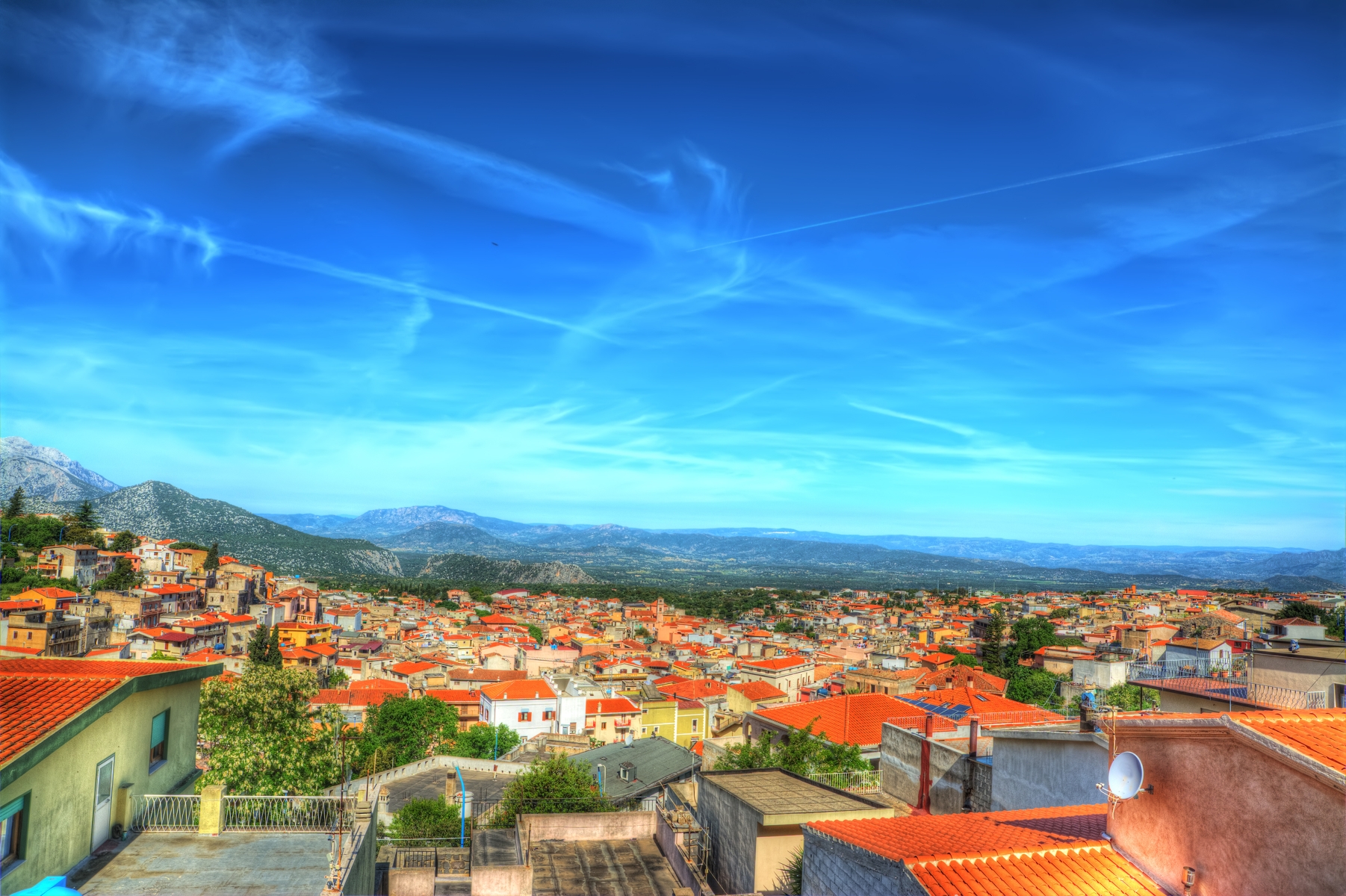
Cala Gonone
History and archaeology, traditions and craftsmanship, gorgeous seas and the mountain wilderness of the Supramonte, covered in a mantle of fragrant woods, will guide you into a magic legendary world. Dorgali boasts 225 square kilometres of wilderness, one of Sardinia’s largest and most beautiful areas. Along the characteristic streets of the historical centre you will stroll past houses made of volcanic rock and boutiques featuring delicate filigree jewellery and ceramics that, along with rugs, exemplify the artisanal vocation of this town. The churches of San Lussurio, of the Madonna d’Itria and Santa Caterina bear witness to the religion so heartfelt by its people. You will take a journey back in time at the archaeological museum, where relics from the Nuragic Age (especially those from the Nuragic village-sanctuary of Serra Òrrios) and from the Punic and Roman eras are on display. Not far from town are trails that lead hikers to the valle di Lanaittu, and through the legendary Tiscali Village, the defensive fortress built to hold off the advancing Romans.
Outside of town, just after a short tunnel, is a veritable gateway between the mountains and the sea, your eyes will gaze over the spectacular view of the Gulf of Orosei. A windy dirt path will take you down to Cala Gonone, famous for its coves and inlets, the destination of nature lovers, adventurers and romantic boating excursions. It sits on a steep hill that runs down to the water’s edge, where beaches of golden sand like Cala Cartoe, Ziu Martine e Cala Osalla offer quiet relaxation. By boat, or a strenuous hike, you can reach Cala Luna, which borders on Baunei, one of the Mediterranean’s most enchanting beaches. Graced with a beach of almost powdery sand and surrounded by blooming oleander trees it was the setting for the Lina Wertmüller cult film Swept Away. Further inland is the Codula di Luna, a deep gorge of steep walls and ancient juniper trees that have always acted as guardians of the beauty of this place. A guided excursion from Cala Gonone will take you to see the famous natural Grotte del Bue Marino, a series of grottoes that are home to ‘forests’ of stalagmites and stalactites, an underground saline lake and once the dwelling of the Monk seal. During the Cala Gonone Jazz event, the grotto becomes the venue of a truly unique, and spectacular, concert. And speaking of marine biology, don’t miss a chance to visit the aquarium in the town of Cala Gonone.
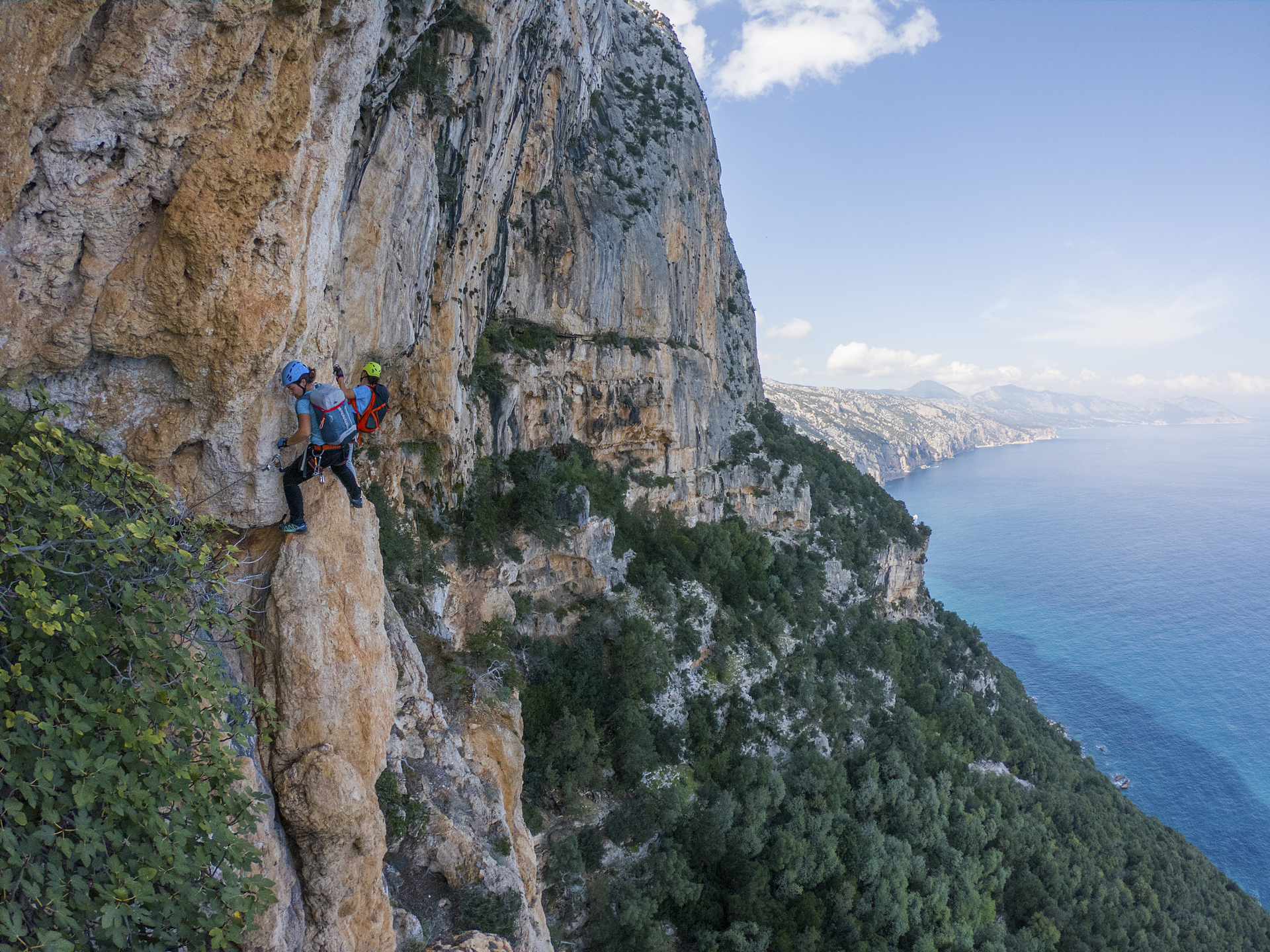
The challenge for the cliffs over the sea
If you find the climbing harness, the rope and nuts exciting, then the central-eastern part of Sardinia is the place for you. You can get to the Gulf of Orosei by car, motorcycle and camper van: departing from Baunei and following the directions for Golgo, after a stone path bordered by shrubbery, you will come across the wide depression of Arcu Annidai. From here, you can leave the path to get to Punta Salinas, or you can move along the ridge that leads to the sea until you get to the Aguglia di Goloritzé that dominates the beach. It is a limestone monolith in one of the most spectacular landscapes of the Mediterranean, ideal for climbing up a rock face. When you are at the top, with your muscles still taut, breathless and with your lungs seeking oxygen, you will feel like you have conquered the island.
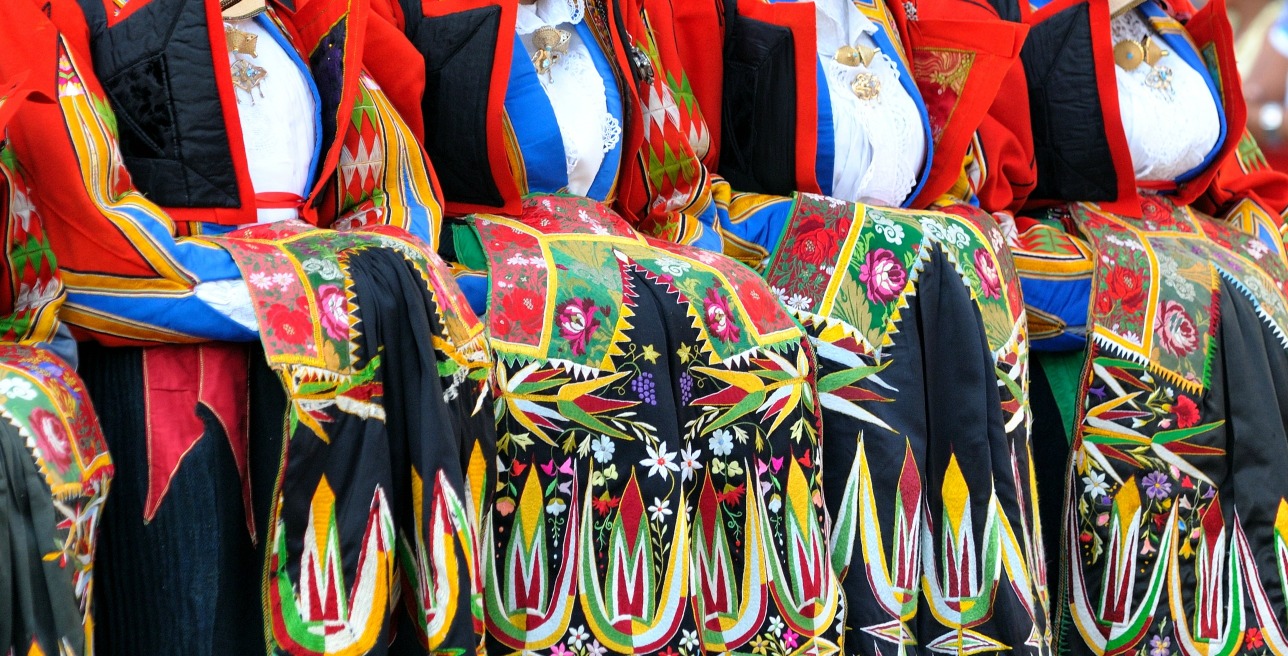
Patterns and textures of the soul
Original and imbued with meanings, the clothes and jewels are a fusion of signs left by the succession of different cultures in Sardinia: Nuragic, Phoenician, Greek, Byzantine and Spanish. Nothing was lost. Like the bright, coloured bonnets worn by the women of Desulo on festive days. They decorated them themselves, embroidering miniature details of the flamboyant Desulo dress: yellow, red and blue geometric designs alternated with embellishments based on the fantasy of skilled and sensitive artists. That of the women of Tempio Pausania was a different world, with their austere precious silk damask dress, which was completely black. They were admired for the elegant grace of their demeanour. On their heads, they wore a cascade of white lace, tied with filigree.

The Stonehenge of the Mediterranean
Sardinia has an age-old story, told by the archaeological evidence dotted throughout the territory. The tangible signs of the prehistoric island are endless: menhir, dolmen, domus de Janas, sacred wells, tombs of the giants and countless Nuraghe complexes. Enormous stones that have been guarding secrets for four thousand years. Buildings, often intact, of the first civilizations ever to exist in Europe, the only sites of their kind in the world, a patrimony to be discovered and experienced: this is the Stonehenge of the Mediterranean.
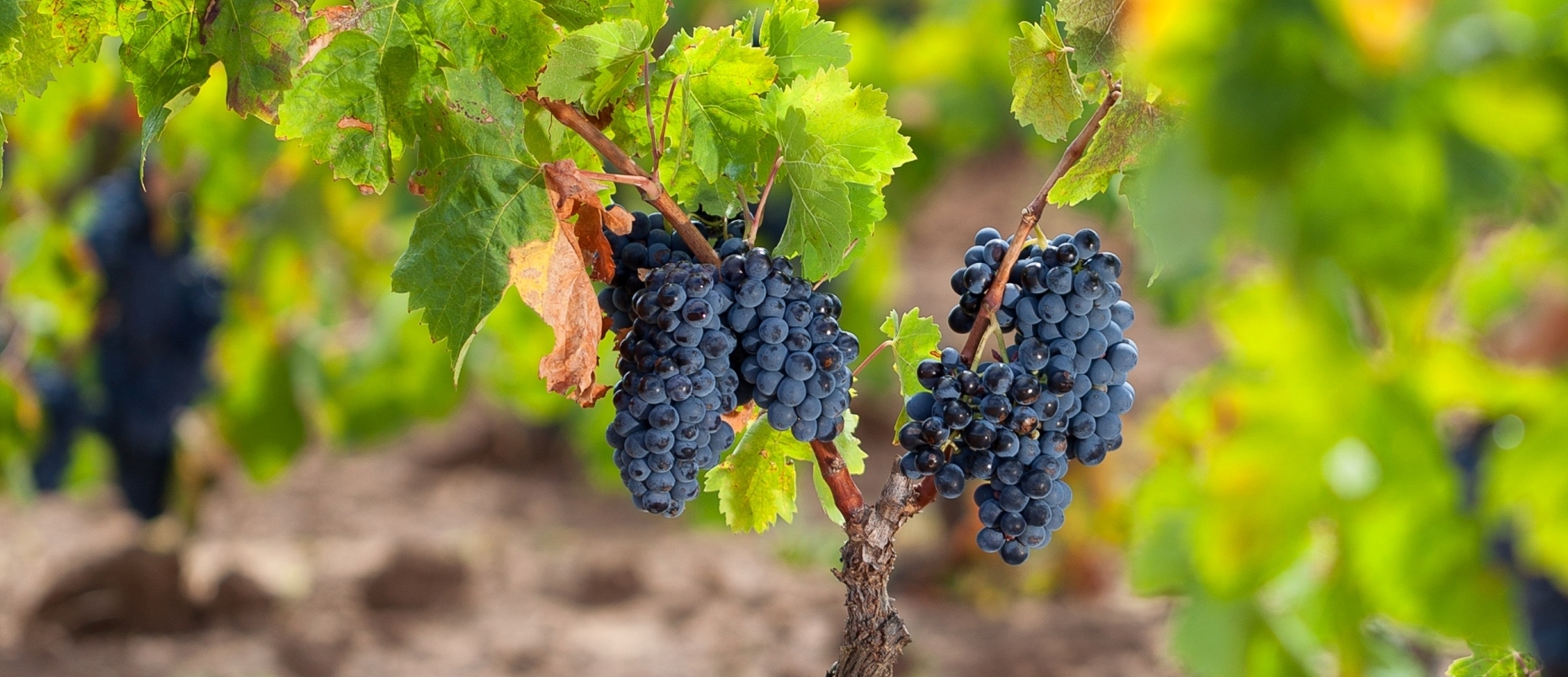
Sardinia, the quintessential land of wine
According to Greek legends, Aristaeus introduced this cultivation to Sardinia. The hero settled here because of the beauty of the land and he gave his two sons names linked to agriculture and viticulture: Kallikarpos, meaning ‘bearing good fruit’ and Charmos, from the Semitic krmy (winemaker). From mythography to reality. Today, the fact that wine-making on the Island goes back at least as far as the 15th century BC is a certainty: according to archaeologists, botanists and chemists, the oldest wine in the Western Mediterranean area was Sardinian. It was a sort of Cannonau dating back more than three thousand years. The theory became a certainty at the end of 2016, with the analysis of organic residue from a stone press discovered in the Nuragic village of Monte Zara, next to Monastir, a few kilometres from Cagliari. Archaeobotanical studies have unequivocally led us back to the practice of pressing and processing of grapes, particularly red grapes. This is the most ancient press in the Mediterranean, proof of the Nuragic civilization's considerable expertise in wine-making. The discovery places wine tradition as far back as the Middle Bronze Age, even though the thriving presence of vitis vinifera sylvestris leads us to assume that there was domestication and highly evolved oenology even further back in time.
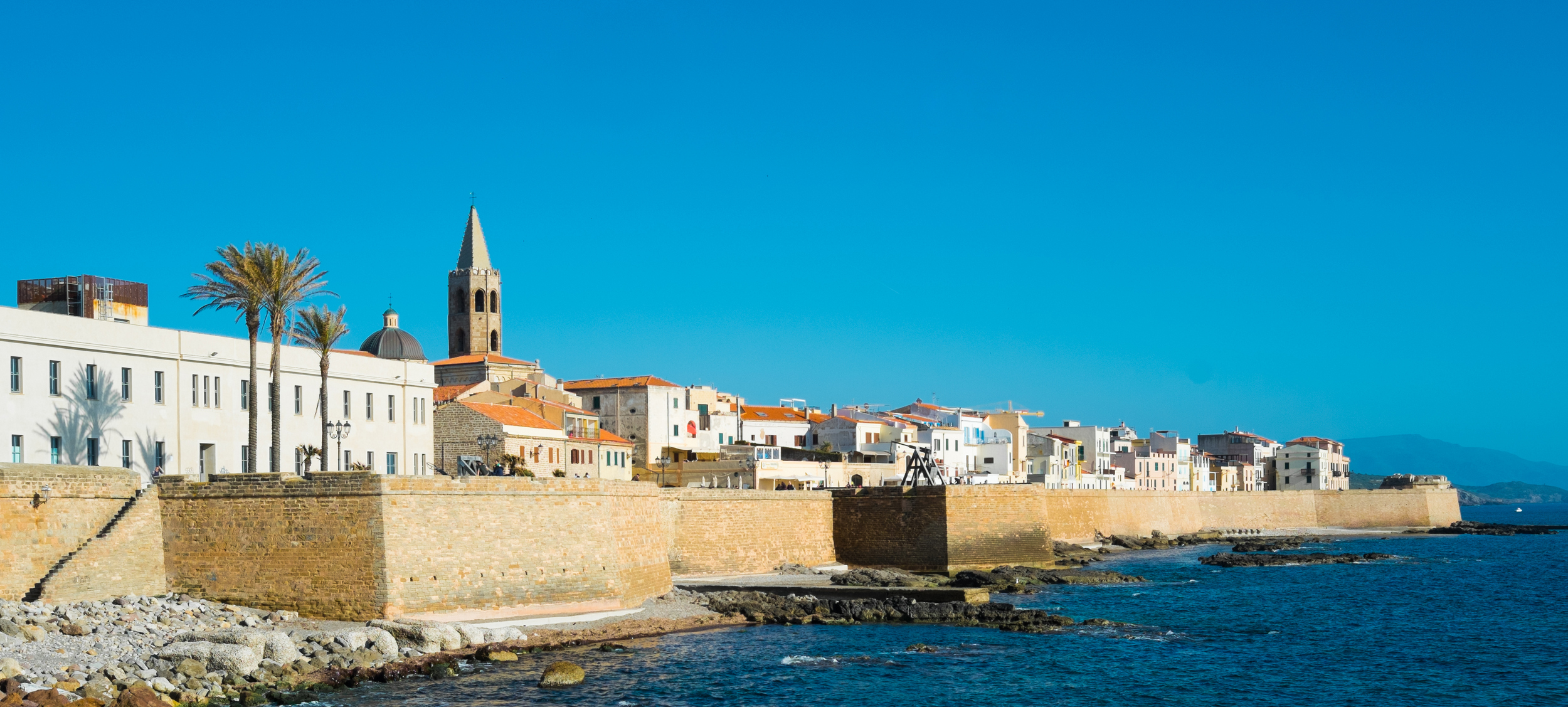
Monumenti Aperti, exploring architectural and artistic treasures
Magnificence, shared memory, authenticity and a sense of community: this is the most encompassing effort to safeguard, enhance and promote the cultural heritage of Sardinia. Over the next seven weekends, the 22nd edition of Monumenti Aperti (Open Monuments) – a candidate for the 2018 Europa Nostra award, a European Union award for cultural legacy – will shine a special light on the island’s architectural, historical and natural heritage: some 800 places of extraordinary cultural value that include the museums and archaeological sites, churches and historical buildings, natural monuments and parks of 59 municipalities all over Sardinia, seven of which are new to the movement. Each town will tells its tale through literary itineraries, architecture routes in cities that have been marked by centuries of powerful rulers, and journeys into the dawn of time among the remains of ancient civilizations. As you follow the route, some 18,000 volunteers – many of whom are school children of a variety of ages - will narrate the stories that marked the history and culture of their town.
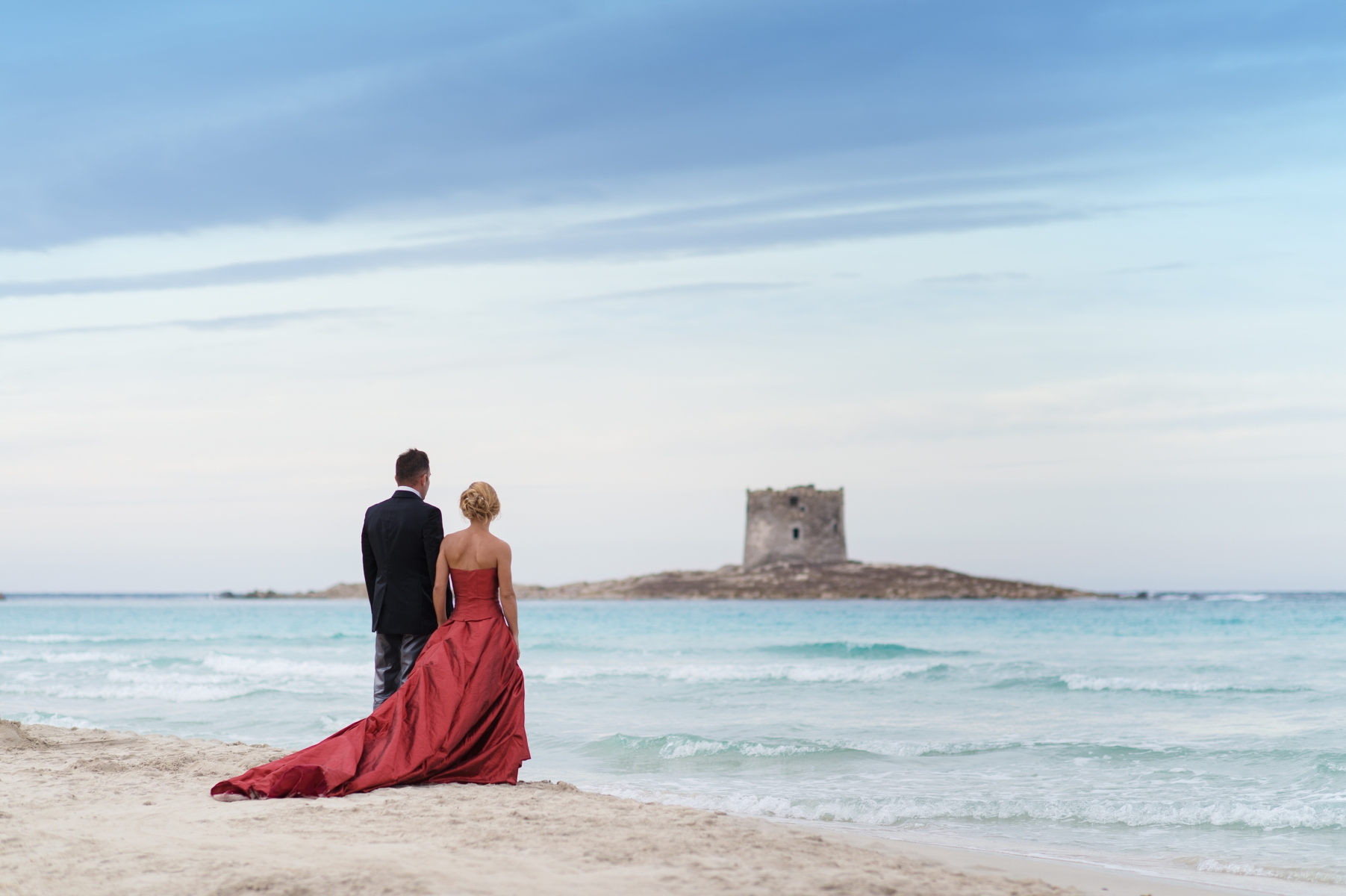
Saying “I do” in a magical setting
An ideal destination in every season and perfect for a wedding. An evocative, romantic and enchanting land: an increasing number of couples choose the most picturesque corners of Sardinia as a place in which to celebrate their love. Numerous guests get to know the island while on holiday, leaving behind a little piece of their heart and they sometimes return to take it back on one of the most important days of their lives. Many say “I do” in famous and captivating places, others in less well-known, poetic places reminiscent of an archaic past, in the bucolic peace and quiet or far away from the hustle and bustle of today’s world: a lighthouse, a cave, a sacred well, the rows of vines in a vineyard kissed by the sun, in gardens where fragrances and colours are transformed by the changing seasons. Dream weddings are celebrated throughout much of the island: the bride and groom spend the pre-event and honeymoon there, while their guests often stay on and take a holiday.
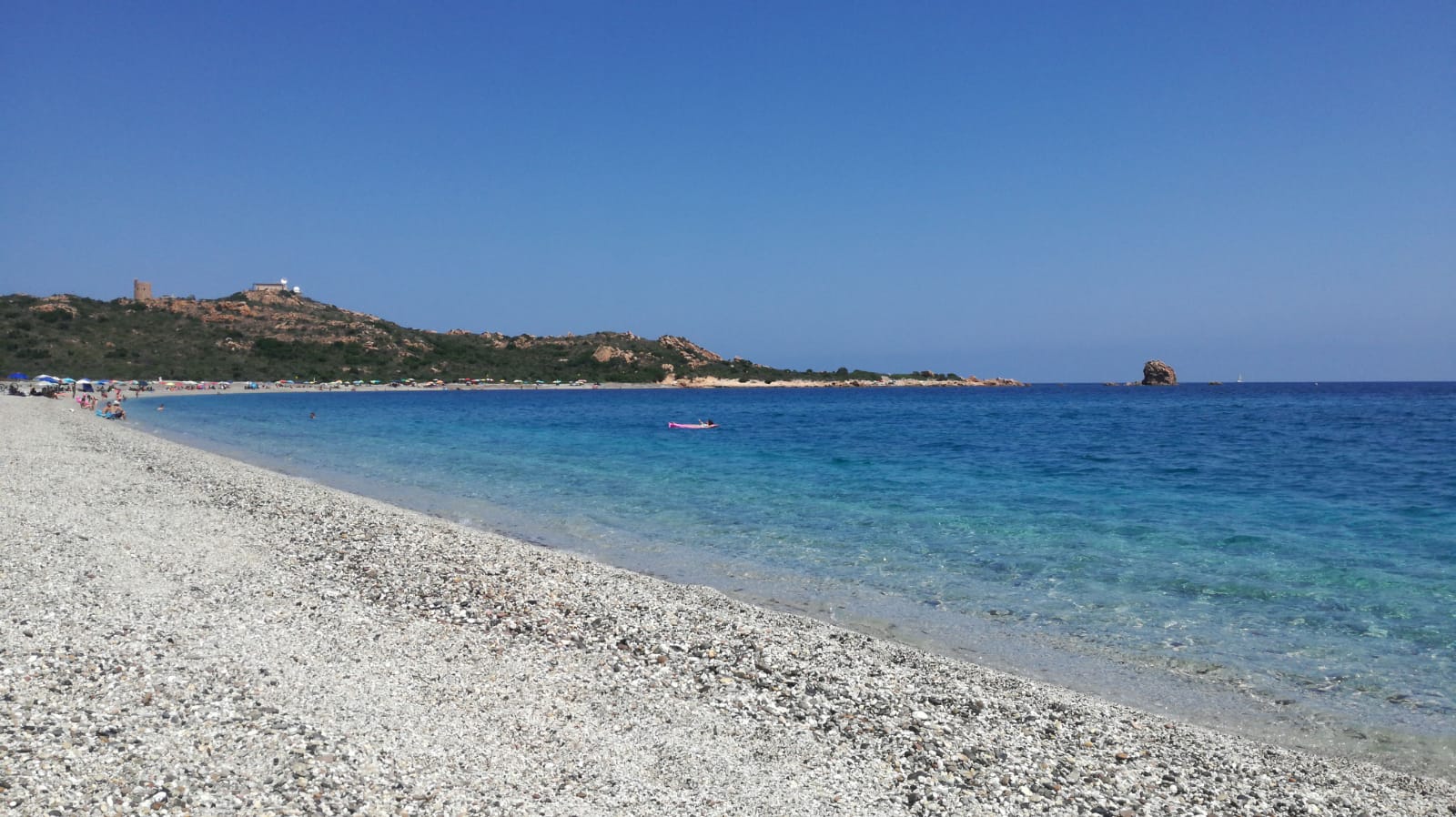
Murtas
The once-forbidden 'pearl' on the coast of Villaputzu: within the shared military shooting range of the Salto di Quirra there is a six-kilometre stretch of light sand with medium and large grains, mixed with some smooth pebbles, edged by large dunes, which plunges into crystal clear waters in shades of intense blue. The long and wide beach of Murtas, also known as Quirra beach and s'Acqua Durci (in the stretch of beach where the Quirra river flows), perhaps one of the most beautiful in the Mediterranean, has been partly closed for twenty years. Since 2016, the free and accessible area has been extended, although only in the summer (from June to September). The small, northern of the beach is reserved for the staff of the base, while the rest is open for you to enjoy.
Being inside the military settlement, it is always uncrowded. The shallow water allows children to play on the shore. It is also an ideal destination for surfers, and is popular with those who like underwater fishing and diving. Opposite the beach stands the islet of Quirra, just behind small sand dunes, overlooked by the tower of the same name. The surrounding landscape is wild and evocative, characterized by Mediterranean scrub and lakes, in a setting that combines sun and sea with birdwatching, biking and trekking. Not far from the coast, the waters of the Quirra pond and other minor swamps are placid, and routinely populated by many rare water birds, including mallards, swamphens and pink flamingos. Do not miss the opportunity to visit the remains of the medieval castle of Quirra, the nearby and characteristic church of San Nicola di Quirra, the Spanish towers, various nuraghes scattered in the area, the remains of industrial sites such as the Baccu Locci mine, and caves with intricate tunnels, stalactites and stalagmites.
Cala Murtas is the northernmost beach on the coast of Villaputzu, stretching 14 kilometres from the town along the 'old' state road 125 (panoramic eastern Sardinian). The rest of the Sarrabus coastline is characterized by sandy expanses alternating with extensive rocky promontories and charming inlets. The closest beach to the village is that of the Flumendosa estuary, with white sands and gleaming waters, shared with Muravera and immersed in a scenario of great environmental value. Four kilometres to the north you will find two more coastal "jewels", Porto Corallo, in front of the tourist village of the same name and next to the modern port, dominated by a Spanish watchtower, and the enchanting Porto Tramatzu, with the same name as the port in Teulada, with its fine sand with golden reflections immersed in the green of the Mediterranean scrub.
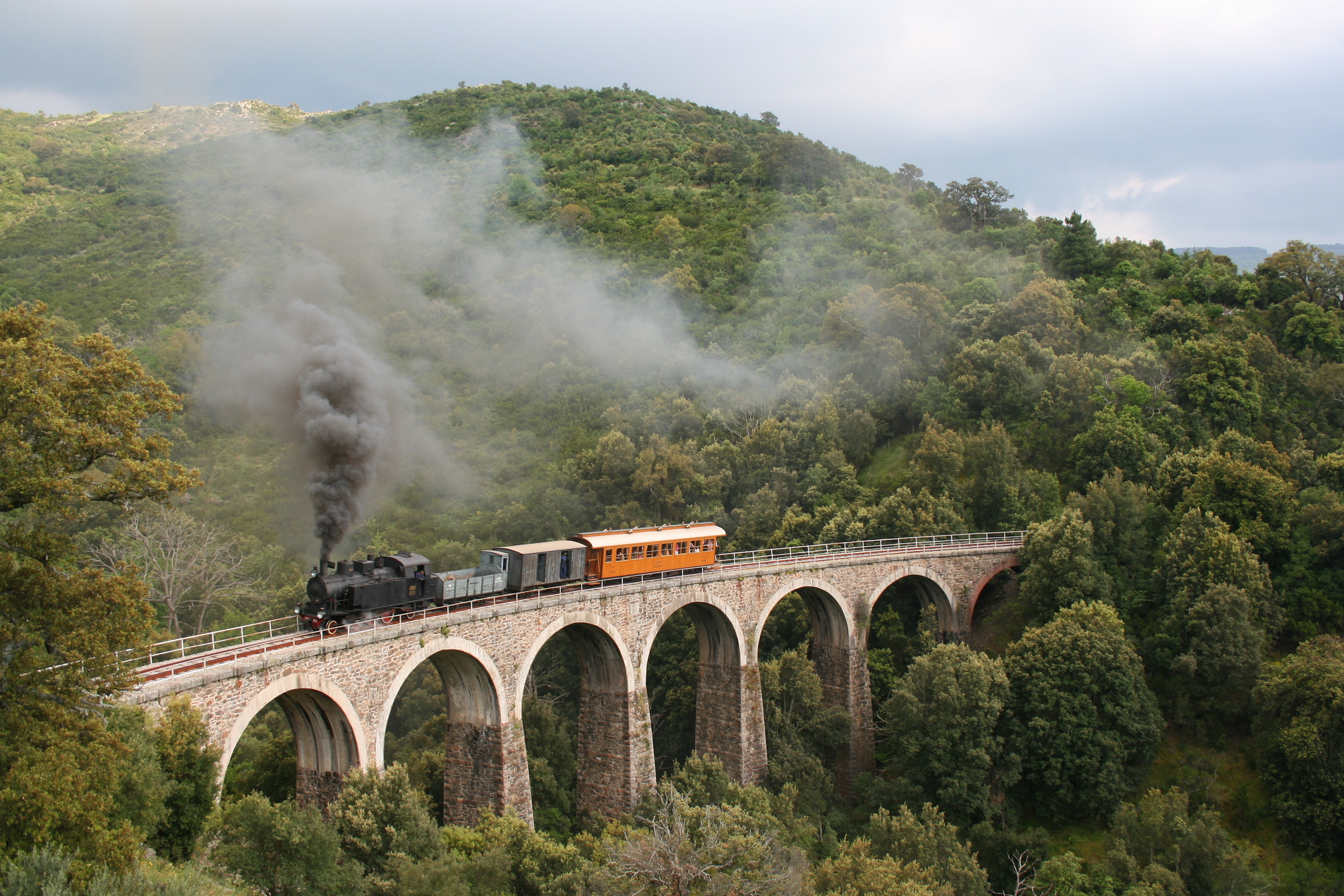
Great beauty travels on the Green train
“After a long pull, we come to a station after a stretch of loneliness. Each time, it looks as if there were nothing beyond — no more habitations. And each time we come to a station.” This is the poetic description, aboard the locomotive that is today the Trenino Verde (Green Train) of Sea and Sardinia, the project dedicated by David Herbert Lawrence on his 1921 voyage to Sardinia. Following in his footsteps a century later, travellers from all over the world are attracted to this unique railway line, derived from the ‘old components’, designed and constructed between the late 19th and early-20th centuries. An Italian excellence, a unique experience comprised of four trails totalling 437 kilometres, with three sections having been operating non-stop for 130 years, including engineering and architectural works, such as bridges and tunnels. The lines, never abandoned, have been preserved and protected, connecting the coasts and hinterland, integrating such with excursions to the lakes by boat, trekking, cycling and horse riding. You can hop on the on any of the seasonal calendar days or hire it out for a group excursion - thanks to the initiative Su Trenu Antigu, aimed at enthusiasts, schools and tour operators, for an exclusive railway line!