

Discovering thousands of years of history on foot
Walking in a rhythmic, meditative way, you can really appreciate the best of a unique, mythical land, fully taking in enchanted landscapes and views, getting to know the people and communities that inhabit it and their authentic traditions. Sardinian walks, spiritual experiences and destinations for pilgrimage offer everything the "slow tourist" is looking for, in full contact with the nature, culture and true identity of the places you visit, providing an enriching, educational experience. The island's walks are ideal for tourists looking for an intimate, true experience in a unique natural and cultural setting, and in an area that sees hospitality as sacred. To be seen on foot, by bicycle, on horseback or with the Trenino Verde.

Loculi
Loculi rests in the plain crossed by the River Sologo, an affluent of the River Cedrino, a few kilometres from Baronia, surrounded by hills and overlooked by the majestic, snowy profile of Mount Albo, the "Sardinian Dolomite". The village has a population of just over 500, and is 34 kilometres from Nuoro. The name is said to derive from locus, "holy forest" or "small place". It may have Phoenician or Punic origins, supported by the finding in 1959 of a jug from the period containing bronze objects and coins. The village has agricultural, sheep-farming, craft trade and religious traditions. Of the 17 churches existing from the 15th to 20th century, only the parish church of San Pietro e la Madonna de sa Defessa (the Defence) remains, and the patron saints are celebrated in late August and mid-January respectively. The rituals of the Holy Week are very popular. In the village centre stands sa Domo de sas artes e de sos mestieris, where you can discover the Baronia arts and crafts through the shots by photographer Carlo Bavagnoli. Part of the long ridge of Mount Albo falls into the territory of Loculi: the limestone bastion can offer evocative views along the marked paths. These paths, once used by charcoal burners and shepherds, climb right to the twin peaks of Turuddò and Catirina (1127 metres), through forests of ancient holm and oak trees. The area is a nature reserve inhabited by mouflons and surveyed by royal eagles. In the northern part, where the plants become sparse, you can admire a "lunar" landscape.
The territory of Loculi has been settled since the Neolithic, as shown by the domus de Japas dug from vertical cliffs, some "single chamber" (the domu of Pira 'è Tusu, Locurréris and Ena Longa), and others with more than one chamber (Tùrrighe and Puntèri). A megalithic dolmen-type burial in Santa Maria di Loculi dates to a period of passage between the pre-nuraghic and nuraghic ages. There are also nuraghic burials in the area: the Giant's tomb of s'Iscusorju ("hidden treasure"), around two kilometres from the town, is covered by pistacia trees, from which a corridor emerges, bordered by granite slabs in a "knife" layout, covered by jack-arched slabs. 15 kilometres from the village is the tomb of Ena Tunda, of which the lower part is preserved in the form of a long, apsed body, a rectangular corridor with a pointed ceiling and a semi-circular (exedra) entrance. The tomb of su Gollèi Lupu, with a cambered stele and gradually curving layout appears to be built over a previous dolmen: covering slabs are spread over the surrounding area. The nuraghes, which are linked, are positioned according to a strategic defensive design. A five metre high tower, entrance with architrave and part of the cell remain of the well-preserved Caraòcu (or Corricanu) nuraghe. The Preda Longa nuraghe is also very evocative.

Valle nuragica di Truculu
Embellishing the Valle di Truculu are two almost-identical nuraghe megalithic edifices that date back around 3,500 years – the Orruttu and Sanu that rise up majestically, two kilometres from each other. Perhaps, together with a settlement and two megalithic tombs, they constituted a fortified palace on the Osini plateau, in the centre of Ogliastra, also renowned for the imposing and beautiful complex of the Serbissi nuraghe. Departing from the village, one reaches the valley passing the Scala di San Giorgio, a narrow passage dominated by the Castello, a rocky peak that was perhaps once a fortified Roman-Byzantine residence. After the ridge, about four kilometres from the village, is a lush green area replete with remnants from the Nuragic civilisation.
At the heart of the valley stands the Orruttu nuraghe. The structure is a lone tower, covered with a tholos (a faux dome) and comprised of large, well-squared blocks of limestone. At its base, the diameter reaches 12 metres, whilst the remaining height today reaches four and a half metres. A trapezoidal-shaped entrance leads to an internal room, where there are two niches and a staircase. Completing the scene are the remains of a circular hut with a rectangular atrium next to the tower. The massive structure was frequented from the middle of the Bronze Age to more recent times (1600-900 BC).
Towards the end of the valley, the Sanu nuraghe rises up, the ‘giant’ of the archaeological area. The layout is identical: a lone tower with a vaulted tholos chamber, which today reaches six metres and has a diameter of twelve and a half metres. It is practically the ‘twin’ of the Orruttu. To be admired is the curated walling work, comprised of well-hewn blocks and horizontal rows. Placed at regular intervals, the blocks help to enhance the slender silhouette. Excavations revealed a niche and a staircase, as well as various bronze rings in an open circle, with a thin circular rod and pointed ends. The Sanu was also frequented throughout the same extensive period as the Orruttu, with a succession of uses. The dimensions express grandiosity and, considering the imposing diameter, both had to have originally been quite tall.
A few dozen metres from the Sanu, two Giants’ tombs can be admired. The burials, used in the Bronze Age, were frequented once more during the historical age. Their layout is that of the head of a bull, an animal deified by the Nuragic peoples. The rectangular apsidal funeral chamber intended for interment rituals is the head, the semi-circular space before it (exedra) are the horns. In Tomb A, part of the exedra can be seen. On the right-hand side, there are five slabs affixed to the ground, a single large block on the left side, which serves as a jamb for the entrance. The rectangular chamber is almost ten metres in length and less than one metre wide. In Tomb B, the exedra is represented by three blocks on the left side and four on the right.
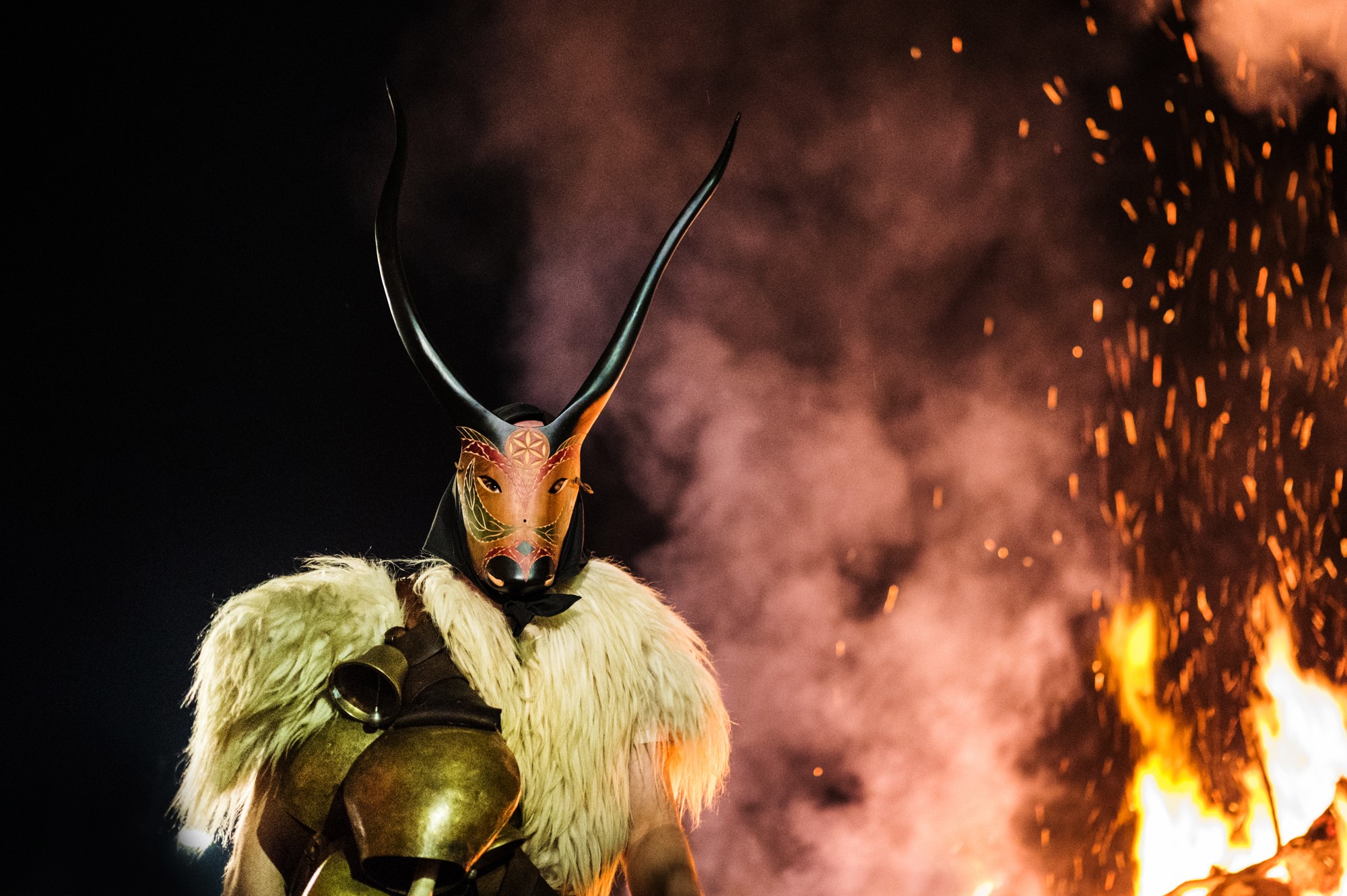
The mysterious beauty of Carnival in Sardinia
With the lighting of the spectacular bonfires in honour of Sant’Antonio Abate, an ancient, solemn rite performed in many of the island’s towns, Sardinia reawakens its spirit and enthusiasm during Carnival. Su Karrasecare has many different sides to it and each community celebrates it with its own traditions, vocations and spirit. January 17 marks the beginning when the bonfires of Sant’Antonio are lit, and Ash Wednesday marks the end, with the beautiful, heartfelt celebrations in Ovodda. They are the first events of the year to enliven winter with ages-old rituals. Sacred and profane, passion and identity, exciting rhythms and magnificent settings like the one at Gavoi, where the tumbarinos (drummers) play. In every town, from the North to the South, you can enjoy typical carnival delicacies like fava beans and lard, pistiddu and coccone, zeppole (doughnuts) and fine wine.
Urzulei
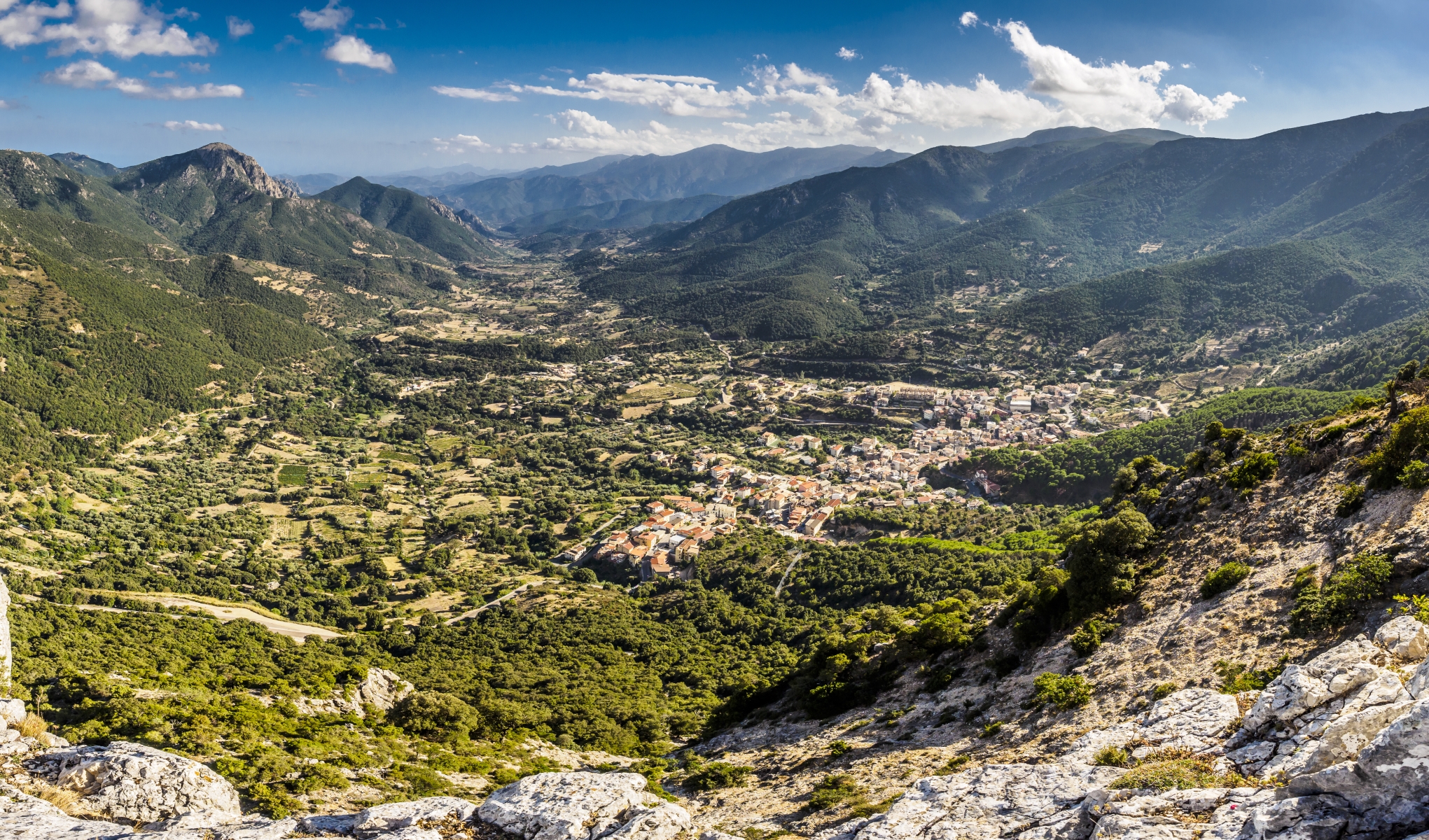
Urzulei extends up the slopes of the imposing Monte Gruttas, surrounded by the impervious and wild landscapes of the Supramonte, reaching heights of a thousand metres and replete with ravines, sheer cliffs, chasms, dolines and gullies right up to the sea. A town of 1,300 inhabitants to the north of Ogliastra, Urzulei borders the Barbagie mountain area of inner Sardinia and is dedicated to animal farming, resulting in exquisite delicacies: hams and Guanciale (cured meat from pork or wild boar jowl or cheek) and cheese, including casu marciu, sa frue and caglio di capretto.
On the border with Orgosolo, the deep su Gorropu gorge is truly impressive. At 500 metres in length and 1.5 kilometres wide, it is one of the largest and most spectacular canyons in Europe, modelled over the millennia by the Flumineddu, one of the two major waterways in the area, together with the Codula di Luna, which flows gently to the Gulf of Orosei. Thousand-year-old junipers and yew, holm-oak forests such as su Fennau, and Mediterranean essences fill the valleys, coloured in spring by orchids, peonies, and oleanders. It is the habitat of the mouflon and the golden eagle. In the oasis of sa Portiscra, the Sardinian deer can also be glimpsed.
For centuries, access was limit to Roman rulers, with a third of the territories composed of carbonate rocks pierced by about 200 caves. Standing out are those of su Palu, 15 kilometres of tunnels and rooms similar to fairy-tale worlds, of s'Edera, in which three rivers flow, uniting in a re-emerging torrent in the su Gologone spring; and of su Eni de Istettai, which reaches the heart of the Supramonte, a destination point for speleologists from all over the world. The impervious elevations were largely inhabited during the Nuragic age. The two monumental Tombs of Giants of s’Arena bear witness to this, part of the complex including the Nuraghe Perdeballa, the village Or Murales, one of the largest on the island and bearing over 100 huts, and the hypogeic sanctuary sa Domu ‘e s’Orcu, a grotto overlooking the town, where the statue ‘Mother With Her Dead Son’ was found, a famous bronze exhibited at the National Archaeological Museum of Cagliari. Grottos and sites on the Cammino di San Giorgio can be visited, a pass from which the s’Iscala de su Piscau can also be admired.
The village is embellished with ancient buildings of worship: the 16th-century Chiesa di San Giorgio in Gothic-Aragonese style, the parish church of San Giovanni Battista (17th century) which contains a pink marble altar and a prestigious baptistery, and the quaint church of Sant’Antonio da Padova. The patron saint is celebrated twice - once on 26th April and again at the end of August, when the Palio di Urzulei is held. San Giovanni is celebrated on 24th June. Celebrated a week prior, festivities are held in the small church of San Basilio Magno of the medieval village of Mannorri, having disappeared at the end of the 18th century due to a mysterious series of events that involved feuds and balentia (courage), love and betrayal. Echoes of the past can be found in the music, dance, poetic competitions and in the small houses of the Museo Andalas de Memory. Echoes of the Dionysus worship rituals can be found in the carnival mask of su Mamuthoì’e Bruvera, also called s’Urcu. Every August, the town comes to life for the morra tournament, in which contenders from all over Europe participate. The cuisine is traditional: macarrones imboddiaos, culurgiones, roast suckling pig and kid, lamb cooked in the pan and the sheep dish, ‘Pecora in Cappotto’, venison cacciatore or flavoured with myrtle. All is accompanied by the cannonau wine. Su piggiolu is the bread par excellence.
Seui
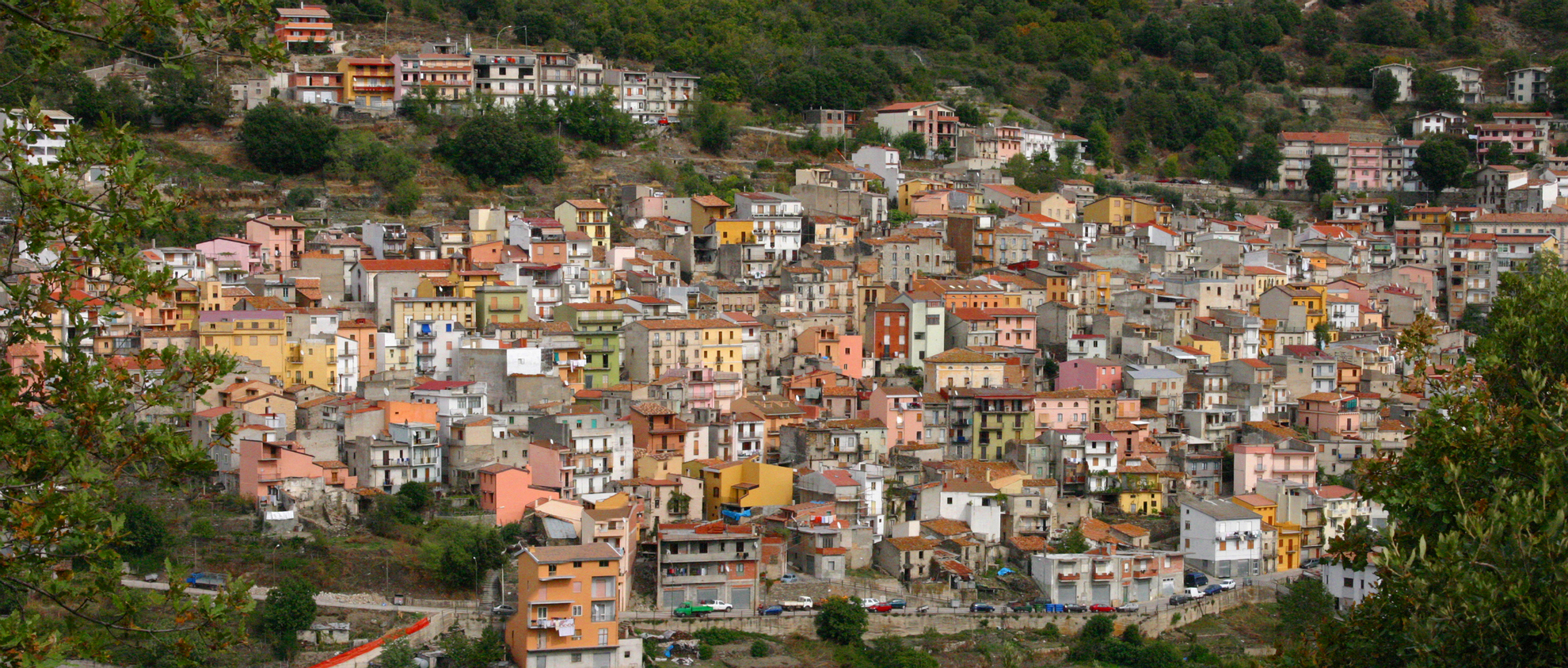
A charming medieval village located at an altitude of 800 metres on the southern slopes of the Gennargentu massif. Around Seui, a village with one thousand 300 inhabitants, you can admire a varied landscape of colours that change according to the season. An enchanted world to travel through along trekking trails or on board the Trenino Verde tourist railway. The setting is made even more precious by the Montarbu forest: 2800 hectares between vertical rock faces and valleys furrowed by streams and waterfalls, like Serra Middai. It is a wildlife oasis, inhabited by the golden eagle, the deer, the fallow deer and the mouflon. During the climb up to Punta Margiani Pubusa (1325 metres), you can admire the sinkhole of Su Stampu and you will reach the monument of Perda Liana. Holm oaks cover half of the 15 thousand hectares of Seui territory, where there is an abundance of downy oaks, cork oaks and conifers on the peaks. An unusual feature is the forest of European hop-hornbeam and yew of Mount Tonneri. Chestnut trees, which take on a warm colour in the autumn, frame the village. There is prehistoric evidence set between cliffs and forests: the Nuraghe Ardasai stands out at an altitude of one thousand metres, with its central tower surrounded by walls, against which there are other towers. Around it, there are the remains of huts.
Seui is a 'village-museum', starting from the Palazzina Liberty (Art Nouveau building), a stately building that became an exhibition of art and popular traditions and reminders of mining activities are also kept here: the disused complex of Fundu e' Corongiu exploited the only deposits of anthracite on the Island and was active for over a century (1850-1960). The itinerary winds amidst the houses made from schist rock with arches, wrought iron balconies and tiled roofs that follow the direction of the little alleys as they twist their way through the village centre. From the building-museum you will pass by the Spanish jail, which was active from the middle of the 17th century until 1975: lodgings for the guards, a kitchen and three cells were the tools of justice (and of torture) for three centuries. Travelling along Via Roma, you will reach the Farci house-museum, where the writer and politician Filiberto Farci lived and who was a friend of Emilio Lussu and co-founder of the Sardinian Action Party. The last stop is at the civic gallery, inside S'Omu Comunali, the impressive civic building dating back to the end of the 19th century, full of works of art, among which valuable paintings by artists of the Caravaggio school. Little lanes and stone houses gravitate around the parish church of Santa Maria Maddalena, in which there is a marble baptismal font with friezes (1644) and an 'unusual' multi-coloured wooden statue of the saint. Inside the eighteenth-century church of San Giovanni Battista, there is the float on which the Madonna del Carmelo (Our Lady of Carmel) is transported in a procession during the most heartfelt festivity, at the end of July. At the end of June, in honour of the saint, there is Su Cardamponi (community lunch). Su Prugadoriu, the 'Sardinian Halloween' is famous, during the commemoration of the deceased. During the festivities you will be able to enjoy agricultural and pastoral traditional delicacies: culurgionis, civargèddus, chickpeas, lardo (a cold cut) and potatoes, pecora in capotto (a sheep meat speciality), còrda and peas, roast meats and cheeses.

Tortolì
Tortolì is the port of Ogliastra, the gateway to a surprising world with a wide variety of landscapes. Around the city, where 11,000 people live and to which tens of thousands of tourists flock in summer, you’ll find tropical beaches, dense woods and Mediterranean brush, fertile plains and marshes, gently rolling hills covered in tilled fields and an oddity, a wide stripe of porphyry red rock that runs parallel to the coastline. The Rocce Rosse, literally red rocks, in the Arbatax area are the most spectacular example of this phenomenon, a natural monument that sticks straight up out of the emerald blue sea along the shore offering a truly amazing colour contrast. It is here that the Rocce Rosse Blues festival is held. The adjacent harbour is where the tourists arrive and take off on excursions to explore the enchanting coves and inlets of Ogliastra. The sea around Tortolì is magnificent, it is the shoreline that has most often been awarded the FEE’s Blue Flag. Behind the Rocce Rosse is Cala Moresca, the city’s pride and joy, a beach of golden sand edged with granite boulders. A bit further south you’ll find the many shades of blue of Porto Frailis and the long Lido di Orrì beach: sixteen kilometres of hidden coves and little beaches, including the lovely Cala Ginepro, blessed with fine sand, polished pebbles and a stand of juniper trees, and San Gemiliano. The red rocks also appear in the little slice of heaven that is Cea, four kilometres of soft white beaches. This spectacle of nature is complemented by lovely green areas: like the town’s La Sughereta park and Batteria park, perched on the top of a hill with views over the entire gulf.
There are more than 200 monuments here that date back to the Nuragic Age, and the s’Ortali ‘e su Monti is an exemplary site. Its seven hectares includes a Nuragic complex, a Giant’s Tomb, two menhirs, huts, a domu de Janas chamber tomb, a wall and the remains of another nuraghe. The port of Sulci Tirrenica was built to accommodate navigators with the arrival of the Phoenicians (VII century BCE) and the Punic peoples. Traces of Punic settlement were found in the marshes of Tortolì, while vestiges of Roman domination take the form of shipwrecks in the depths of the gulf. The ancient control towers, like the torre di San Miguel, were built by the Spaniards. The city’s landmarks include the su Logu de s’Iscultura museum of modern art and the former Cathedral of Sant’Andrea, a classic building from the XVIII century built over an older church. Two chapels of the older church remain, and in one of them they found the simulacrum of St. Elisabeth of Hungary. Inside the church is an elaborate altar of multi-coloured marble. The town’s most heartfelt festival is Stella Maris in late July at the church of Arbatax and features a procession that leads to the water’s edge.
While in the area, make sure to eat some culurgiones, typical ravioli, the stews, porcetto, roast lamb and boiled sheep meat along with a glass of cannonau, the most authentic of Ogliastra’s experiences.

Cardedu
A tourist village, a few minutes from splendid beaches, that emerged following a tragic event. Cardedu is the youngest Municipality in the Ogliastra region, with less than two thousand inhabitants and overlooking the Ogliastra coast. The original nucleus includes several families from Gairo that, after violent floods in the middle of the 20th century, were forced to abandon their houses in the old village of Gairo Vecchia. Some of them moved to the new Gairo and some to the plain near the sea. In the area where the village lies, there was first a scattered settlement, known as 'la borgata' (the hamlet) and then, in 1966, the homes of the families from Gairo were built around it, giving rise to the real village. Cardedu was a district of Gairo until 1984, the year in which municipal autonomy took place. In the residential area, worthy of note is the parish church of San Paolo Apostolo, inside which there is a Via Crucis, a work resulting from the multifaceted talent of Maria Lai. The municipality was formed recently, but the population has thousands of years of culture, which is deeply-rooted in Gairo Vecchio and is evident in the local skills (cutlery works, basket-weaving and food and wine), in the popular traditions and the religious celebrations.
In its territory, which has been inhabited since prehistoric times, there are various archaeological sites. Dating back to the Neolithic period, there is the Domus de Janas of Monte Arista, the Domus de Janas of Cucuddadas and the Menhirs of Costa Iba. The most evident period in the area is the Nuragic one: four Nuraghi, among which the Perda 'e Pera Nuraghe and the impressive Su Presoneddu sacred well, which is still intact.
The territory has a very varied structure: large plains, gentle hills, mountains, among which the natural oasis of Mount Ferru, as well as stretches of shoreline, with both sand and rocks. The sandy coast is nearly five kilometres long: in Marina di Cardedu you will find the beaches of Foddini, Tramalitza, Museddu and Perd 'e Pera, with a sandy seabed and light, fairly fine sand mixed with little pebbles. The waters are transparent and crystal clear. Then, a one kilometre long rocky, rugged stretch begins, which is reddish in colour, typical of the Ogliastra region, and features low Mediterranean scrub. In the southernmost part of Cardedu, there is Sa Spiaggetta, with smooth, rather large pebbles.
The grotto of the Miracle
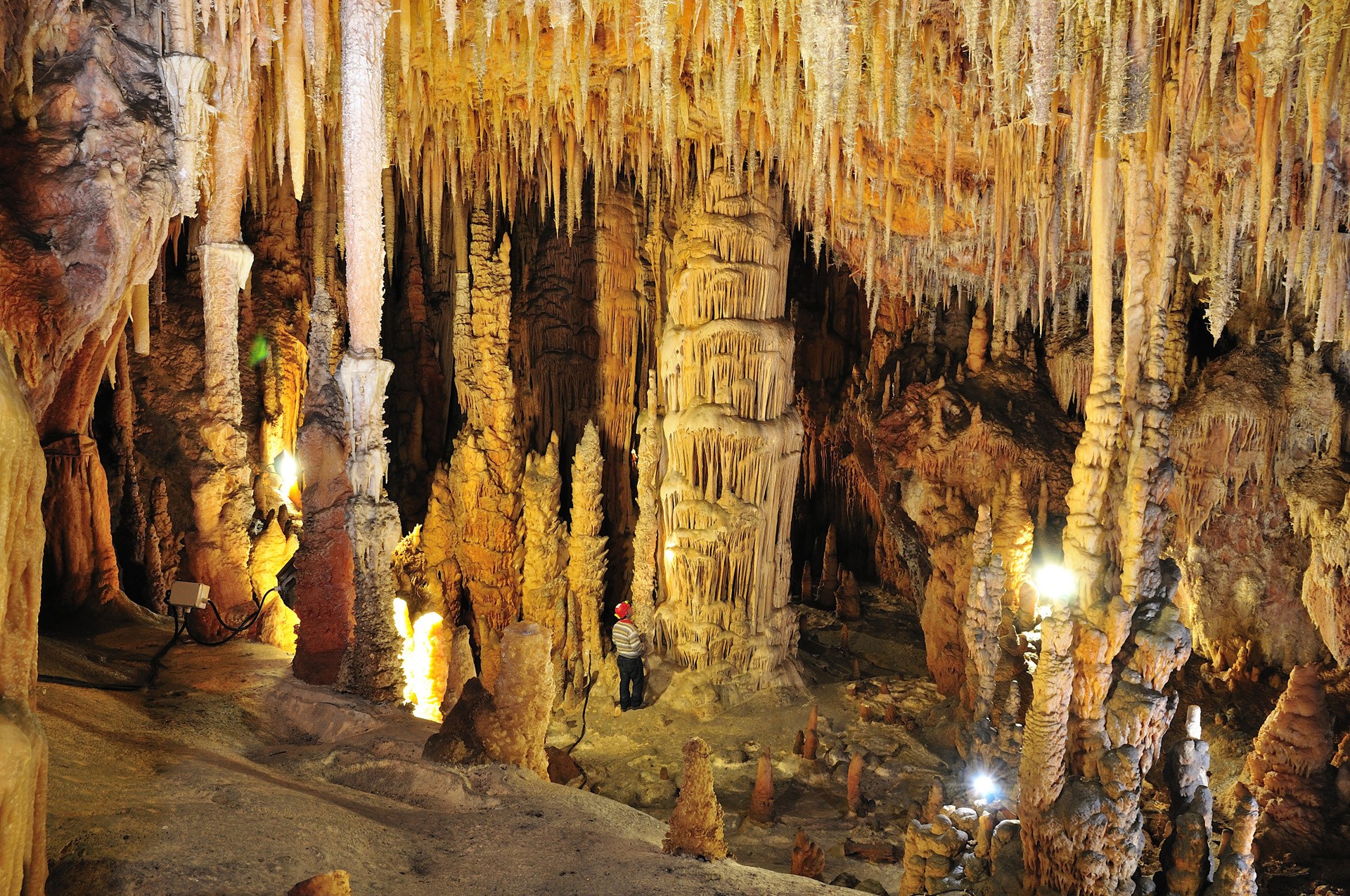
From the hinterland to the coast, the Supramonte hides a subterranean world marked by the patient labour of water. As limestone dissolves, it generates treasures such as sa rutta ‘e su Meraculu, the grotto of the miracles, which faces Cala Sisine from the feet of Baccu Erettili. Visit the mystical beauty of this gem of Baunei and you will understand the origins of its name. Over millions of years, nature has moulded the rocks, creating a succession of halls enclosed by walls with limestone formations that are veritable works of art. An expressionist scenario formed by columns, stalactites, stalagmites, pisoliths, pools and glossy floors.
The grotto continues for 200 metres, at 17° C. The foyer has a narrow corridor with cauliflower stalagmites, leading to the central hall, one hundred metres long and from four to six metres high, a splendid gallery of natural sculptures.
There is also a spring, very dear to shepherds who used it in the past. The itinerary is not lacking in excitement. Among the various sculptures, one is shaped like an amphora, while a column looks like the Tower of Pisa. The “treasure hall”, pink and grey, is covered by vaults with transparent ribs that reproduce a starry sky. For a better view, climb a schist platform. The shapes are bizarre: there is an hourglass and a frog. There is even a classroom: a sturdy stalagmite is the teacher, while the shorter mounds around it look like students. The causeway was built in such a manner as to allow you to admire the profiles and have a glimpse of halls that have yet to be explored. In the ark, the slow rhythm of the water proceeds undisturbed.
Immerse yourself in the sacral Miracle atmosphere arriving from the sea, using the boat services leaving from Arbatax and Santa Maria Navarrese. Coming through land, you will get to Cala Sisine after some long, difficult and exciting trekking. From here, a track marked by pink oleanders and by the pearly grey of the pebbles in a narrow gorge, it gradually climbs all the way to the mouth of the grotto. During your stay in Ogliastra, do not miss the chance to admire the other magnificent pearls of the Gulf of Orosei: Cala Goloritzè, Cala Biriola, Cala Mariolu and Cala Luna.

Villagrande Strisaili
This is the village of longevity, with the world’s highest concentration, compared to births, of people over the age of 100. Since WWII, more than thirty locals have made it to ten decades of life. Villagrande Strisaili has a population of 3,200 and sits at an altitude of 750 metres on the southern slopes of the Gennargentu, in deepest heart of the Ogliastra area, yet just minutes from the eastern coast. Its western flank is protected by Mt Suana, to the north are mounts Isadalu and Orguda, while to the south is monte Idòlo. All of these mountains exceed altitudes of 1,300 metres and are interspersed with high plains and valleys. The town looks eastward over the Ogliastra plains to the Gulf of Arbatax. It’s area ranks third in size and is made up of steep rocky cliffs, covered with stands of various types of centuries-old oak trees that are the habitat of mouflons and royal eagles, crisscrossed by a network of rivers and streams from springs. The area also comprises monte Novu and the parco di santa Barbara, steeped in prehistoric remains: seven giant tombs and a megalith, 17 nuraghes and ten nuragic villages. In early July they celebrate their saint with festivities in the park. A path leads to the spectacular Sothai falls, where the Flumendosa river falls down into the Bau Vigo canyon. Seven kilometres from Villagrande, at the centre of the high plains, on the shore of Flumendosa Lake, is Villanova Strisaili, home to nature of the wildest sort: the Pirincanes gorge and the Rio ‘e Forru falls. You can reach these two marvels via a trail and admire them from a natural belvedere. The surrounding woods complete the picture with a thick layer of Mediterranean underbrush. Here lie other pre-nuragic remains: five stone domus de Janas chambers and the sa Pred’e s’Orcu menhir. The most important Nuragic site is by the lake, s’Arcu ‘e is Forros. Next to three-lobed nuraghes and huts is a megaron temple made of blocks of granite and schist. Other archaeological treasures include the Troculu complex, with two nuraghes, a village and giant tomb, as well as the archaeological area of sa Carcaredda, with four giant tombs near a rare in antis temple and village.
Tradition has remained unchanged here for centuries: they celebrate the bonfires of sant’Antonio Abate and the feat day of San Sebastiano early in the year. The patron saint San Gabriele, to whom the church is dedicated, is celebrated on the first of August. Even the cuisine has retained its traditional flavours, with prosciutto ranking as the star of local delicacies. Others include: is gathulis, fried doughnuts, is culurgiones, ravioli filled with potatoes, pecorino and basil, then roast meats and sa paniscedda, sweets made with honey, grapes and almonds.