
Protected oases between land and sea
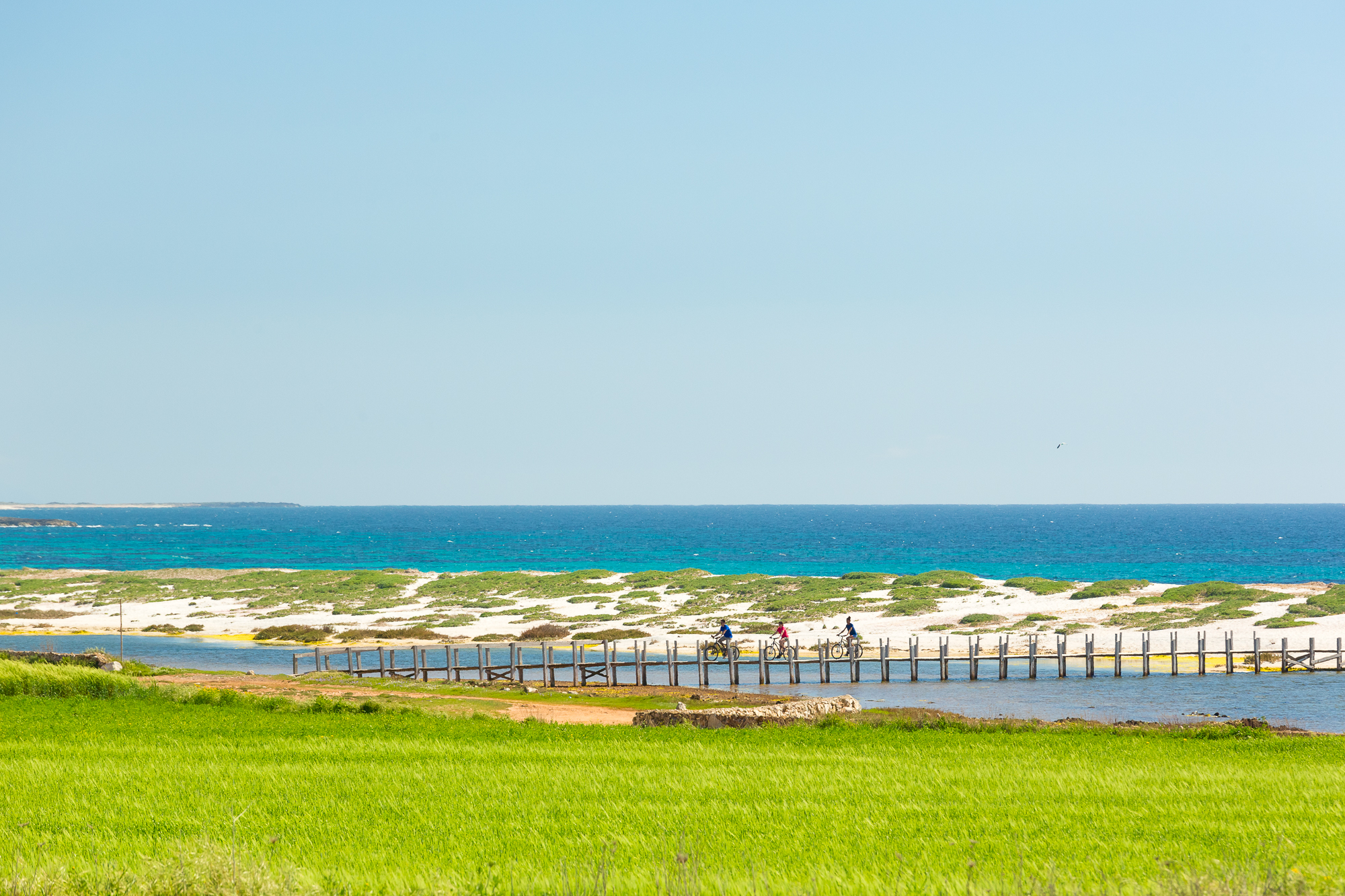
Wearing hiking shoes or riding a bike, with binoculars and smartphone always at hand. ...and, of course, a lot of curiosity for exploring nature. This is what you need if you want to dive into an ‘aquatic’ world very close to the sea, yet distant in terms of characteristics and ways of experiencing it: these are the wetland, marshy areas of Sardinia, ecosystems populated by often rare examples of plant and animal life, where a delicate balance reigns between man and the environment. Ideal destinations for relaxing walks, especially with the warm colours of sunrise or sunset. The sea is sometimes only separated from a pond by a strip of sand, like at Villasimius, in the protected marine area of Capo Carbonara: behind the pure white beach of Porto Giunco you will find the Pond of Notteri, with its blue waters coloured by the pink of its famous inhabitants, the flamingos.

Cala del Morto - Chia
Many consider it the most beautiful of the seven ‘sisters’ that make Chia one of the most captivating and popular coastal destinations on the Island, perhaps because it is a small cove bordered by two rocky ridges or thanks to the pink granite rocks dotted across a carpet of fine, golden sand. Cala del Morto is the most intimate and sheltered of the beaches in the coastal district of Domus de Maria. The origin of the name ('dead man's cove') is linked to a cross, between the rocks, that has given rise to various stories and legends over the years. A short walk, lasting a few minutes, will take you to the beach, from the car park of the adjacent Porto Campana, along a scented path surrounded by myrtles, junipers and lentisks, before diving into the immense beauty.
The cove is ideal for those who want to be in close contact with nature: there are no services, just sand, cliffs that shelter you from the winds, pink-coloured rocks and a crystal clear sea, with shimmering colours of blue and emerald green. The waters are shallow, with a sandy seabed, populated by a variety of marine fauna, attracting numerous snorkelling enthusiasts. You can also reach it by sea, by canoe or by standup paddleboard from one of the adjacent beaches. In fact, there are two larger beaches equipped with numerous services on the sides of the bay: to the east, linked to Cala del Morto by another path, you will find the beach of Monte Cogoni. Although it gets its name from the green elevation behind it, it is actually the extension of the beach of sa Colonia. The latter is characterised by white sand and the presence - on the east side - of ashlars dating back to the Phoenician-Punic age and referring to the ancient city of Bithia, the acropolis of which was located on the promontory where the sixteenth-century tower of Chia stands. Monte Cogoni is more exposed to the winds, making it perfect for windsurfing and kitesurfing. To the west of Cala del Morto lies the Campana Dune shoreline, also known as Porto Campana. The name reveals the presence of sand dunes, on top of which rockrose bushes and sea daffodils emerge. Vegetation, rocks, golden sand and a turquoise sea will give you the impression of being on a beach in the tropics. Another cliff interrupts the expanse to the west, beyond which the most famous beach of Chia, often a setting for films and TV commercials, begins: su Giudeu. Crystal clear water, fine, light sand, the islet of the same name opposite and a pond inhabited by pink flamingos: it is a destination not to be missed. Its continuation is s’Acqua Durci, also dotted with dunes and with very shallow waters, making it ideal for children. After another promontory, you’ll find the seventh (splendid) sister, Cala Cipolla.
S'Acqua Durci - Chia
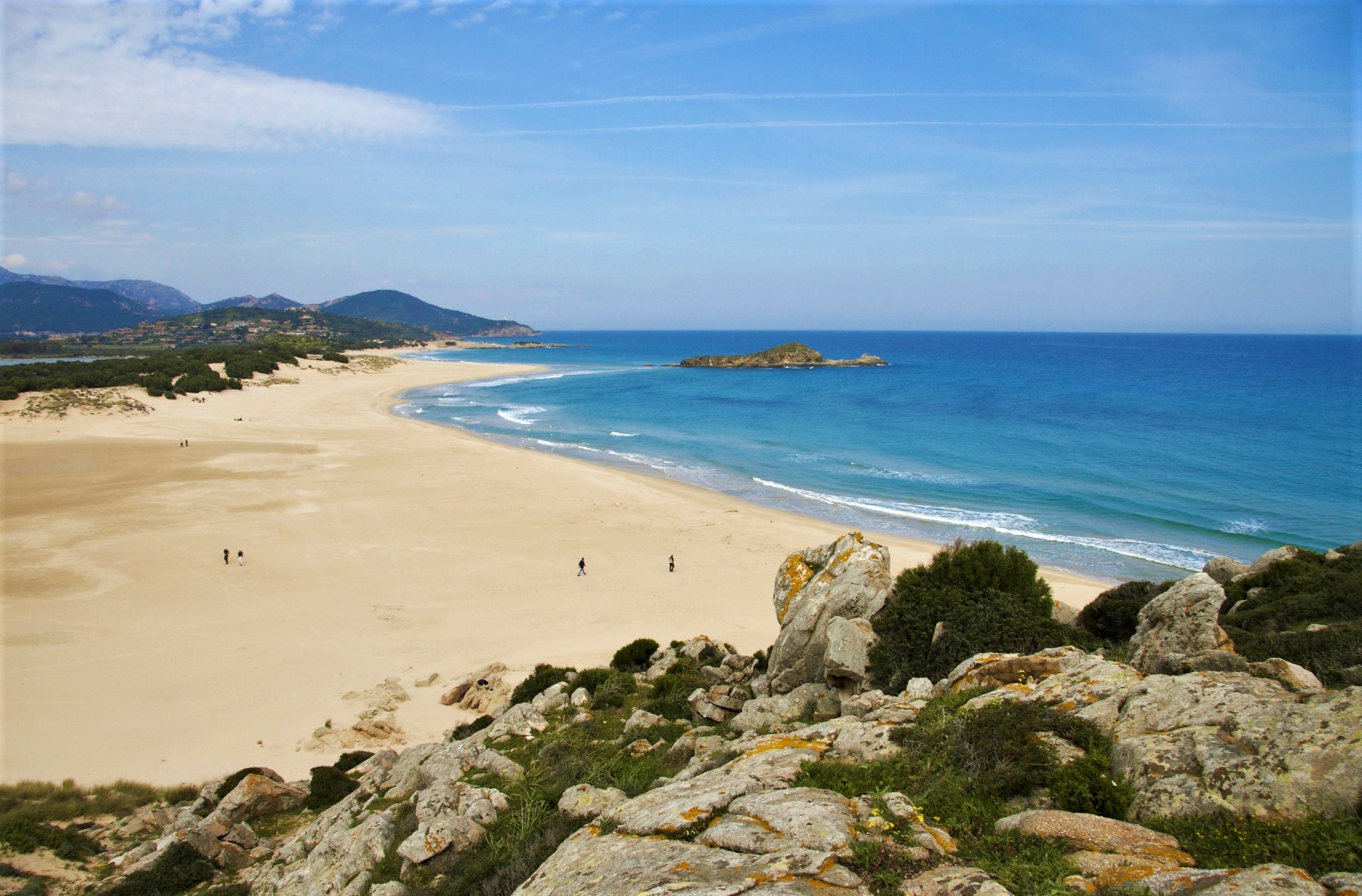
Perhaps a little less glamorous than its ‘neighbour’, but equally charming, also because it has all the right elements: a crystal clear sea, golden sand and dunes, breathtaking views and all the comforts you need. S’Acqua Durci is the westward extension of the beach of Su Giudeu. Together, they form Chia’s most famous stretch of coastline and a coastal ‘pearl’ of the Domus de Maria territory. The beach is often turned into a film set or a location for shooting commercials with a strong visual impact. The waters are shallow for several metres and the seabed is sandy, so the beach is suitable for families with children. There is also a refreshment area with the possibility of renting beach umbrellas, sun loungers and boats. Above all, you will be enchanted by the colours of the sea, as they change from turquoise to emerald green, with a few rocks emerging from the water.
The view of the sea is dominated by the islet of Su Giudeu, an 18-metre-high rock, which you can get to by swimming or, during low tide, by ‘walking on the water’. The dunes rising out of the fine, soft sand of the beach sometimes have bushes and shrubs growing on them. Along with those of Su Giudeu and the sandy ’little hills’ that characterise the beach even further east and, not by chance, called Campana Dune, they make up the Spartivento dune formation. Speaking of names, S’Acqua Durci, or ‘fresh water’, is a reference to the system formed by two ponds, connected to each other, extending behind the two beaches. The biggest one,Stangioni de su Sali, occupies the space behind the beach of su Giudeu, while you will find the second one - known as the ‘little pond of Stangioni de su Sali’ - just behind the beach of S’Acqua Durci. The complex is inhabited by various birdlife species, which attract passionate birdwatchers: you will be able to admire red herons, black-winged stilts, western marsh harriers, pink flamingos and Audouin’s gulls. S’Acqua Durci is the second to last beach of Chia along the road running from east to west: a promontory covered in vegetation separates it from the small bay where Cala Cipolla lies. It is an arch-shaped stretch of golden sand set between pink granite reefs extending into the sea, almost forming a natural swimming pool. Here too, you will find shallow, transparent waters, ideal for exploring with a mask and snorkel. Then, to the east, beyond Su Giudeu and Campana Dune, lie Chia’s other beaches: Cala del Morto, cosy, sheltered and also coloured by pink granite rocks; Monte Cogoni, a popular destination for water sports; Sa Colonia, an expanse of white sand close to the Phoenician-Punic remains of the ancient city of Bithia, and Su Portu, ‘watched over’ from above by the tower of Chia, dating back to the 16th century, and from which you can reach the islet of Su Cardulinu, where you will find traces of a Punic temple and a Phoenician tophet.

Riding along the coast
With its cliffs overlooking the sea, this is the ideal itinerary for morocyclists: a journey through the wonders of nature with nuraghi (ancient Sardinian buildings) and secret coves. Loved above all by solitary travellers, Sardinia is the most popular destination among bikers, because of the emotion that many of the spectacular, winding coastal and hillside roads arouse, making them suited to even the boldest of motorcyclists. The coastal stretch that leads from Bosa to Alghero is a perfect example of this.

Cala Petra Ruja
It brings together the two ‘souls’ of the Costa Smeralda, as it is both glamorous and unspoilt at the same time: in fact, it is considered the ‘wildest’ beach of the symbolic location of high-end tourism on the Island. However, Petra Ruja, in the coastal territory of Arzachena, also has another distinctive feature, as its name, which means ‘red stone’, indicates: it is dotted with reddish-coloured rocks and granite pebbles. The beach, about 250 metres long, is in a bay with two promontories on its borders that determine its crescent shape. The sand is white and soft, while the transparent sea will surprise you with its shimmering colours, ranging from light blue to turquoise and glistening emerald green, typical of the Costa Smeralda.
On the subject of greenery, the entire bay is protected from behind by a crown of fragrant Mediterranean vegetation, where junipers, helichrysum, sea rushes and sea rocket stand out, as well as white sea daffodils. The islands of Mortorio and Soffi, which are almost ‘aligned’ in front of the beach, further embellish the landscape. To the east, you can see Porto Rotondo and the promontory of Punta Volpe.
The beach is suitable for families with children, as the waters are shallow, and it is also popular with snorkelling enthusiasts because of the transparency of its waters and the rocky outcrops, around which you can observe colourful fish fauna. Beyond the promontory, to the south, you’ll find a series of little coves that together make up the coastline known as Razza di Giunco. The name comes from giunchi, meaning rushes, which populate the marshy areas behind it, but its greatest charm comes from the myriads of islets, cliffs and pink granite fjords that draw a line of jagged coastline between the various inlets. On the opposite side, the largest beach of the Costa Smeralda awaits you: Liscia Ruja, 500 metres of white sand with golden and pink reflections - depending on the play of light -, is caressed by a crystal clear sea, with a turquoise colour among the most intense you will ever encounter. Plenty of services: bars and restaurants, beach equipment and boat rentals - canoes, kayaks and rubber dinghies - with which you can explore the numerous and captivating little coves scattered along the coast.
Three days in the southern seas
Ten minutes after landing in Sardinia, you will find yourself in the lively alleys of Cagliari’s historic districts. Glamorous boutiques and traditional shops, clubs, bars and restaurants where the best cuisine in Italy awaits you, according to the food and wine magazine, Gambero Rosso. The evenings continue at the beach bars along the ten kilometres of the city beach of Poetto, so close to the town centre and ideal for a dip in the sea on your day of arrival and departure. The itinerant short break along the coast of the golfo degli Angeli, returning to the city in the evening, is an ‘aperitif’ that precedes the picture postcard landscapes and beaches, while the journey of discovery of the southern seas is postponed to the following days.

In Sardinia, just like Hawaii
They never fail to turn up and arrive on the shore, regularly and well inflated. In Sardinia, good ‘surfing’ waves appear almost everywhere. The stars of surfing have discovered this too, in their search for nearby places for training when preparing for various international challenges. However, the ‘rumours’ spread above all among the army of non-competitive enthusiasts looking purely for fun. Most of them know the beaches reached by the best waves and they move from one side of the island to the other to await them and ride them, almost as if they were in exotic places, classic surfing havens. What’s more... you can surf without a wetsuit in Sardinia until late autumn!

Mare nostrum
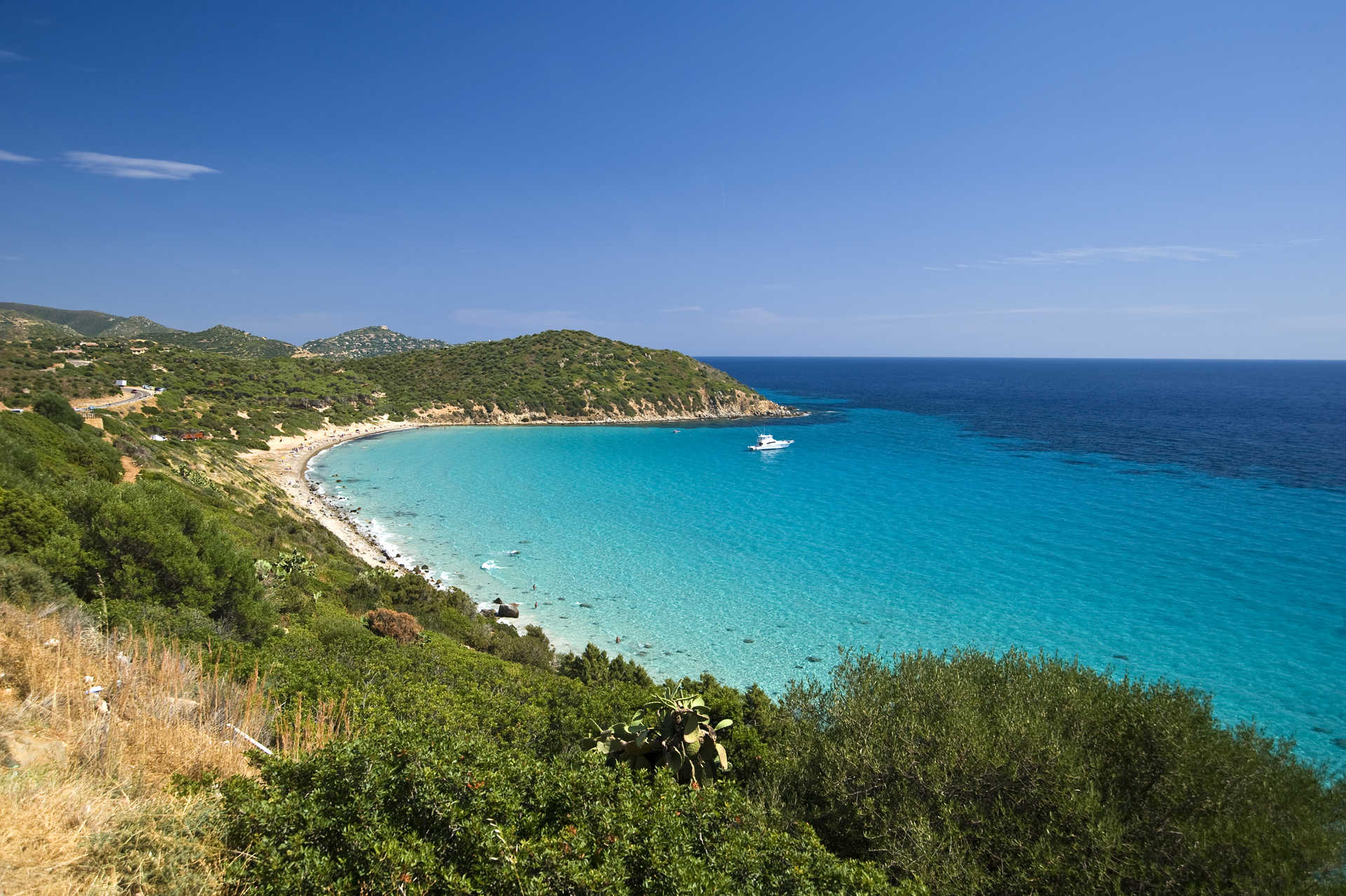
Transparent waters wash kilometres and kilometres of free coastline, with landscapes made up of inlets, reefs, coves and an infinity of beaches. A short walk will take you to some of them and you will never find yourself elbow to elbow with neighbouring beach umbrellas even in mid-August. You will find others set among fantastic reefs, close to cool pine forests, soft sand dunes and natural oases inhabited by pink flamingos. Each speaks its own language: there are precious, delicate ones that it will seem an insult to walk on, while others are so wild that you will feel the thrill of being the first to set foot on them and sometimes their past experience comes before their beauty. You could experience a different one (or more than one) every day, but a lifetime of holidays in Sardinia would not be enough to discover the vastness of its sea.

Sardinia, magic moments
The force of wild nature and the fascination of the sea live here, along with a glamorous lifestyle and the magnetic charm of ancestral cultures. It is easy to think of Sardinia when you want to satisfy whatever desire that comes to mind concerning original and memorable locations where you can celebrate weddings and anniversaries or renew your vows. In seaside resorts they are celebrated everywhere, on the beaches and on top of cliffs, at the foot of lighthouses and coastal towers and even on the islets visible from the coast. You will surprise your guests even more if you say “yes” in the surreal silence of the mining villages or villages once abandoned and now reborn to a new life, in the delightful country churches scattered through the void of poetic primordial landscapes or in the presence of Nuragic palaces and sacred wells, not by chance built in places full of positive energy, a big plus left as a dowry by ancient people for your special moments.

Until the last ray of sunshine
The weather is mild and the sun is shining, while the beaches gradually become more and more deserted, with no traces of overtourism at all. At the end of the summer, the dreamy nature of Sardinia can catch its breath and win back its spaces. It is the best time to seduce even the most skeptical ones, with beaches that become real private rooms. They are hidden between rocks that look like works of art created by the wind and the rough seas, and, behind them, candid dunes of sand and lagoons coloured by the pink of the flamingos. There are still lots of mild days and hours of light to engage in exciting hikings, to trek along paths that lead to the most secluded stretches of coastline. Or maybe boarding a minicruise to admire sea oasis sheltering lonely islands: Tavolara, Asinara, Mal di Ventre, dei Cavoli and the outstanding archipelago of la Maddalena, where the 'most beautiful among the beauties' shines, Budelli.