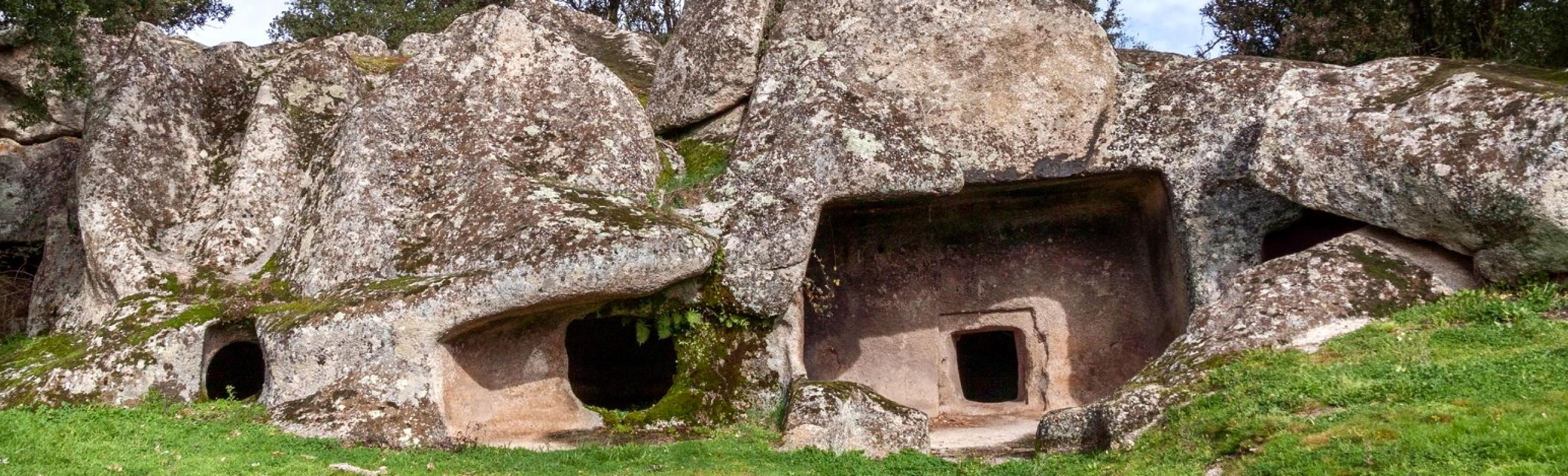
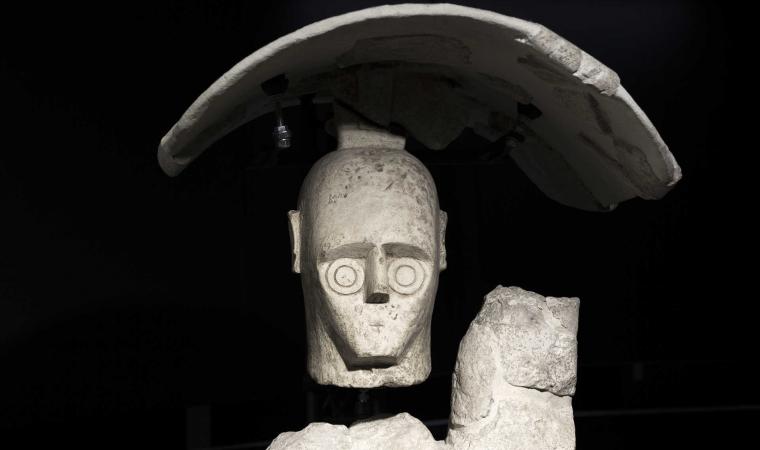
An underground universe, camouflaged in the landscape of the Sardinian countryside, designated as a UNESCO World Heritage Site since 2025. Over 3500 domus de Janas are scattered throughout the island, an expression of the funerary rites of people who lived five thousand years ago, and then reused in later periods. Using only stone pickaxes, these people dug and shaped the hard rock to create underground tombs where they laid the dead and 'returned' them to the Mother Goddess, a divinity attested to by the discovery of hundreds of votive statues.
The name of these 'artificial' caves derives from the ancient belief, spread by popular legends, that they were the homes of tiny fairies, the Janas, who wove golden threads in the moonlight and watched over children's sleep. Sacredness and rituals drove the pre-Nuragic men to dig into the rock and decorate the 'rooms' that housed their loved ones, who 'slept' in the womb of mother Earth while waiting for the regenerative journey to the afterlife.
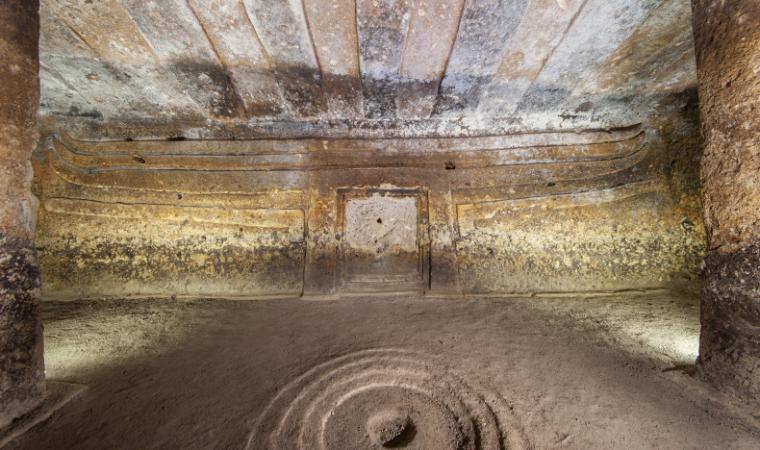
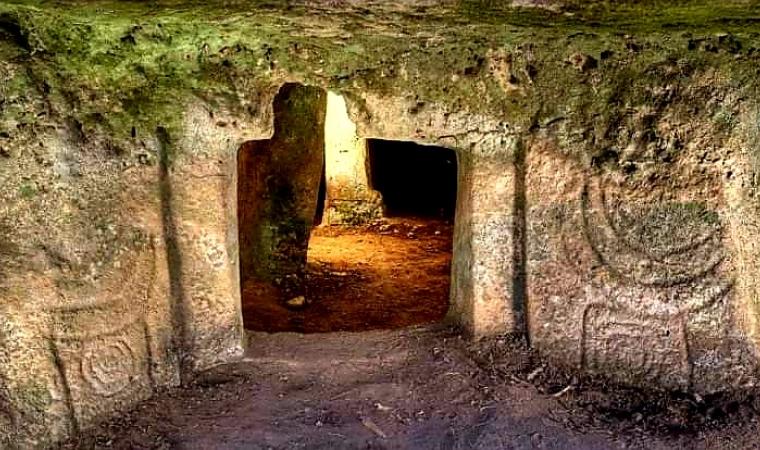
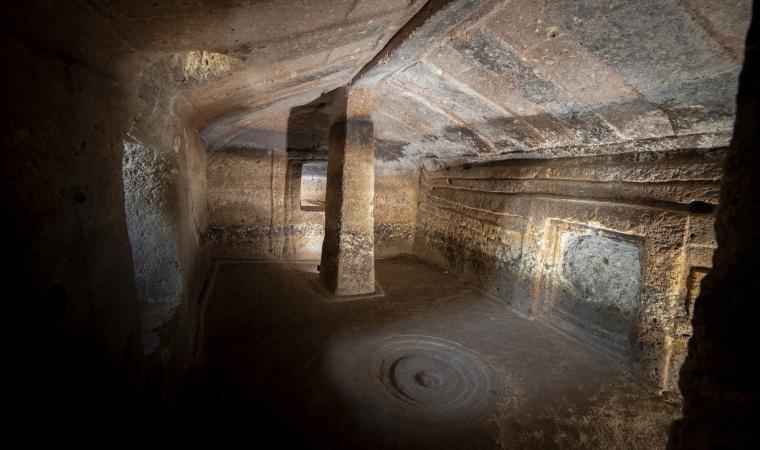
The domus are carved into isolated boulders or grouped in necropolises on rocky ridges. There are many types: pit, oven, chamber and with dromos. Many were built in the likeness of the houses of the living, equipped with double-pitched ceilings, hearths, columns, plinths, basins and false doors, symbols of the passage to the afterlife. Of the thousands discovered, more than 200 retain carved, engraved and painted decorative motifs, largely symbolic, such as cattle heads, bull horns and spirals. All the domus de Janas, from the simplest to the most sophisticated, exude a magical charm.
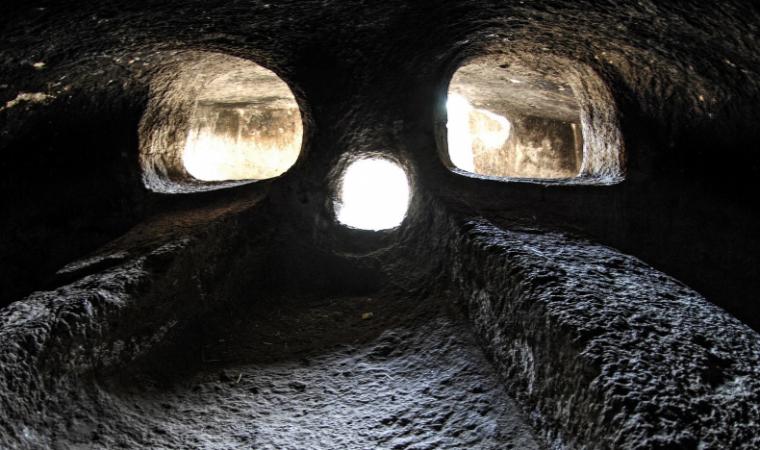
Looking at the walls of the necropolis, which stretches out like an amphitheatre, you will see small and large entrances to no less than 35 domus de Janas, skilfully excavated from the 3rd millennium BC: some are decorated with spirals and concentric shapes. What prompted the men of that time to take such painstaking care of the rooms in which the dead were housed?
It is also known as the 'tomb of painted architecture', an emblematic name for the construction and ornamental features of the most famous of the four underground tombs on Mount Siseri, a hill on the border between the Nurra and Logudoro Turritano. It is divided into several chambers, some made like Neolithic huts, and decorated with all the characteristic motifs of the pre-Nuragic age.
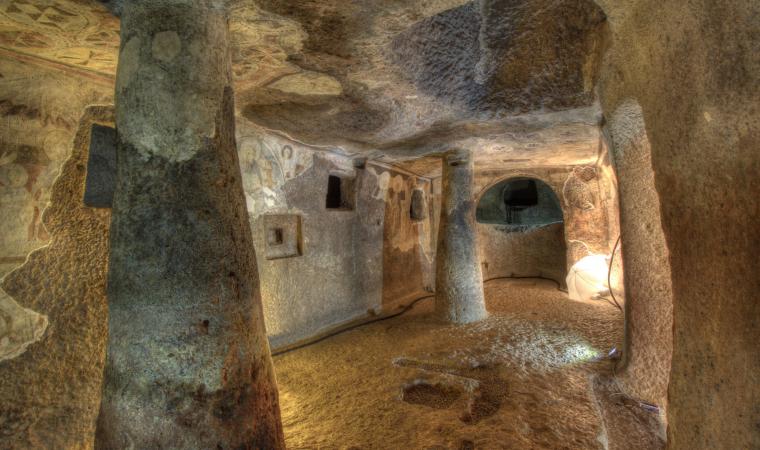
Three domus in the necropolis will amaze you with their size and state of preservation. The 'Tomb of the Chief' has an area of 250 square metres and comprises 18 chambers arranged in a labyrinth around two main rooms. The necropolis was reused for a long time. In Roman and later Byzantine times, the 'Tomb of the Chief' was transformed into a rock church, one of the first in the time of the persecutions. Repeatedly plastered and frescoed with scenes from the New Testament, which you will notice inside, it was dedicated to St Andrew.
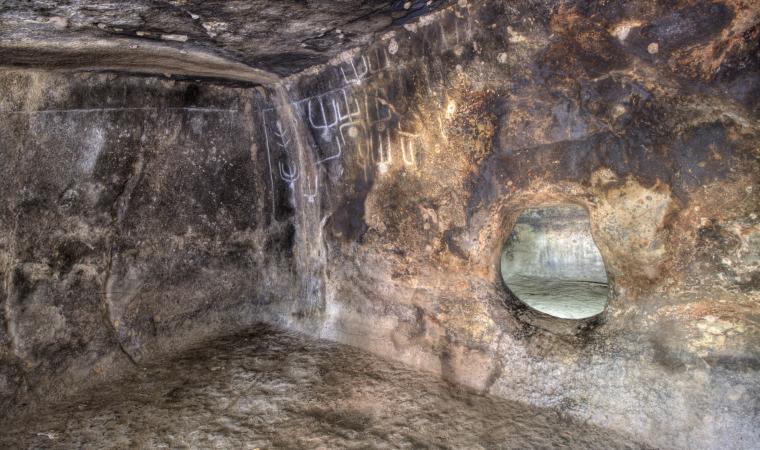
Of the underground complex, excavated in the final Neolithic period in the Oniferi area, you will be impressed by the Emiciclo tomb: its complex structure consists of an antechamber, a large central chamber and five secondary cells. Among the symbolic representations are eleven upside-down anthropomorphic petroglyphs, perhaps representing the dead returning to Mother Earth.
A valley in the hinterland of Alghero is 'pierced' by 38 tombs excavated in sandstone between the 4th and 3rd millennium BC and spread out in two groups, one group of seven in the flatter part, the other of 31 on a small hill. Inside them, even the stone spikes used to excavate them were found. The domus are decorated with the 'classic' symbols related to the veneration of the dead of the time, carved in relief.